Why China's 'new three', green push irk West







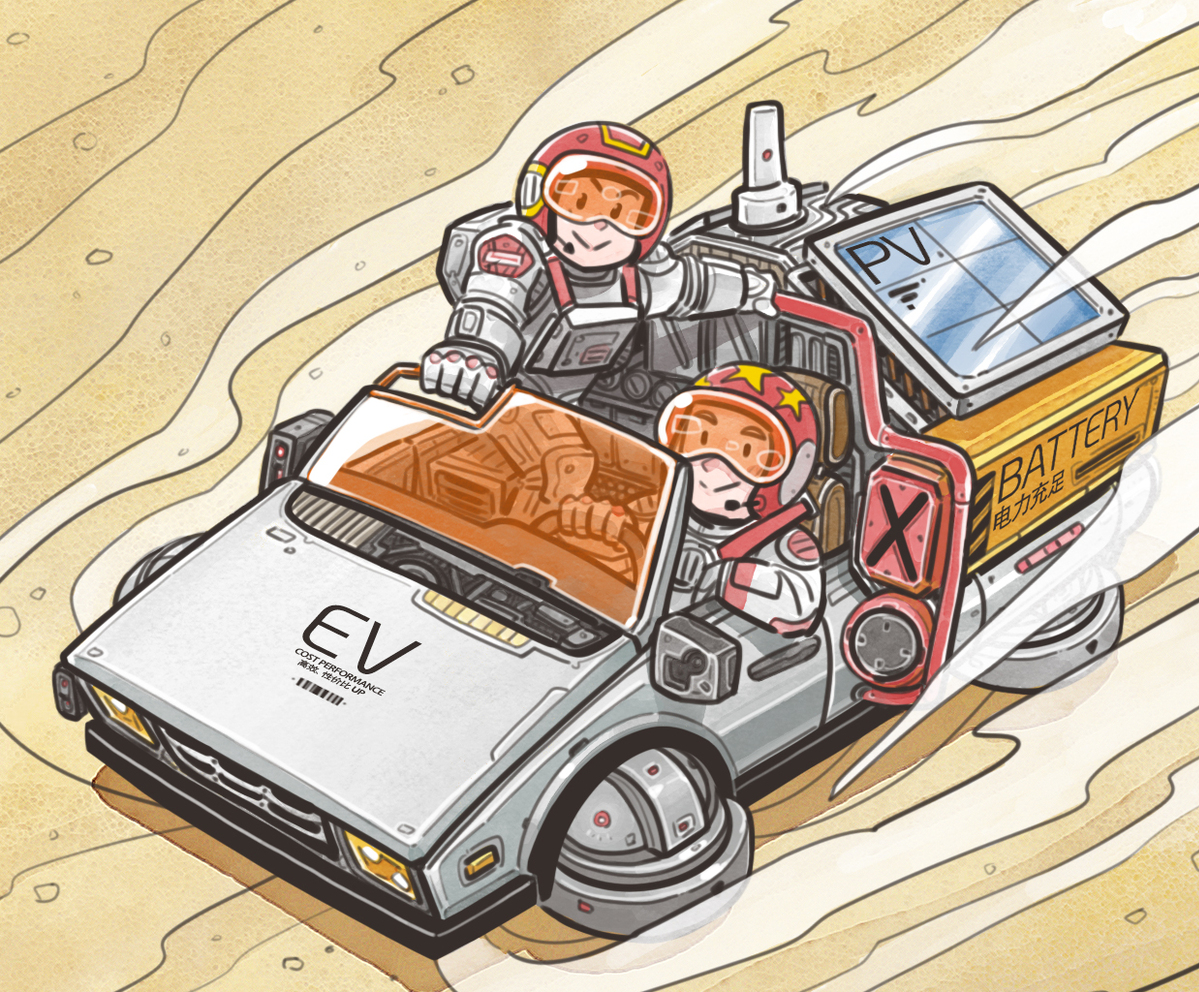
One of the issues raised by US Treasury Secretary Janet Yellen during her visit to China last month is the so-called overcapacity in China's "new three" industries — new energy vehicles, lithium-ion batteries and photovoltaic products.
But seen from the global governance level, what the world lacks most now is a mechanism for redressing global imbalances, a mechanism for handling global losses, gains and compensation, and an arbitration mechanism for conflicts and coordination among major economies.
Thus, the focus of such an issue can be traced to how major global powers take the responsibility of building a mechanism for global rebalancing and adjustment.
Yellen, as a professional economist, believes that China's current production capacity is excessively large, and other countries in the world simply cannot digest it. She also claimed to be concerned about China's long-term macroeconomic imbalance, which is caused by insufficient household consumption and excessive corporate investment.
Yellen believes that it is the government's industrial policies that have supported emerging industries in China, such as electric vehicles, lithium-ion batteries and solar energy.
On Sept 13 last year, the European Commission also announced the launch of an anti-subsidy investigation into electric vehicles imported from China. At that time, I was doing research in Europe, and several major European associations told me that this investigation was initiated by the EC instead of the European business community, and was targeted at China's "new three "industries. They added that not only did the EC intend to take action against China's "new three" industries, but also the US government would follow suit soon.
All these suggest that noneconomic factors are at play behind this so-called overcapacity problem.
According to the International Energy Agency, global demand for NEVs in 2030 will reach 45 million units, which is 4.5 times that of 2022. Global demand for newly installed capacity for photovoltaic products will reach 820 gigawatts, which is about four times that of 2022. This shows that current production capacity is far from meeting global market demand.
In response to the accusation by Yellen and European regulators, US economist David Goldman raised several questions: Is the overcapacity problem primarily due to China's excessive investment, or is it due to insufficient investment in the United States and other Western countries? Does the increase of China's production capacity have an impact on demand for industrial products? In other words, could an increase in supply lead to an increase in demand? Who is buying more Chinese products? Is it the US, which buys a large number of Chinese products at the expense of its own industries, or are Chinese products being sold to countries without competitive industries?
During the global financial crisis in 2008, the US introduced a theory of global economic imbalance, claiming that China was the initiator of such global economic imbalances and that China should foot the bill for the global financial crisis.
When discussing it with my US friends, I drew two charts: one showing the US' current account deficit and the other showing China's current account surplus. The charts show that the US deficit accelerated starting from 1991, peaking from 2005 to 2007. The root of the deficit lies in the tech bubble in the 1990s and the financial bubble in the 2000s.
Meanwhile, China's surplus accelerated from 2005, making it a victim of the two bubbles led by the US. Yet, the US demanded that China should take responsibility for the international financial crisis and foot the bill to mitigate global imbalances.
Over the past few years, the US has taken massive economic stimulus measures in response to the COVID-19 crisis. As a result, by June 2022, inflation rates in the US and Europe reached 9.1 percent and 8.6 percent, respectively. Subsequently, aggressive interest rate hikes were implemented to counter inflation. This year, the US is expected to have a fiscal deficit of $1.6 trillion, with total debt reaching $35 trillion and annual interest payments reaching $1 trillion, indicating a towering debt burden.
As for the geopolitical game between China and the US, on the one hand, the US is engaging in a comprehensive reassessment, correction and reboot of its education, technology and industrial policies of the past 40 years, attempting to address the hollowing out of its manufacturing sector. On the other hand, the US is leveraging new protectionism, industrial policies and government intervention to undermine the solid foundation of China's production and supply chains.
In this context, is the US once again using global imbalances as a pretext to make China foot the bill for alleviating global imbalances? This time, there is a stronger tint of geopolitical confrontation, with a tendency to oppose China at every opportunity. The progress that China has made in the "new three" industries is politically incorrect for the US, along with its allied countries.
This retrogressive approach is not only unfair to Chinese companies and global consumers, but also a step backward in the global transition toward sustainability.
Currently, the global economy is entering a new era of green revolution, new energy revolution and digital technology revolution. There are two different trends in the global green revolution. One is romanticism, which only talks but doesn't act. In some developed countries, there is even a new trend of regressing from dual carbon goals. The other is realism, which starts from reality and progresses step by step. China, adhering to the principles of "seeking truth from facts", being pragmatic and progressing step by step, encourages technological innovation and high-quality development of new energy and NEVs.
Thanks to the joint efforts of various entities in China, significant technological and industrial progress has been made in strategic emerging industries represented by the "new three" industries in the green transformation of traditional industries including transportation, chemicals, metallurgy and construction.
If there were no negative spillovers of geopolitical tensions, protectionism and over-generalization of security, the supply and demand of NEVs, photovoltaics and lithium batteries would reach a dynamic equilibrium on a global level.
At the same time, China will further deepen market-oriented reforms, expand high-standard opening-up, improve the legal system, and enhance the institutional framework for fair competition, green development and the advancement of clean energy domestically.
China is accelerating the development of new quality productive forces, which will make a greater contribution to achieving global sustainable development. New quality productive forces are in and of themselves green productivity, which will promote a comprehensive transformation from controlling energy consumption to controlling carbon emissions.
China will achieve more technological and industrial breakthroughs in fields such as green revolution, new energy revolution and digital technology revolution. However, Chinese-style modernization requires us, as a responsible major country, to not only focus on our own development, but also drive common global development.
We cannot just pursue winner-takes-all or zero-sum games, but should promote shared benefits, cooperation and shared development. We should not only focus on exporting green goods and services, but also pay more attention to importing green products and services, and promote comprehensive international cooperation in green development. China will continuously improve market-oriented reforms and achieve new progress.
The writer is chief researcher at the China Center for International Economic Exchanges.
The views don't necessarily reflect those of China Daily.