



Unity in diversity, not conformity







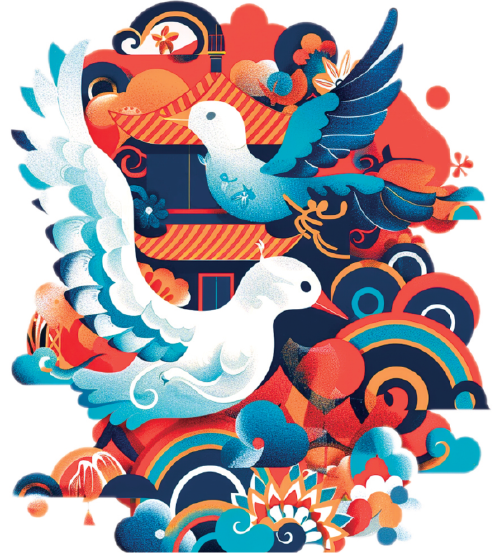
WANG XIAOYING/CHINA DAILY
Chinese and Western ways of thinking are complementary not mutually exclusive
We learn about other cultures mostly through the media and through books, films, travels and personal encounters. All news reports are micro glimpses of a time and place.
This challenges us in at least two ways: how do we get a more accurate and holistic perspective of the world, and how can we learn to understand each other across cultural diversity.
One way to understand societies is to look for similarities and differences in the ways people think. Or, what is in their general attitude to "others" — are they perceived as a danger, potential friends, "barbaric", or as someone to be curious about, explore and learn from?
Next, do the citizens think in terms of either/or, or both/and? Exclusivity or inclusivity?
Different behaviors come from who we are and what ways of thinking we were brought up to think of as being the most "natural".
The Western way of thinking is very different from that of the Eastern way, but I would argue they are also, in principle, complementary.
Regrettably, the present Western Cold War-like policy against China is rooted in at least two things: in the denial of its own decline and coming fall and in its cosmology, which tends to prevent it from learning and integrating elements of other cultures. The Western system is based on the tradition of teaching others, not learning from others. Thus, the Westerners have the idea of a civilizational mission and making others look and behave like themselves.
In contrast, China has learned and eclectically integrated Western cosmological elements. It's learned negatively from Western interference, occupation and colonialism, which has caused it to emphasize defense in a wide sense and "doing it my way" (maximizing self-reliance), the hard way without shortcuts.
So, while modernizing impressively, China has kept dear its traditional thinking of collectivism/the group/family, Confucianism, Taoism, harmony, Yin and Yang, meritocracy and maintaining face.
Simultaneously — and positively — China has imported and adapted elements of Western ideas: Marxism, the idea of political parties, capitalism, science and technology and so on.
Furthermore, China today knows the West better than the other way around. Chinese media focus much more on the West and not only negatively, while Western mainstream media focus very little and always negatively on China. And many more Chinese speak English than people in the West speak Chinese.
Inclusivity, adaptation, openness to others and a steadfast sense of one's own cultural rootedness seem to me to be one important "deep" key to understanding China's recent — and amazing — development. It's also the key to the Belt and Road Initiative's future. Indeed, the BRI could add more intercultural dialogue and serve as a peace accelerator.
In recent years, with China's ever-larger global reach, it has produced a series of valuable and visionary documents and initiatives, such as "A Global Community of Shared Future: China's Proposals and Actions" issued in September 2023, the Global Development Initiative, the Global Security Initiative and the Global Civilization Initiative. They all refer back to the brilliant philosophy in the 1955 Five Principles of Peaceful Coexistence that are embedded in China's Constitution.
These trend-setting initiatives should be studied in all corners of the world. We need to discuss concepts and principles before we make action plans, and think long term. They are constructive but also contain diplomatic criticism of the dominating, confrontational West.
All other countries should present their matching documents and promote constructive dialogue. But sadly, what was once called future studies in the West — reports such as Limits to Growth and What Now? — seem to have been outmaneuvered by almost daily reports about impending doom and gloom.
The United Nations system is built on Article 1 of the UN Charter that peace shall be established by peaceful means. That fits well with the concept, which China has also integrated, namely "common security" advocated by the Swedish Olof Palme Commission Report in 1982 as the foundation for all security policies.
One could easily add the thinking of Sun Tzu — and then features of the present-world community — offensive weapons including nuclear weapons and offensive deterrence — would have to be abolished. Security has to be aligned with rational analyses of civil and military threats, and all military-industrial-media-academic complexes have to be dismantled because they produce only war and profits to their elites, never peace and security.
Instead, the global community would share a future with a huge reduction in all kinds of violence and invest in intelligent civilian conflict resolution, mediation, violence prevention and peace-building. Non-violence would be a basic, cherished norm replacing armament and militarism.
This not idealism; it is realism.
A global community and unity in respect for diversity should guide us in the struggles for a shared future of peaceful coexistence. In contrast, confrontation, militarist offensive thinking, nuclear weapons and mass-destructive warfare will lead, sooner or later, to a dead end for humanity.
Interestingly, the recent meeting between President Xi Jinping and US Secretary of State Antony Blinken illustrated what we have discussed here. President Xi emphasized global norms, non-interference in the affairs of another country, unity in diversity and humanity's overarching common interests. Blinken presented a series of complaints and accusations, without any global future ideas, based on a mission to change China and promote unity in conformity to the US.
The author is director of the Transnational Foundation for Peace and Future Research, TFF, Sweden. The author contributed this article to China Watch, a think tank powered by China Daily. The views do not necessarily reflect those of China Daily.
Contact the editor at editor@chinawatch.cn.





