



Blast from the past







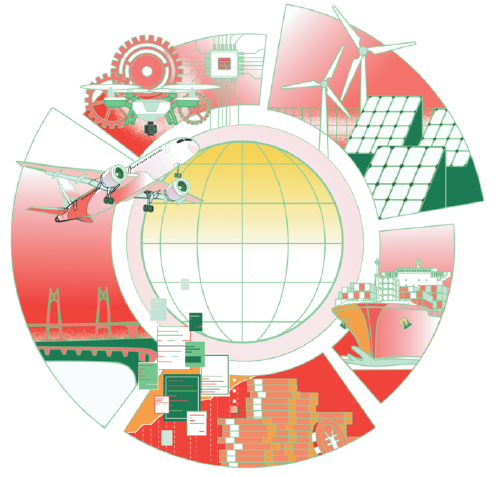
SHI YU/CHINA DAILY
US inability to compete does not equate to Chinese overcapacity
During US Secretary of State Antony Blinken's visit to China, his weapon of choice was the allegation of "overcapacity", particularly in areas where the United States lags behind China's advances and ability to produce competitive products.
This includes many aspects of the green economy, so necessary if the US' 2050 global climate targets are to be achieved.
The Joe Biden administration claims about Chinese overcapacity are being made amid concerted US efforts to deny China access to advanced chips. This so-called overcapacity comes at a time when US inflation has picked up and China's economy has entered a stage of high-quality development.
The overcapacity claim is a difficult assertion to uphold given the utilization rate of manufacturing capacity in the US was 77.24 percent in the fourth quarter of 2023, while the utilization rate in China during the same period was similar at 76 percent.
The false assertion reflects a deeper and selfish US policy of refusing to accept that China's pre-eminence in these areas provides a starting point for genuine cooperation in achieving climate objectives.
Rather than build on the progress China has made, and use this as a basis for further and faster advances, the US has chosen to restrict China's advances.
China installs more green energy resource in a year than the rest of the world combined, but the US chooses not to learn from this experience. It makes no sense to restrict this output by fallaciously labeling it as overcapacity as it will slow down progress toward the global climate goals. Yet this is the very foundation of the US' demands on China.
This is a continuation of the entrenched US approach to China. The Biden administration seems to think that compliance with US demands is the same as cooperation.
Foreign Minister Wang Yi said the US is taking "endless measures to suppress China's economy. This is not fair competition, but containment — and it is not removing risks, but creating risks."
The alleged overcapacity helps to meet US and European consumer demand for safe, efficient and advanced electric vehicles. It's a demand that the US cannot meet because for a decade or more it chose not to effectively develop these sectors.
It is an irony that many of China's EVs are produced as part of US-China and Europe-China joint ventures.
Warren Buffett's investment in BYD profits from the company's advantage in batteries that is the result of the accumulation of the competitive strengths the Chinese company has built up over two decades with sustained investment in R&D and in manufacturing economies of scale.
For the Biden administration and others, this potential to cooperate is discarded in favor of trade protectionist policies such as the CHIPS Act that are designed to hamper China's economic development.
The West's claims of Chinese overcapacity suggest that EVs are exported below the cost of manufacture. In reality decades of Chinese investment in research, and the refinement of the production process, mean that EVs, solar panels and wind turbines can be produced more efficiently and at a more cost-effective price. Rather than trying to develop competitive industries in the US, the Biden administration prefers to manufacture an illusion of overcapacity and use this as a tool to propel the China threat theory to downplay China's significance for global economy.
In the 1980s, similar accusations were leveled at Japan's car exports at a time when consumer advocate Ralph Nader described US cars as "unsafe at any speed".The US imposed punitive tariffs on Japanese vehicles. The Japanese added even more technological value to their vehicles so that even at higher prices, they were more attractive to US consumers. In a short time the consumers came to prefer the high quality of Japanese vehicles. The US car industry was slow to adapt and meet consumer needs.
We are seeing a repeat of this political approach to Chinese products across a range of industry areas. It includes attacks on Huawei, TikTok, EVs, solar panels and a broad range of efficient and cost competitive Chinese products.
In China, by far the biggest auto market, BYD's low-cost pure battery and plug-in hybrids account for about one-third of all new electric vehicles sold in China. The company has positioned itself as a manufacturing powerhouse with its flagship lithium batteries, solar modules, electric-powered buses, trucks and trains, as well as the complex artificial intelligence and software used to control and connect transport and power systems.
The Biden administration's demand that China reduces its production capacity ignores global consumer demand and is part of the broader US policy designed to suppress China's economic development. It is unfortunate that Blinken did not come to China with proposals to build on the advances that China has made in green energy developments so that the world could more rapidly move toward achieving the global climate targets by taking advantage of, and building on, China's advanced technologies.
The author is an international financial technical analysis expert and a former national board member of the Australia China Business Council. The author contributed this article to China Watch, a think tank powered by China Daily. The views do not necessarily reflect those of China Daily.
Contact the editor at editor@chinawatch.cn.





