



Shandong artisans revitalize ancient architectural craftsmanship







Not long ago, a video of a man spending a year to recreate Chaoran Tower with 10,000 stalks went viral. Chaoran Tower, located in Jinan, Shandong province, is a famous historical and cultural tower in China. The video's creator is Wang Dayang, a native of Liaocheng, Shandong, who was born into a family of carpenters. Thanks to his father, Wang Dayang became fond of woodworking in childhood. It took him a year to make this work. He said no glue or nails are used for the main building. It is all built with mortise and tenon structures.
From the traditional katydid cage, straw lantern, to all kinds of antique building models, all need to use the mortise and tenon craft. The mortise and tenon structure is a connection method that combines concave and convex parts on two members. The protruding part is called tenon and the concave part is called sockets. Buildings or furniture with this structure do not require metal connection devices such as nails or screws. The mortise and tenon joints reflect the wisdom and exquisite skills of ancient Chinese craftsmen, which are the basic skills that ancient Chinese carpenters must have.
Mortise and tenon structure can improve the load-bearing capacity and stability of wood, and can absorb and disperse earthquake energy, reduce the impact of earthquake on the building. Therefore, it is widely used in ancient Chinese architecture. As an all-wood building without an iron nail, Kuiwen Pavilion is built using the mortise and tenon craft. Kuiwen Pavilion is equivalent to the sixth gate of the Confucian Temple. Kui Wen Pavilion, formerly known as "Cang Shu tenement", a building where books are stored, was built in the second year of the Song Tianxi (1018 AD) Dynasty. In order to praise Confucius, Jin Zhangzong was renamed "Kuiwen Pavilion" when it was rebuilt in the second year of Mingchang (1191 AD).
In addition to being used in architecture, it is also widely used in furniture. The furniture of mortise and tenon structure is durable, easy to repair, and has aesthetic and artistic value.
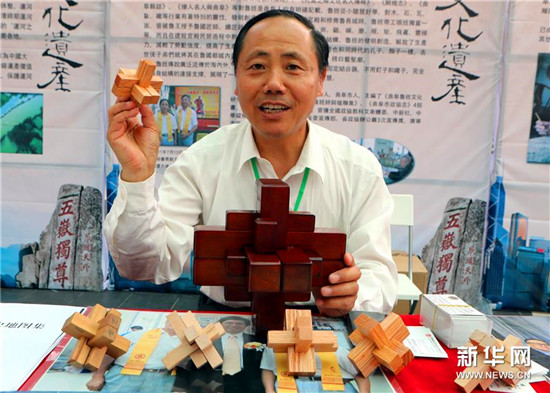
Furthermore, the well-known Luban lock, a kind of educational toy similar to building blocks, is also a mortise and tenon structure. Lu Ban, a native of the State of Lu in the late Spring and Autumn Period, was known as "the ancestor of all kinds of crafts". Unlike philosophers such as Confucius and Mencius, Lu Ban was a skilled craftsman. According to the legend, Luban lock was a toy invented by Lu Ban in order to test his son's hands-on ability.
Nowadays, Luban locks are very particular about material. They are often made of rare hardwood such as rosewood, flower pear sour branch and so on, with inlaid silver wire, engraving patterns and other crafts to make embellishment. The surface of Luban lock is painted with traditional auspicious patterns such as auspicious clouds, ruyi and Wanfu, implying peace and good fortune. In 2010, Li Hao, the non-genetic inheritor of Luban Lock, established Tengzhou Luban Tiangong Wood Art Co., Ltd, founded the "Saint crafter Luban" brand, and built Luban lock production workshop, which integrates research and development, production and marketing. Through Internet e-commerce, Li Hao spreads the cultural story behind Luban lock, so that more and more young people are familiar with and interested in traditional Chinese artisans.
When you think of Tengzhou, you may think of Tengzhou pancakes first, but Tengzhou is also the hometown of Luban. In Tengzhou, Shandong province, Hao Liyan, a post-80s inheritor of Luban's wood-making skills, developed Qiao Lin mortise and tenon building blocks. Different from the ordinary two-dimensional building blocks on the market, Qiao Lin mortise and tenon building blocks with three-dimensional structure are more conducive to exercising children's memory and creativity. Located on the second floor of Shandong Handmade Exhibition and Experience Center, the "Ingenuity Zaozhuang" store displays Qiaolin mortise and tenon building blocks. From building miniatures to all kinds of small animals, a variety of mortise and tenon building blocks are welcomed by many children and parents.
At present, many craftsmen combine the needs of life, constantly innovate, and integrate mortise and tenon structures into people's daily life."Grandpa Amu" from Liaocheng, Shandong province, is nearly 70 years old. He is a carpenter who is good at mortise and tenon. In his spare time, Grandpa Amu likes to make mortise and tenon toys for his grandson. An ordinary piece of wood, after Grandpa Amu's processing - sawing, planning, grinding, chiseling, drilling, picking, all kinds of interesting toys will be shaped. From a wooden horse to a music box, from a "hand-cranked bubble machine" to a "walking Peppa Pig", Grandpa Amu has made a lot of fun toys.
Like Wang Dayang, Hao Liyan and Grandpa Amu, there are many craftsmen in Shandong who good at making mortise and tenon handicrafts. They are hardworking and love life. They innovate in inheritance, develop in succession, and create countless amazing handicrafts.
Wang Ruimin is a student at Shandong University, and a trainee at the workshop "Telling Shandong Stories Well" hosted by Global Engagement Academy in the School of Culture and Communication at Shandong University (Weihai). The views don't necessarily reflect those of China Daily.
If you have a specific expertise, or would like to share your thought about our stories, then send us your writings at opinion@chinadaily.com.cn, and comment@chinadaily.com.cn.





