


Secrets emerge in Northwest China from the mists of time







A newly excavated site has revealed a graveyard containing the largest number of prehistoric tombs found in Northwest China, and a mysterious culture, experts say.
The Xia'eryamakebu Site in Dulan county, Haixi Mongolian and Tibetan autonomous prefecture, Qinghai province, about 100 kilometers from the well-known Tang Dynasty (618-907) Reshui Graveyard Site, one of China's top 10 archaeological discoveries of 2020, has been identified as the only large-scale Nuomuhong Culture site containing both residential and burial areas ever found, says Du Wei, a researcher with the Qinghai Provincial Institute of Cultural Relics and Archaeology.
Xia'eryamakebu means "the riverbank where gazelle appear" in Mongolian. The excavation was carried out by the institute and Northwest University in Xi'an, Shaanxi province, between 2021 and 2023. Located in the Qaidam Basin on the Qinghai-Tibet Plateau, the site occupies an area of nearly 250,000 square meters and dates to around 3,500 to 3,000 years ago, contemporaneous with the middle and late periods of the Shang Dynasty (c. 16th century-11th century BC). The Hatu River runs through the site and divides it into two halves, north and south of the river respectively.
The north part comprises a large cemetery, while its counterpart in the south is a residential area with two smaller cemeteries.
Altogether, 3,228 tombs have been discovered in the three cemeteries, making this the best-preserved and largest prehistoric graveyard found in Northwest China to date. The scale is also rare in contemporaneous sites in the Central Plains, says Du, who is also head of the archaeological project.
The tombs show evidence of a special burial custom. They were reopened years later, the remains disturbed, and then reburied.
They show differences in level, since some are large and contain many funerary objects, while others are smaller and contain fewer objects. This is evidence of social differentiation in the Qaidam Basin, an indicator of civilization, Du says.
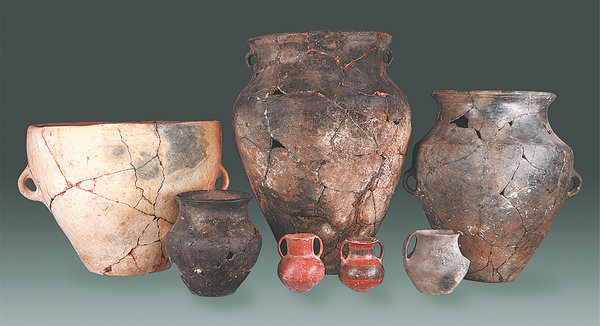
A great number of artifacts combining multiple cultural elements have been unearthed, including pottery, bronze, jade, stone, bark and wooden artifacts, animal and plant remains. For example, millet, painted pottery and lacquer ware, probably from the Central Plains and North China have been found, as well as bronze pole head decorations in the styles that were widely seen across the Eurasian grassland, and carnelian beads similar to those from South Asia.
"It shows how early people moved to the Qinghai-Tibet Plateau and the process of communication and integration among multiple ethnic groups," Du says.
Nuomuhong Culture was discovered when archaeologists excavated the Talitaliha Site in Dulan in 1959, and found evidence of a Bronze Age culture in what is now central Qinghai. Further study of the cultural type almost ceased afterward due to the lack of new archaeological evidence.
The Xia'eryamakebu Site fills in this gap, and Du says the artifacts found so far are believed to enrich the "panoramic understanding of the time, settlement features, economic forms, handicrafts and human structures of Nuomuhong Culture".
They have also made clear the evolution and layout of the settlement part of the site, and bear witness to an uninterrupted history spanning 500 years, Du says.
"It's rare to find such a large group of tombs on the Qinghai-Tibet Plateau," says Huo Wei, an archaeology professor at Sichuan University. "It proves the long history of the Qaidam Basin and enriches our understanding of the civilizational history of the Qinghai-Tibet Plateau."
Chen Xingcan, head of the Institute of Archaeology at the Chinese Academy of Social Sciences, says with its large number of bronze artifacts, well-built and well-preserved tombs, the site changes archaeological ideas about the social development of the northern area of the Qinghai-Tibet Plateau.