



China and Germany have potential for cooperation







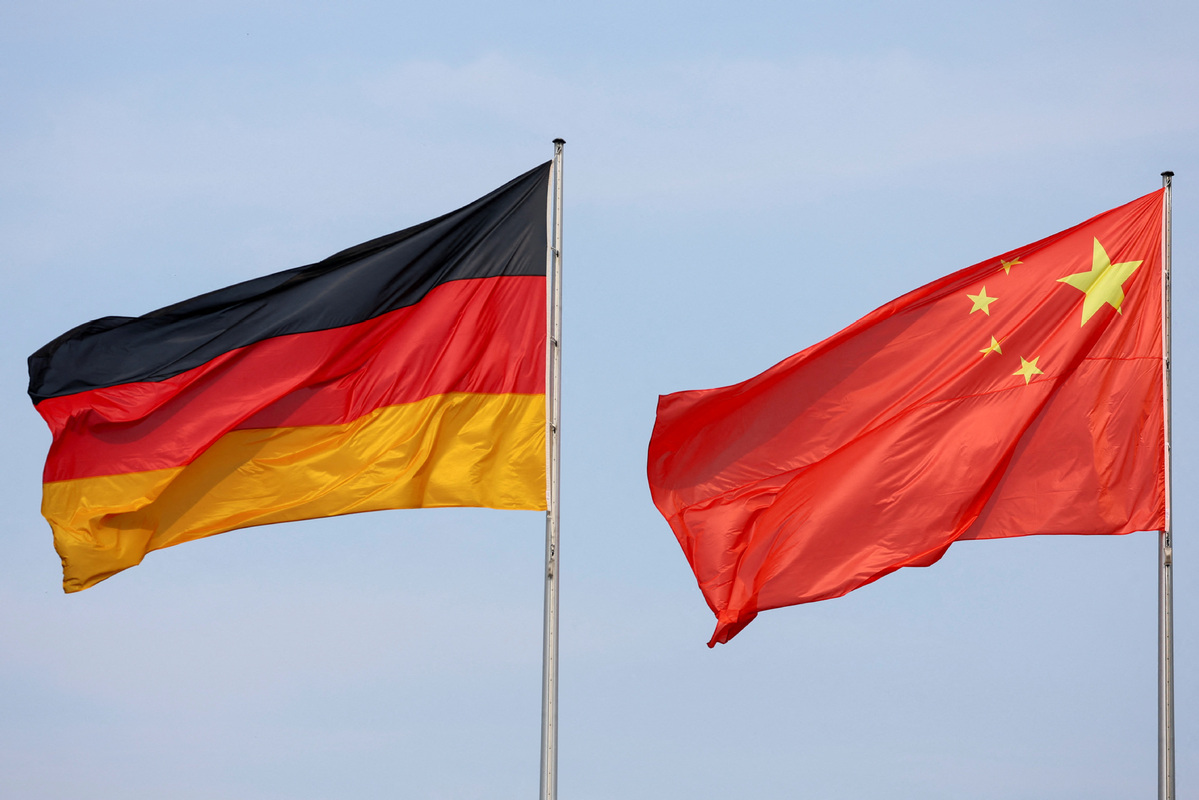
Editor's note: China and Germany have huge potential for win-win cooperation in both traditional fields such as machinery manufacturing and automobiles and emerging fields including green economy. As such, the two sides should engage in mutually beneficial exchanges. Three experts share their views on the issue with China Daily.
Cooperation only certainty for Germany
By Liu Zuokui
All eyes are on German Chancellor Olaf Scholz who just concluded a three-day visit to China from Sunday. That Scholz was accompanied by Environment Minister Steffi Lemke, Agriculture Minister Cem Ozdemir, and Transport Minister Volker Wissing shows how important the visit is for both sides.
The historical trajectory of Sino-German relations shows pragmatic cooperation has served as the cornerstone of bilateral ties. Conversely, endeavors veering toward ideological confrontation have disrupted and undermined their partnership. Anchored by the tenets of economic globalization and interdependence, Sino-German relations have thrived, buoyed by a robust mutual strategic trust and open communication.
Economics and trade are the linchpin of Sino-German relations. Over the past half a century, Germany has emerged as one of China's foremost trading partners in Europe, with bilateral trade accounting for one-third of the total China-European Union trade. And the fact that German investments in China constitute a third of total EU investments underscores the symbiotic nature of their economic interdependence.
The two countries' automobile and energy sectors serve as exemplars of successful industrial collaboration, exemplified by CATL's significant investments in Germany. Even amid escalating geopolitical tensions, German businesses continue to express confidence in the Chinese market and its economic potential, as evidenced by a 4.3 percent year-on-year increase in direct investments in 2023, which reached a record 11.9 billion euros ($12.9 billion), according to IW institute. Also, German investments in China accounted for 10.3 percent of its total foreign investments in 2023, the highest since 2014.
Besides, the "Business Confidence Survey 2023-24" the German Chamber of Commerce released in January shows that more than 90 percent of German companies operating in China plan to continue to do so, with more than half of them saying they intend to increase their investments. Not for nothing has China been Germany's most important trading partner for eight straight years.
There is still ample potential for economic cooperation between China and Germany, especially in digital and green economies, as well as in electric vehicles, clean energy, biopharmaceuticals, and artificial intelligence.
China-Germany relations have been successful, because the two sides practice pragmatic cooperation and win-win collaboration for mutual benefit, promote globalization, uphold multilateralism, and are committed to building a community of shared interests through their cooperation.
But the litany of crises, from financial meltdowns to geopolitical upheavals the EU has been grappling with, have given rise to conservatism and extremist ideologies, leading to a discernible shift in its foreign policies. In particular, the Russia-Ukraine conflict has dramatically reduced, if not ended, the peace and growth dividends Europe, especially Germany, had been enjoying for more than 70 years.
As a result, the development landscape has undergone significant changes. Relying on Russia's cheap energy supply, the United States' security assurances, and China's inexpensive goods, the EU, and German economies, had maintained relatively good growth despite the challenges.
But now Germany's international development environment has changed, because the severing of energy supply from Russia due to US and European sanctions against Moscow has drastically increased Germany's energy bill, hurting its economic competitiveness. And given its concerns over excessive reliance on the US for security, Germany has been making substantial investments to boost security to minimize the "threat" posed by Russia.
In such circumstances, the only certainty for Germany is cooperation with China.
However, this cooperation is also subject to changes given the complex international and domestic situations. And Germany's oscillating policy toward China is bound to cast a shadow over future economic cooperation.
After the EU's report, "EU-China: A Strategic Outlook", in 2019 defined China as a "partner", a "competitor" as well as a "systemic rival", there has been a noticeable shift in the EU's policy toward China, with ideological and broad security factors coming more into play.
Following the Russia-Ukraine crisis, the EU followed the US in adopting a "de-risking" strategy toward China, which has significantly impacted Germany, leading to the adoption of new security and China policies in 2023.
On July 13 last year, the Scholz government passed its first comprehensive China policy, which advocates for "systemic rivalry" with China and emphasizes the necessity of reducing economic dependence on China. Simultaneously, it stresses the importance of China and Germany continuing their cooperation on global issues such as free trade and climate change.
However, Scholz has emphasized that Germany has no intention of "decoupling" from China despite the new policy. Instead, he said, Germany is committed to continuing cooperation with China. The second visit of Chancellor Scholz to China is the first one after the adoption of the new policy last year. Some foreign media have suggested that Germany seems to be shifting its focus toward Southeast Asian countries in an attempt to reduce its dependency on China. However, this approach is impractical and runs counter to Germany's interests.
It is in the interest of both Germany and China to deepen cooperation, because "decoupling" or "de-risking" is not in the interest of either party. Sino-German relations will benefit from deepening pragmatic cooperation.
As two economic powerhouses, China and Germany must seize the opportunity to recalibrate their partnership on a trajectory of mutual benefit and sustainable growth. By charting a course anchored in mutual respect and shared interests, the two sides can navigate the complexities of the current geopolitical landscape and forge a path toward a future defined by cooperation and prosperity.
Moreover, the growth of the Chinese economy will create considerable opportunities for Germany, too. So the two sides should engage in fair competition, not indulge in a zero-sum game, and strengthen cooperation for mutual benefit.
The author is deputy director of the Institute of European Studies, Chinese Academy of Social Sciences. The views don't necessarily reflect those of China Daily.
If you have a specific expertise, or would like to share your thought about our stories, then send us your writings at opinion@chinadaily.com.cn, and comment@chinadaily.com.cn.





