



Elemental struggle
Rapid growth of renewable energy sector has intensified the competition for critical minerals posing a challenge to China's green transition







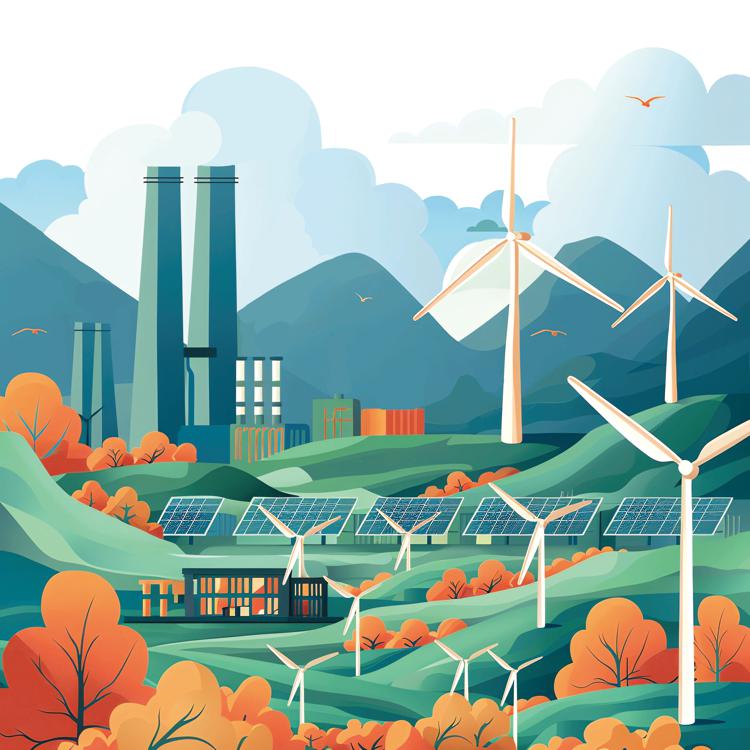
As there is emerging global consensus on attaining carbon neutrality by the mid-century, countries across the world are going all out to develop clean energy systems such as solar and wind in an attempt to transition from fossil fuels to renewable energy sources at a faster pace.
The worldwide application of clean energy technologies has strongly boosted the demand for energy-related minerals while critical mineral resources — most notably lithium, nickel, cobalt, copper and rare earths — are unevenly distributed worldwide. Most of such critical minerals are concentrated in a handful of countries. The critical mineral supply gap has further increased the strategic importance of those minerals. Countries across the world are vying for control over such mineral resources.
For instance, against the backdrop of the soaring prices of crucial metals and notably the rising profits of mining companies, host countries of mining projects are raising tax or royalty rates to claim a larger share of mineral wealth from global mining companies.
Once those assets are appropriated or nationalized, global mining companies will lose all of their mineral interests in host countries. But such measures are rarely used. Other measures include renegotiating existing contracts, and limiting or banning the exports of raw minerals.
China is an important global supplier of clean energy products and technologies today, holding at least 50 percent of the world's manufacturing capacity for the clean energy market (solar photovoltaic, wind systems and electric vehicle batteries).
However, in terms of most critical minerals, China does not have abundant reserves and is strongly reliant on imports. First, the import prices are rising. Policies, such as increasing royalties and taxes, nationalization of investment projects and breach of contracts, will greatly undermine mining companies' investment enthusiasm, hinder the expansion of mining capacity and push up the costs of mineral exploration and mining investment. Escalating geopolitical tensions between major countries will make the global mineral market even more fragmented, lower the efficiency of critical mineral supply chains, and increase the operating costs of such supply chains.
Second, import uncertainty is rising. Resource-rich countries such as Indonesia and Tanzania have banned the export of some raw mineral ores in an attempt to develop their own domestic mineral processing and refining industry. Meanwhile, some major sources of critical minerals imports for China, such as Australia and Canada, are close allies of the United States. Thus, the stability of China's critical mineral imports will inevitably be affected by China-US relations. Furthermore, the rapid growth in the renewable energy sector will continue to strengthen the geopolitical importance of critical minerals. Normal trading activities of critical minerals are likely to be sabotaged or disrupted by those trying to contain China, thus undermining the stability of critical mineral supplies.
Third, risks associated with overseas mineral investment are rising. Evidently, policies, such as increasing royalties and taxes, nationalization of assets and reviewing existing contracts, will adversely affect Chinese companies' normal operations in those countries. Mexico and Chile have nationalized their lithium deposits, making it hard for Chinese companies to find any new investment opportunities in lithium ores. Over the past few years, some Western politicians and media have launched a smear campaign against Chinese companies' investment in overseas mining projects by exaggerating the negative impacts of such investments on the region's ecology and environment, arousing concerns from those resource-rich countries and mining communities.
Last, resource-rich countries are more inclined to restrict the export of unprocessed minerals in an effort to boost their domestic mineral processing industry and claim a larger share of mineral wealth. This will increasingly threaten the security of raw materials supply chains in China's mineral processing industry. It's worth noting that Indonesia's export ban on some raw minerals has come into play. Such a model has attracted a large amount of foreign capital to flow into Indonesia's mineral refining and processing industry, resulting in its rapid growth. Some other resource-rich countries are following suit. This will pose greater challenges for China's traditional model of massively importing raw minerals to develop its domestic mineral refining and processing industry, or even make it unsustainable.
Amid China-US strategic competition and the increasingly fierce global fight for critical minerals, securing the supplies of critical minerals and strengthening the resilience of critical mineral supply chains have become a concern of underlying importance to China's push for energy transition and high-quality economic growth.
To secure the supplies of critical minerals, China needs to take the following measures.
To start with, China needs to scale up investment in mineral exploration and development. The country should increase its domestic mineral reserves and develop domestic mines in an orderly manner. It should establish a compulsory system for scrap metal recycling, beef up support for research and development of recycling and alternative technologies for critical minerals that China lacks or relies heavily on imports, and vigorously develop alternative raw materials. The country should also appropriately increase the strategic reserves and commercial reserves of certain critical minerals to reduce the risk of supply chain disruptions to the greatest extent.
Second, China should deepen mineral cooperation with resource-rich countries involved in the Belt and Road Initiative. It should expand import sources for critical minerals, particularly by finding new raw material suppliers from African, Latin American and Central Asian countries, and encourage Chinese businesses to set up processing companies in resource-producing countries.
China should also enhance investment and aid in such areas as people's livelihood, infrastructure construction and low-carbon growth, in Africa and Latin America's resource-rich countries to further improve its national image as a major country and a friendly country and strive for more recognition.
Last, businesses concerned should improve their risk identification and early warning systems. Relevant companies should closely monitor and systemically assess any changes to the resource-producing countries' mining policies and laws. They need to incorporate the environmental, social and governance concepts into the whole process of investment and manufacturing. Also, they can effectively defend their legitimate rights and interests by making the utmost of laws and regulations of the host country, bilateral economic and trade agreements that China has signed with the host country and the WTO's dispute settlement system.
The author is a researcher at the Institute of World Economics and Politics at the Chinese Academy of Social Sciences. The author contributed this article to China Watch, a think tank powered by China Daily. The views do not necessarily reflect those of China Daily.
Contact the editor at editor@chinawatch.cn.





