A voice for women's issues
Author and CPPCC member has a proud record of proposing initiatives to help enhance society, Yang Yang reports.







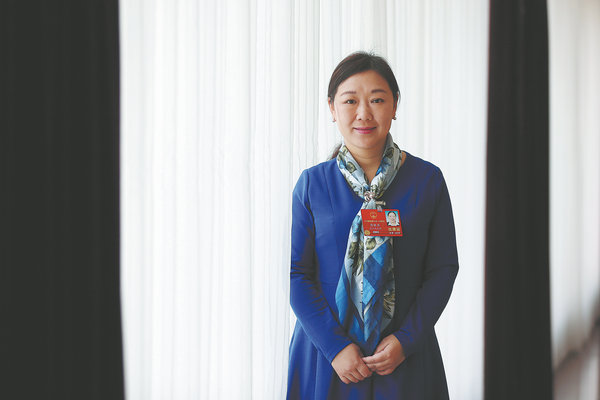
Almost every March since 2018, Jiang Shengnan's name has appeared in the hottest topics section on micro-blogging platform Sina Weibo. The 51-year-old member of the Revolutionary Committee of the Chinese Kuomintang was a deputy to the National People's Congress from 2018 to 2022, and has been a member of the 14th National Committee of the Chinese People's Political Consultative Conference since 2023. She often made headlines for the motions and proposals she submitted to the two sessions and other political meetings.
In 2020, Jiang suggested dropping the "cooling-off" period before divorce mentioned in the draft of the Civil Code, because the rights of the weaker side in a marriage — more often than not the women — could be further harmed. For example, one party might use the period to hide assets, maliciously incur debt, escalate abuse or destroy evidence of misconduct, leaving the other party in an even more dire situation, she told media.
For the two sessions in 2022, she proposed a motion to improve maternity and paternity leave. In interviews, Jiang said that people should remain alert to the discrimination against women in the job market as a result of prolonged maternity leave, and suggested increasing paternity leave for fathers.
Her proposals have provoked wide discussion. Other suggestions have included reducing the workload for grassroots civil servants using big data, canceling the upper age limit of 35 for the employment of civil servants, and employers strictly observing the 8-hour day, instead of making employees work long hours.
"What we NPC deputies and members of the CPPCC care about is often what the people care about. What we should do is to deliver on what concerns people, and propose more targeted and feasible solutions to solve problems and implement policies," she said during this year's two sessions, which ended on March 11.
Born in 1973 in Wenzhou, East China's Zhejiang province, Jiang is the third and youngest daughter in the family and her name, Shengnan, translates as "better than men". She was a bookworm as a primary school student and often spent what she calls "a colorful day" at the school library, reading one or two books a day, nourished by steamed stuffed buns and a bottle of water.
Jiang began reading Qing Dynasty (1644-1911) author Cao Xueqin's Dream of the Red Chamber in the second grade, when she did not even fully understand all the characters. She also loved reading history, and the first historical books she read were the Chronicles of the Eastern Zhou Kingdoms, stories that are more than 2,280 years old.
In 1996, she wrote her first martial arts novel Modao Fengyun (Magic Sword Tempest) to entertain herself. In 1997, she bought a computer and typed in the manuscript, but with nowhere to publish, only family and friends read the book.
At the suggestion of a friend, Jiang posted the novel on a bulletin board system, starting her career as an online writer, and became witness to the development of China's online literature sector.
With people from all walks of life able to write online, internet literature thrived, and diverse genres and themes catering to popular tastes emerged one after another, offering more possibilities for writing.
Jiang focused on women, who were usually overshadowed and presented as simplified characters in Chinese literature, particularly important historical women. She realized that Chinese historical novels tended to focus on emperors, kings, generals and ministers, and women often featured as vehicles, either as virtuous wives and good mothers, or as beautiful women who caused mayhem.
However, she knew that major figures like the empress dowagers Mi Bazi in the Warring States Period (475-221 BC) and Xiao Yanyan in the Liao Dynasty (916-1125), and Empress Liu E in the Northern Song Dynasty (960-1127), possessed political savvy equal to that of men and shaped history with their wisdom and actions.
"In them, I saw patriotism and an elegant demeanor as they fearlessly pursued the value of life despite difficulties," she wrote in a recently published article. "They should be seen, remembered and studied. I wanted to change this situation in my writing.
"By combing through historical texts to unearth the contributions and achievements of women to the history of civilization, I wanted to bring them to the surface, pave the way for a more harmonious, equitable and insightful perspective on gender relations and historical understanding, and shed light on the indelible impact of women on the tapestry of human civilization."
In her novel Mi Yue Zhuan (Legend of Mi Yue), one of her most well-known books, which is based on the life of China's first empress dowager Mi Bazi, who ruled the Qin state under the name of Empress Dowager Xuan at the age of 30, she imagined the empress dowager's life, from her first cries to her parents, mentors, brothers and sisters, as well as her romances, as there are few historical records about her actual life.
Among the 2,000-odd ratings on Douban, a major review aggregator in China, nearly 70 percent of readers gave Jiang's most famous novel four stars or more out of five. One reader, nicknamed Yinrendeponiang, who gave the novel four stars, commented that, "The book narrates the life of China's first empress dowager, through a blend of fiction and history. It details her journey from birth to reign, and how the changes in her life influenced her, shaping her into a kind yet cunning individual with talent and ambition. She resists others' control over her.… This book not only informs us about her path to growth, but also shows how a woman can achieve success through her own efforts".
In her another novel, Yanyun Tai (The Legend of Empress), Jiang presents the historical changes to the Liao Dynasty through the life of her hero, Empress Dowager Xiao Yanyan.
Jiang has not limited her aspirations to improving the social status of women — who account for half of humanity — to novels. As a writer, she also keeps a keen eye on the real-life problems of people, and tries to realize their aspirations.
"As a member of the National Committee of the CPPCC, I represent the grassroots, so when I have the chance to improve their lives, I grab the opportunity," she says.
Her first proposal related to the problem of protecting the intellectual property of online literature. As a contributor for over two decades, she has not only seen her own work plagiarized, but also that of fellow writers. Following further investigation, she discovered that it was difficult for creators to defend their rights because of a lack of people involved in IP protection.
As even IP-related majors at university were more focused on theory rather than practice, Jiang proposed a motion to promote the training of application-oriented talent in IP protection, which not only received a great response from the industry, but was later implemented by the government in 2020. She was greatly encouraged by the result and expanded her areas of investigation, making more suggestions.
Jiang's proposals frequently resonated with many people, and often rose to the top of Sina Weibo's trending topic list. Her greatest concern remains women and children and she has posted her email address online to collect issues of different people.
"I believe that society's awareness of protecting women's rights has continued to improve. What I need to do is to bring people's opinions to the two sessions, to the public, for solutions," she says.
Over the past few years, her proposals have included promoting nationwide, multi-department action to combat human trafficking and subsequent rescues, classifying surrogacy as a criminal offense, and protecting the private information of juvenile criminals.
As she continues to tackle deep-seated problems concerning the rights of women, she discovers new ones. During this year's two sessions, one of her proposals was about promoting the protection of rural women's land rights to advance gender equality and facilitate rural vitalization.
Although the law requires that women enjoy equal rights to men when it comes to land, in reality, the traditional practice of depriving women of their land when they leave home after getting married means that rural women either lose their land or own less land than is mandated by law. Even if they later become single, most cannot reclaim any land previously lost, Jiang says, adding that even if they sue, winning is difficult.
This greatly harms women's rights and leads to many problems. Jiang says that one of the consequences is that unequal rights distribution between genders directly affects rural birth gender ratios. If these problems can be solved, she says, maybe more women will want to stay to work on their own land rather than leave for cities to make money. This may then solve the problem of rural men being unable to find wives, some of whom turn to marrying abducted women, which in turn will address problems like human trafficking and high bride prices.
Speaking of the relationship between her gender and her political proposals, Jiang says that a female perspective will make the world better. "In the age of the internet and the future age of artificial intelligence, physical difference is no longer important, so women can better use their strengths," she says. "The more you take part in social activities, the greater your speaking rights become."