



A new chapter for those with disabilities







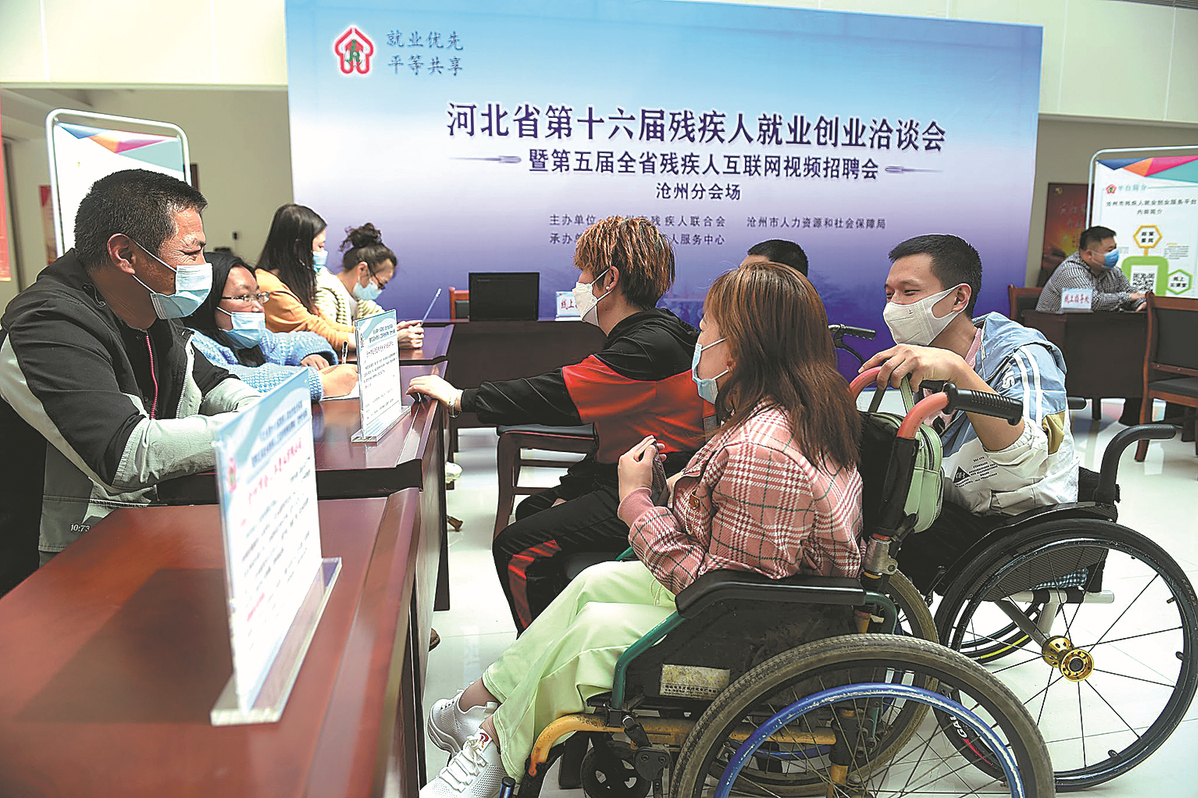
The cause of persons with disabilities is an important part of the cause of socialism with Chinese characteristics, and the cause of supporting persons with disabilities an important symbol of social progress. Today, the rights and interests of persons with disabilities are better protected in China. Around 85 million persons with disabilities have entered a moderately prosperous society, and their sense of gain, happiness and security continue to improve. As participants, contributors and beneficiaries of economic and social development, a majority of persons with disabilities have seen unremitting self-improvement on a broad scale, scripting a brilliant chapter of struggle in their lives.
As a multi-ethnic country, China has always attached importance to the development and protection of the cause of persons with disabilities. Through legislation and policy formulation, China has safeguarded the rights and interests of persons with disabilities. It has gradually formed a legal system for the cause of persons with disabilities, with the Constitution of the People's Republic of China as the core, the Law of the People's Republic of China on the Protection of the Disabled as the main body, the Regulations on the Education of the Disabled, the Regulations on the Employment of the Disabled, the Regulations on the Construction of an Accessible Environment and the Regulations on the Prevention and Rehabilitation of the Disabled as important support, and normative documents as supplement. At the second session of the 14th National People's Congress and the second session of the 14th National Committee of the Chinese People's Political Consultative Conference in Beijing in March, many deputies and members put forward suggestions and proposals related to education, employment, rehabilitation, social security and accessibility of the persons with disabilities.
China attaches great importance to the protection of the right to education of persons with disabilities. In past decades, China has made remarkable achievements, providing them more educational opportunities and development space. China guarantees them equal right to education. It has promulgated and revised the Regulations on Education of Persons with Disabilities, which has included education of persons with disabilities in the national plan. It has formulated and implemented the three-phase action plan for the development and improvement of special education, comprehensively promoted integrated education, and focused on improving the education level of persons with disabilities.
China has also promulgated the Regulations on Employment of Persons with Disabilities, which actively promotes employment of persons with disabilities and their social integration. Employers that formally recruit persons with disabilities are provided with post subsidies, social insurance subsidies, vocational training subsidies, subsidies for the purchase and renovation of facilities and equipment, and vocational skill assessment subsidies. Also, rewards are given to employers that arrange for a disproportionate number of persons with disabilities to be employed. Currently, such employers include massage agencies for the blind, vocational rehabilitation factories, and employment bases. In recent years, various regions have explored new forms of employment for persons with disabilities. New jobs such as that of telephone customer service representative, data annotator and barrier-free travel service engineer have emerged as new options for people with disabilities.
China also attaches great importance to the protection of the health rights of persons with disabilities. It has promulgated the Regulations on Disability Prevention and Rehabilitation of Persons with Disabilities, incorporated rehabilitation of persons with disabilities into the outline of planning and long-term goals, formulated and implemented two national disability prevention action plans, comprehensively carried out disability prevention, vigorously promoted rehabilitation services, and strived to achieve the goal of "rehabilitation services for all persons with disabilities". The current Catalogue of Basic Rehabilitation Services for Persons with Disabilities specifies basic rehabilitation services, including medical treatment, rehabilitation training, adaptation of assistive devices, and supportive services, for persons with visual, hearing, physical, mental, and spiritual disabilities.
The Standards for Community Rehabilitation of Persons with Disabilities has set requirements for standardizing community rehabilitation of persons with disabilities in various regions from four aspects: organization and management, service system, service content, and evaluation index. The State has included 29 medical rehabilitation items, such as exercise therapy and comprehensive rehabilitation assessment, in the coverage of basic medical insurance. At the same time, it sets conditions to appropriately increase medical rehabilitation items according to the capacity of the fund and the principle of ensuring basic medical needs.
In recent years, the Chinese government and other parties concerned have paid greater attention to the construction of a barrier-free environment for people with disabilities, making remarkable achievements. The Regulations on the Construction of an Accessible Environment adopted in 2012 is China's first special regulation on the construction of such an environment. The Law on the Construction of an Accessible Environment adopted in 2023 stipulates that the State should take measures to promote the construction of an accessible environment and convenience for people with disabilities and the elderly to cross roads, enter and exit buildings and use their ancillary facilities, take public transport, obtain, use and stream information, and access social services.
In China, the social security system for people with disabilities refers to the organic whole of laws, regulations, rules and policies established by the State and society to ensure the basic life of people with disabilities in response to their special difficulties and special needs. The social security of people with disabilities has attracted increasing attention. The report of the 20th National Congress of the Communist Party of China proposes to "improve the social security system and care service system for people with disabilities and promote the all-round development of the cause of people with disabilities." China's Social Insurance Law, Interim Measures for Social Assistance, Regulations on Work-related Injury Insurance, Regulations on Pensions and Preferential Treatment for Military Personnel and other laws and regulations have specific provisions on the social security rights of persons with disabilities. Disabled persons enjoy social assistance, welfare and social insurance benefits in accordance with relevant regulations.
The Chinese government has always attached great importance to the affairs of persons with disabilities and has implemented a series of policies and measures nationwide to improve the quality of life and ability of persons with disabilities to integrate into society. Persons with disabilities enjoy the right to participate in cultural life on an equal footing. People's governments at all levels and relevant departments encourage and help persons with disabilities to participate in various cultural, sports and recreational activities, and actively create conditions to enrich their cultural life.
"I am happiest to increase my income and gain recognition through my own labor!" said Li Qin, who is hearing impaired and works at Canyi Workshop in Haishu district of Ningbo in Zhejiang province. Handicrafts such as key cases and purses are stacked around her, all newly made products on order. In 2019, the Disabled Persons' Federation of Haishu district set up a display and sales center for cultural and creative products for people with disabilities in Nantang old street, a local tourist attraction. This ensured for Li Qin a stable income of several thousand yuan per month (1000 yuan = $138.25), helping her family get out of poverty. "I am looking forward to selling my handicrafts to more people, and I believe the future will be better."
In 2021, in Beihai, Guangxi Zhuang autonomous region, brothers Pang Jian and Pang Qiang (both pseudonyms) entered the Beihai City Disabled
Persons' Care and Support Service Center, where they were taken good care of. They had mental health issues and had problems communicating with others. Now they take the initiative to say hello to people every day, smiling happily. They used to be introverts but are now more outgoing. "Seeing their life getting better, I feel very relieved! I don't have to spend all day taking care of them now, I can go out to work and earn money to improve the life of my family," said their sister.
The protection of the rights of persons with disabilities in China has always been upheld by the leadership of the Communist Party of China, which has promoted the core socialist values and humanitarianism, integrated them into overall national development, developed and safeguarded the rights and interests of persons with disabilities in accordance with the law, and given full play to the main role of persons with disabilities in the cause of persons with disabilities.
The author is vice-dean of Research Institute for Human rights, Guangzhou University.The views don't necessarily represent those of China Daily.
If you have a specific expertise, or would like to share your thought about our stories, then send us your writings at opinion@chinadaily.com.cn, and comment@chinadaily.com.cn.





