HK's future as business center secure under 'one country, two systems'







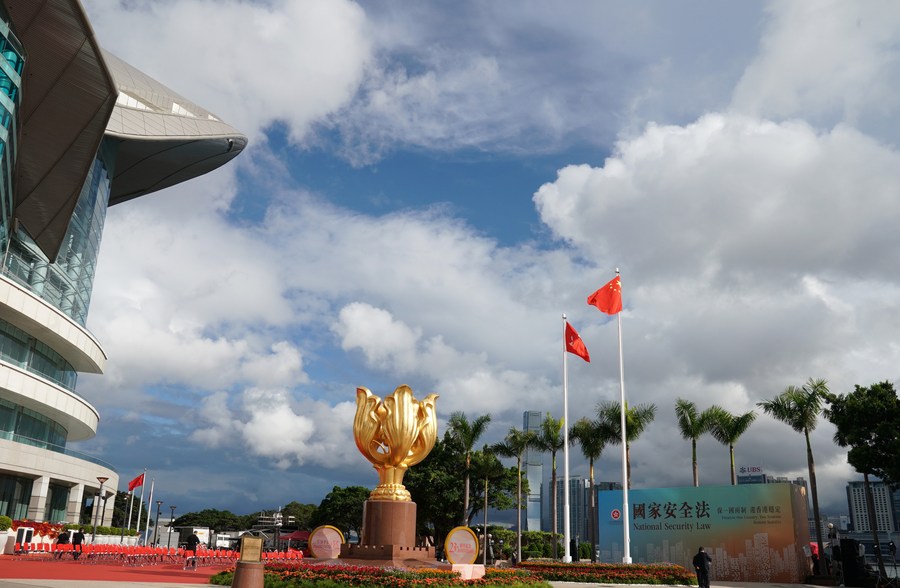
A recent report in Western media that suggested Hong Kong was planning to ban some popular social media platforms, such as Facebook and YouTube, is another futile attempt to mislead international opinion. Such comments are simply untrue, but they were made when Hong Kong's legislature was about to debate the since-enacted Safeguarding National Security Ordinance under Article 23 of the Basic Law.
The incident crystallizes the optic through which many Western media outlets report on Hong Kong. Therefore, it is hardly surprising that overseas businesses are often confused. It is also increasingly common for friends overseas to inquire about safety and whether they should use "burner phones "during their visits to Hong Kong.
Contrary to these concerns, the consensus among business leaders based in Hong Kong is that the new ordinance will protect their businesses and provide stability for business operations.
Hong Kong's best days are ahead, as China has secured the city's status as the Asia-Pacific region's leading finance-corporate management center.
The "one country, two systems "governance framework guarantees Hong Kong's protection from external threats: under the "one country "principle, Hong Kong is an inalienable part of China, and the "two systems" gives Hong Kong a high degree of autonomy to govern itself. The Safeguarding National Security Ordinance was adopted in accordance with common law practices. The principles of fairness and justice guarantee human rights more than other similar jurisdictions, and Hong Kong's Court of Final Appeal even consists of non-Chinese nationals, a practice not seen in other countries.
This governance framework, in which national leaders have repeatedly emphasized their vision for the Hong Kong Special Administrative Region, serves as the country's window to global capital, and ensures Hong Kong will not be "just another Chinese city". This is especially significant.
Now national leaders are so confident about Hong Kong's future as China's window to global capital that the year 2047 has become just another year for the city, rather than the expiration date of the"50 years of no change" promise made in 1997. President Xi Jinping has frequently alluded to this.
One of the strongest reconfirmations came during the recent visit to Hong Kong of Xia Baolong, director of the Hong Kong and Macao Work Office of the Communist Party of China Central Committee and Hong Kong and Macao Affairs Office of the State Council. In meetings with local and foreign business executives, various attendees agreed that Xia clearly articulated that the governance principle of "one country, two systems" is for the long term, perhaps even permanent.
This has monumental consequences for Hong Kong as the Asia-Pacific region's leading finance-corporate management center. China's authorities have reiterated that Hong Kong will be "permanently "open to the world as a global business center. International businesspeople will be welcomed as full participants in the sophisticated interpersonal business networks that define the city as a hub of global capital.
Commentators, critics and academics continually fail to recognize that Hong Kong's status as the leading financial center of the Asia-Pacific region rests firmly on the networks of its financiers and their firms, on the support of sectors of sophisticated lawyers and strategic consultant accountants, and on the nonfinancial senior global and regional managers. Their network behavior makes Hong Kong the hub of Asia-Pacific networks.
Within Hong Kong, financiers, lawyers, consulting accountants and other nonfinancial senior decision-makers engage in intense network relations. These operate in face-to-face strategic exchanges of knowledge and business discussions. Each actor brings to these meetings the expertise and knowledge that they have built within their firms. Based on their business activities, each of these actors has external network relations with other financiers, clients and government officials within Asia and globally.
Senior financiers have stated that the new ordinance would have no negative impact on their businesses, with their only fear being that businesspeople outside Hong Kong would misinterpret the safety of the city and, perhaps, be reluctant to do business in Hong Kong.
Global businesses would normally place their senior management for the Asia-Pacific region in Hong Kong if they expect to be major players in Asia's economic growth during the 21st century. When measured based on purchasing power parity, China is the world's largest economy. Its growth over the coming decades at 3 to 5 percent will far surpass that of the United States and the European Union. China is the technology innovation and manufacturing powerhouse of the global economy and owns the intellectual capital for future advanced manufacturing.
China's global enterprises increasingly shift their senior managers to Hong Kong. The consequences are immense because of the scale of the Chinese economy and of its businesses. These executives join the existing sophisticated business networks of Hong Kong. This larger network group will make the pivotal decisions about capital exchange within Asia and the rest of the global economy. Senior executives based at other Asia-Pacific centers such as Singapore, Tokyo or Sydney will be outside Asia's most critical business networks.
The people of Hong Kong face a dynamic future as residents of the greatest business center of the Asia-Pacific region. Young people have enormous opportunities to participate in the city's future growth as China's window to global capital.
David Meyer is a senior lecturer in management at Olin Business School at Washington University in St. Louis and professor emeritus of sociology and urban studies at Brown University. Jane Lee is president of the Our Hong Kong Foundation.