



Manila's myths bring more challenges to stability of South China Sea







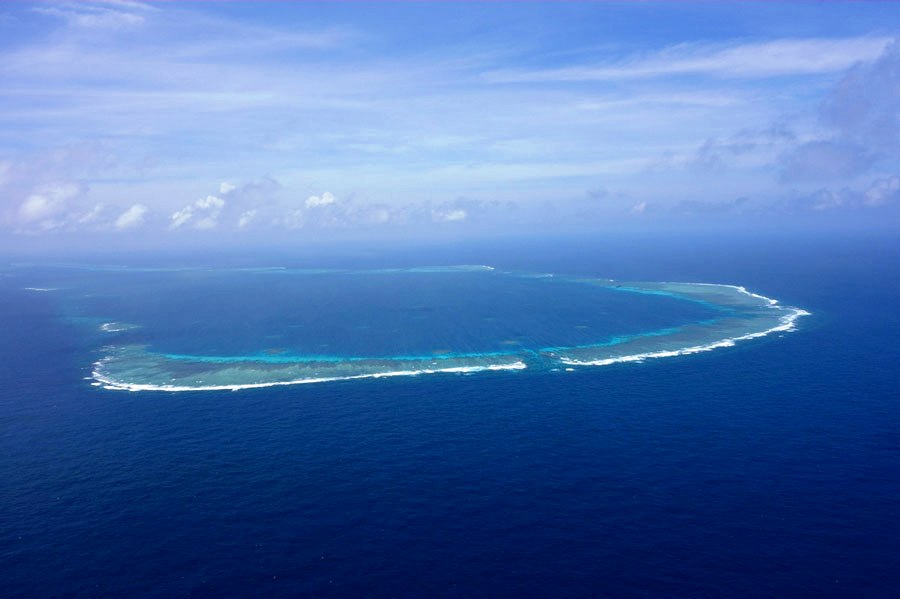
Since February this year, the Philippines have conducted multiple joint patrols with the US in the South China Sea, while overplaying discord with China and smearing China's international image. The Philippines' approach is to describe China's behavior of safeguarding sovereignty as a kind of "maritime bullying". This is a hype strategy adopted by the Philippines in recent years in the field of public opinion, including on multilateral diplomatic occasions.
The actions taken by China's maritime law enforcement forces on Ren'ai Reef and Huangyan Island are normal activities to safeguard its territorial sovereignty. The starting point of these measures is China's territorial sovereignty over the relevant islands and reefs, not geopolitical considerations, nor is it taking advantage of the current international situation to expand in the South China Sea.
From the perspective of international law, China has sufficient historical and legal basis for its territorial sovereignty over Ren'ai Reef and Huangyan Island. This has been discussed in detail in China's official documents, including the white paper released in previous years. The outer territorial limits of the Philippines are determined by three international treaties. The Ren'ai Reef and Huangyan Island are both outside the territorial limits of the Philippines. The Philippines' territorial claims to Huangyan Island are either based on so-called "security reasons" or so-called "geographical proximity", which are not the rules for territorial acquisition under international law.
During the Duterte period, China and the Philippines reached a consensus that they would not discuss the South China Sea issues under the premise of the arbitration award and made temporary arrangements at the operational level for Filipino fishermen to fish in the waters near Huangyan Island. The two sides have a tacit understanding in handling maritime frictions and, at the same time, they also consider the overall relationship between the two countries. There are preconditions for the temporary arrangements. For example, Philippine fishing boats are not allowed to enter the lagoon, are not allowed to catch rare marine life and are not allowed to damage the ecological environment of nearby sea areas. At the same time, the Philippine Coast Guard is not allowed to expel or detain Chinese fishermen. These premises reflect China's sovereignty and jurisdiction over Huangyan Island, and the temporary arrangements made for Philippine fishermen are a show of goodwill to the Philippines.
After the new Philippine government came to power, it adjusted its South China Sea policy and China policy, and the tacit understanding between the two sides at the maritime operational level was successively broken. In this regard, China has taken strong measures to safeguard territorial sovereignty and, at the same time, advise the Philippines to return to the right track of managing maritime disputes through negotiation and consultation and avoiding the escalation of crises. This will also make the Philippines and the United States aware of China's determination and bottom line in safeguarding territorial sovereignty and maritime rights in the South China Sea, including Huangyan Island.
The Philippines has recently taken up the issue of marine environmental protection and even threatened to file an "international lawsuit" against China again. The Philippines is by no means the "marine environmental protector" it advertises itself to be. In fact, Filipino fishermen are destroying the environment in the waters near the relevant islands and reefs of China's Nansha Islands, including exploding fish, poisoning fish and electrocuting fish. This violates China's territorial sovereignty and maritime rights. China has sufficient legal basis to control Philippine fishermen's actions.
The Philippine warships that illegally beached the Ren'ai Reef have residual fuel. The construction waste generated by the reinforcement of the warships and the domestic waste of the personnel stationed on the ships have caused pollution and damage to the marine environment of the Ren'ai Reef for many years. Chinese scientific research ships and law enforcement ships have repeatedly salvaged plastic garbage with Filipino characters printed on it near Ren'ai Reef.
Over the years, China has actively implemented the mid-season fishing moratorium policy in the South China Sea and achieved good results. It has also repeatedly called on the Philippines to jointly implement the fishing moratorium policy, but the Philippines has a very negative attitude towards this. Protecting the marine environment of the South China Sea is a task that cannot be accomplished by one country alone. The Philippines should work with China to gradually restore political mutual trust and promote cooperation in marine environmental protection and resource conservation from a small perspective and on specific issues, rather than the other way around.
Before the resolution of disputes on maritime delimitation in the South China Sea, all relevant parties should endeavor to build up the political mutual trust and promote cooperation in marine environmental protection and resource conservation. If China and the Philippines can take the lead in cooperating in these areas, it would help solve disputes and create a better atmosphere in the region. If both countries can identify and handle key points of contention appropriately, it could help deter the South China Sea narrative dominated by the West, led by the United States.
At present, the key internal factor affecting the stability of the South China Sea is still the unilateral infringement actions of other parties concerned, and the United States is the largest external source of shock. Without the involvement of the United States, it would be much easier for the countries involved to negotiate many matters.
The US is the biggest external cause of tension in the South China Sea. Whenever incidents occur around Ren'ai Reef or Huangyan Island, the US tends to step in to support the Philippines, citing the US-Philippines Mutual Defense Treaty, and making explicit military threats. The actions of the US have also led to increased miscalculations by the Philippines. Over the past years, the Philippines has borne the brunt for foreign powers, especially the US and Japan, when there was regional unrest. The bitter consequences ultimately fall on the Philippines.
A peaceful and stable environment in the South China Sea is the common aspiration of regional countries. Under the current situation, the Philippines should have a clear understanding of the South China Sea disputes and see that only managing differences through bilateral negotiations and consultations can a feasible solution be found. The Philippines should not attempt to initiate compulsory arbitration or resort to other third-party dispute settlement mechanisms against China again. Abuse of the law of the sea dispute settlement process will only make South China Sea disputes more complicated. The Philippines should not want a "South China Sea Code of Conduct" and at the same time want a South China Sea arbitration award. The current establishment of rules and order in the South China Sea is not to resolve disputes but to manage crises. The rules are not just for China but should be applied equally to every country involved, regardless of size. Other parties involved should not have any illusions about imposing on China their own unilateral claims adjusted in accordance with the arbitration award.
Ding Duo is deputy director and associate research fellow, at the Research Center for Ocean Law and Policy at the National Institute for South China Sea Studies.
The views don't necessarily reflect those of China Daily.
If you have a specific expertise, or would like to share your thought about our stories, then send us your writings at opinion@chinadaily.com.cn, and comment@chinadaily.com.cn.





