



China and US should join their strengths in AI revolution







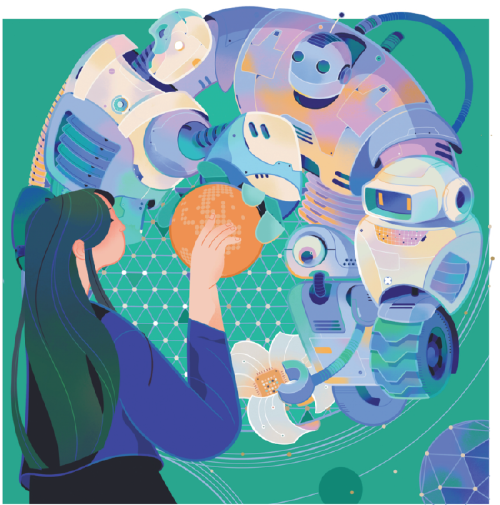
The artificial intelligence leader OpenAI has unveiled a new AI model named Sora, which it asserts can generate "realistic" and "imaginative" 60-second videos based on brief text prompts.
Artificial intelligence is rapidly permeating every industry. In 2023, within two months of its launch, ChatGPT, a tool developed by OpenAI, ignited global competition in the AI sector. While the risks associated with AI have heightened regulatory concerns, it's evident the world is on the doorstep of a new era of AI development.
Beyond the core areas of chips and data, innovation in applications, especially in creating unique scenarios, is crucial. These will determine whether AI technology can truly transform into tangible economic value and complete the commercialization loop. In response to the challenge posed by ChatGPT, major global players and start-ups alike are rolling out new products. Google has introduced Bard, a chatbot, and integrated AI-enhanced features into its products, and Microsoft has launched Bing chatbot and introduced AI-driven collaborative tools in its products.
Compared with traditional AI, Generative AI has four major advantages: automation, personalization, creativity and interpretability. No wonder GenAI has become a driving force of the new wave of innovations.
From media to finance, healthcare to transportation, GenAI, as a representative of universal AI technology, is making inroads primarily into the "soft" aspects of the service and manufacturing sectors. The sectors with the highest potential value include retail, consumer goods, finance, pharmaceuticals and medical products.
On the other hand, AI-generated content (AIGC) and learning from data elements are enabling machines to autonomously generate entirely new texts, images, videos and other multimedia contents. Concentrated in creative sectors such as advertising, marketing, game creation and art design, AIGC is reshaping their future. As for customer services, multi-turn human-machine dialogues are enhancing user experience while saving the cost of manual customer service.
In medical technology, AIGC, based on real case data, can address the data scarcity problem, providing data generation services, among other things, for developing medicines, providing precision medicines, and facilitating magnetic resonance imaging. In chip development, AIGC-produced 3D models can help optimize the positioning of chip components, significantly shortening product development cycles to just a few hours.
AI applications in industries such as finance and education are in the early stages of small-scale pilots. AI can monitor, process and analyze large volumes of financial data, assisting financial institutions in making more accurate data forecasts and decisions. It can identify potential fraudulent activities, strengthening the security and reliability of financial transactions. Quite a few Chinese commercial banks are already using GenAI technology, advancing the practical application of large-scale models and AI technologies such as computing clusters.
As industrial-grade large-scale AI models gradually emerge, AI will become increasingly embedded in various stages of industrial production. General AI is being applied in design, intelligent manufacturing, quality management and autonomous driving. For instance, the integration of AI with electronic design automation is becoming a mainstream trend in chip design. AI large models enhance industrial robots' understanding of natural language commands, improving their information processing and perceptual execution capabilities.
Autonomous driving is a crucial part of the overall development of the auto industry, which has already been commercialized in California. General AI is also a key driver of humanoid robot development. At present, commercial services offer the fastest-growing market for humanoid robots. As for China, the domestic market has the highest potential for humanoid robots.
But embodied AI technology faces challenges such as high R&D costs and the absence of regulatory frameworks, which can make it difficult to achieve commercial viability.
But AI has created risks, too, including the risk of inappropriate use, which can raise user-privacy concerns, potential moral and ethical risks, and the resulting risk of stringent regulations.
Countries across the world are paying close attention to the impact of AI-induced productivity on the workforce. Various international organizations' assessments suggest professions such as office and administrative support, legal and financial positions are generally vulnerable to the impact of AI. And the OECD has warned that 27 percent of professions face the highest risk of being automated.
In the global AI competition, both China and the United States prioritize AI, investing significant amounts of resources in the sector. The US holds a leading position in cutting-edge chip design, new algorithms and underlying technologies. It also has an advantage in the number of AI unicorn companies and top talents. But China's vast population, robust data collection capability, and continuous innovation of apps are propelling the development of the country's AI industry.
To be sure, for both China and the US, the path to AI development is challenging and requires substantial effort. If the two countries collaborate and complement each other in terms of resources, they can leverage their relative strengths to get mutual benefits, promote technological progress, and ensure the safe, trustworthy and reliable application of AI.
The author is director of and a researcher with the Institute of Innovation and Development, Chinese Academy of Science and Technology for Development.
The views don't necessarily reflect those of China Daily.





