


Yes, that's it, it's always tea time
A US law school dean has made tea a religion of the art of life as he connects with China's rich tea tradition and spreads its knowledge far and wide







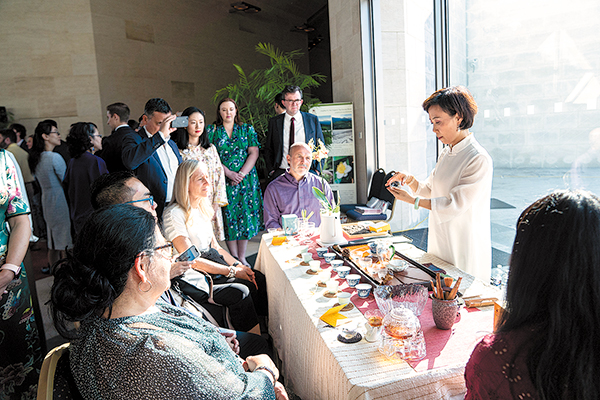
A tea master performs Chinese tea ceremony at the Tea for Harmony Yaji Cultural Salon event at the Chinese embassy in Washington on May 21.[Photo/Xinhua]
Hiking around tea plantations that rise and fall on gentle mountain slopes in China, John Smagula always used to carry his instant coffee flask. A former Wall Street lawyer and at present a law school dean who oversees international programs at Temple University in Philadelphia, Smagula has taught at many universities in China that had educational partnerships with Temple University. To say he was earlier addicted to coffee would not be absolutely wrong.
But something happened one day that prompted him to change his faith — and switch from the dark, strong, aromatic brew of coffee to the fine, delicately balanced, nuanced, refreshing fragrance of brewed tea.
"One day I was just traveling in China — I like hiking and being in the mountains — and I said (to myself):'That's wrong. Why am I drinking (instant) coffee when I have the best tea in the world here?'" Smagula recalled the moment he first became interested in tea. It was a turning point. A point that motivated him to taste and test Chinese tea, and more deeply explore Chinese tea culture.
Having studied Chinese for more than 30 years, Smagula has also spent over a decade living in China and immersing himself in Chinese culture. He still returns to China every year, driven by the dual purpose of keeping the law school educational exchange program between China and the United States running, and exploring the different origins of unique, small batches of Chinese tea, each notable for its distinctive palette and aroma.
"I learned when I started drinking tea that there's more to tea than just the beverage. When I would go to a tea store, I would hear the stories behind each (type of) tea. It's interesting, it's accessible, and it also provides that cultural background," he said.
Smagula recalled connecting different types of tea with different impressions of the brew using his imagination. "It's a way of connecting with distant places in a meaningful way, and the people who were there. I remember those experiences and they give me a greater appreciation for the tea."
He said he likes the distinct flavors and aromas of different types of tea. That prompted him to dive into the history of each type of tea, its taste profile and the nuances of brewing and infusion. Thanks to his in-depth knowledge about and passion for tea, he became a certified tea specialist in the US and China in 2010 and 2012, respectively.
Tea is one of the world's oldest beverages, and it has been the favorable drink of the Chinese people for thousands of years. According to legend, Shen Nong, a mythical ruler known as the "Father of Agriculture" in China, serendipitously discovered tea, when leaves from a wild tea plant drifted into a pot of boiling water in his garden.
Initially, tea leaves were primarily used as herbs for medicinal purposes. The popularity and increasing consumption of tea during the Han Dynasty (206 BC-220) led to the development of tea culture in China. During the Tang (618-907) and Song (960-1279) dynasties, tea became integral to Chinese culture, leading to increasing consumption, sprouting of teashops and inclusion of tea in poetry and art.
Scholars penned down detailed works (or manuals) on tea, such as The Classic of Tea by Lu Yu, written between 760 and 780. This treatise on tea provides comprehensive information on tea cultivation, preparation and the tea-drinking tradition, including classification of tea and the ideal water and its temperature for brewing different types of tea.
Derived from the same Camellia sinensis plant, different types of tea are produced depending on the processing method, from oxidization, wilting, bruising and crushing to fermentation. This results in a diverse variety of teas. Roughly, there are six types of tea: white, yellow, green, oolong, black and post-fermented (or dark), each with its unique aroma and flavor, appealing to different palettes.
Tea from China was first introduced to the Western world by Portuguese priests and merchants in the early 16th century. Over time, it became popular in other European countries. By the 17th century, it had become so popular among Britons that Britain was doing regular trade with China to meet the growing demand for tea, Eventually, tea became popular worldwide.
The global consumption of Chinese tea has been rising by the year. In 2022, the world consumed about 6.9 billion kilograms of tea, and nearly one-third of that came from China, according to the market data provider Statista.
The appeal of Chinese tea extends beyond its taste. The entire brewing process, coupled with the cultural significance, stories and connotations associated with tea, captivates both Chinese and foreign tea lovers, enhancing their appreciation for this unique beverage and converting more people to the faith of Camellia sinensis.
"One thing about tea is that it's very equalizing everywhere I've gone in China," Smagula said. "Where (ever)I've drank tea, I've been with different kinds of people … and I think that's historical in China, where we just have our tea, and whoever is sitting around the table, it doesn't matter where they're from, what their backgrounds are and what their economic circumstances are. Everybody is the same when we drink tea. And there's something very disarming about tea."
Blending the rich aromas of different types of tea in his teapot, he has infused those fragrant odors into the educational circles across China and the US.During his visits to the tea plantations in Dayan township of Hubei province, Smagula established a strong bond with the local people, particularly with children eager to learn English.
While teaching English to the kids in the tea plantations, Smagula loved combining the lessons with real-world experiences. He introduced children to basic tea-related terms. He was more than a teacher; he was a mentor, advising the children and their parents how to go about life.
Smagula said whenever he drinks tea from Dayan, it reminds him of the time he spent in the township. But more than anything else, he is reminded of the smile on the children's faces. "It's a reminder of the special relationship that I built with the people (there)," he said.
While at Temple University, Smagula established a tea club that attracted students from different departments, bringing together a diverse mix of youths and prompting them to interact in ways they might not have typically interacted otherwise. "That, I think, is also part of what tea culture is (about)," he said, emphasizing the club's role in promoting inclusivity.
"One of the beauties about tea is that there is no right or wrong answers in many cases. If a student doesn't like the West Lake Long Jing (a highly valued and appreciated green tea), maybe a different kind of tea will suit that student. And so it's not right or wrong, good or bad," he said.
"Students are free to judge each type of tea in a very relaxed and comfortable environment. There's something about tea that unifies people, that brings people together, and it disarms us in such a way that we feel like we can speak about anything we want (to) in a friendly and cordial setting."
Expanding his reach beyond students, Smagula manages his own social media platform, @laosaoshuo, to share his passion for tea culture. Leveraging his professional knowledge and expertise in foreign languages, he engages a broader audience, offering insights into Chinese culture from an international perspective.
"It creates a conversation, not about a country, not about a specific thing, but we're talking about tea, and how, what tea means to you. There's something about that environment where we have that exchange of ideas that will then allow us to supersede or transcend our national boundaries, so we can get to know each other as people and friends first, and then that, I think, will create a dialogue. It has been a great way of bringing down walls and barriers that may have existed," Smagula said.