From leaflets to lifelines







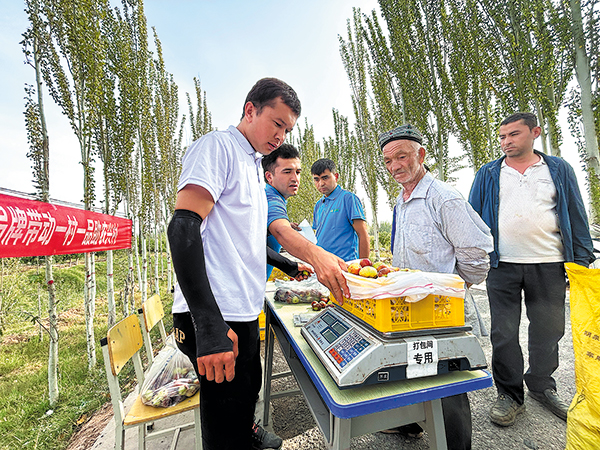
Employees of Kashgar Jiangguoguo Agricultural Technology Co purchase dates from farmers at a village in Kashgar, Xinjiang Uygur autonomous region, in September.[Photo provided to China Daily]
When Chen Wenjun first came to Kashgar prefecture, Xinjiang Uygur autonomous region, in early 2015, he had no intention of staying and starting his own business.
At that time, he and his colleagues were promoting the Guangzhou New City, a commercial complex in Kashgar's Shufu county. They traveled around southern Xinjiang and felt the warmth and kindness of locals.
Every time they went to the countryside to distribute leaflets, the villagers welcomed them with watermelons and cantaloupes. During meal time, the farmers would insist on inviting them to eat. When they got lost and unable to communicate due to language barriers, people would ride electric bikes to take them to their destination, even a dozen kilometers away, according to Chen.
"What touched me the most was one midnight, our car broke down in the Gobi Desert, more than 100 kilometers from our destination Yarkant county. When we felt desperate in the darkness, a small car stopped, and two Uygur friends got out. They helped tow the car for more than six hours. By the time the car reached the repair shop, it was already getting light," Chen said.
"However, when we wanted to thank the two men, they firmly refused and said something that deeply shook my hearts: 'Friend, I believe that when we encounter difficulties, you will help us too.'"
At that moment, they decided to stay and do something meaningful and helpful for the local people.
After a six-month investigation, they found that the quality and taste of the fruits in southern Xinjiang were exquisite and available in every household year-round. Yet, there was no good market for them, which was one of the reasons for the local people's poverty at the time.
In November 2015, they founded Kashgar Jiangguoguo Agricultural Technology Co in Shufu county to purchase fruit from farmers, teach them planting skills, upgrade their gardens, hire them and make them stakeholders.
Now a leading agricultural company in Xinjiang, it has four branches and sells fresh fruit, nuts, dried fruit and fruit drinks across China. That includes jujubes, grapes, pears, Badam nuts, walnuts and pistachios.
"Thanks to long sunlight hours, the big temperature difference between day and night and good soil, annual fruit production in Xinjiang reached more than 16 million metric tons, which involves the interest of 10 million farmers," said Chen, chairman of the company.
"However, in the past, when I visited the farmers' homes, I saw their red dates and walnuts piled up in the corner because they couldn't be sold due to long distance from customers and poor cultivation methods affecting fruit quality. They could only be used as animal feed."
Jiangguoguo signed an agreement with 76 local cooperatives, which will collect fruits the company wants and get paid. The money will then be given to farmers who provide the fruit.
"In this way, farmers will not worry about whether their products can be sold," Chen added.
As of the end of last year, the company has purchased 105,000 tons of agricultural products from Xinjiang farmers, providing 3,500 jobs to locals in tandem with the cooperatives. They work in logistics, packaging, selection, marketing and other posts.
Dilbar Hani, a sales manager of the company, earns about 350,000 yuan ($48,000) per year, with a maximum monthly salary of 47,000 yuan. She joined the company in August 2019 and became a team leader the following March.
She said she is satisfied working there. "I sent my child to a good school. I took my parents to travel and bought them gold," she said.
About 90 percent of the company's 405 employees are from Uygur, Tajik, Hui or Kazak ethnic groups.
Abderiyim Kmil, from the storage and logistics department, used to do farm work at home after graduating from high school. His annual income was between 10,000 and 20,000 yuan.
One year after he joined the company in 2019, he became a shareholder because of good performance. Now, he leads a team of 18 people and earns between 4,000 to 8,000 yuan per month. His family moved out of their village. "I bought a car and house in Kashgar. My daughter studies there. Our life is better now."
On Nov 8, 53 families in Oksak, a town in Shufu county, split 60,000 yuan as dividends from Jiangguoguo. Ablat Oxur, who received 1,000 yuan that day, said he is grateful for the excellent policy, Shufu county media center reported.
In 2019, China Telecom, one of the country's three major telecommunications operators, donated 2 million yuan to Ruinong Cooperative, which then bought agricultural product processing equipment for Jiangguoguo, making the cooperative a company shareholder, the center reported.
Every year, the cooperative receives 200,000 yuan as a dividend and sends it to farmers, especially those with economic difficulty, according to the report.
Additionally, the company has organized about 800 training sessions for roughly 50,000 farmers. It upgraded 300 hectares of fruit farms. The families of 146 farmers became shareholders, receiving a total dividend of 1.4 million yuan.
The company's sales grew from 105 million yuan in 2020 to 350 million yuan last year through online and offline channels.
After the China (Xinjiang) Pilot Free Trade Zone was established in November last year, Chen also saw more opportunities from overseas. "With the construction of the zone, export of products to Europe through Central Asia will become more convenient," Chen said, adding that he is confident about its future development.
As part of the program for Guangdong province to aid the development of Xinjiang, the company also enjoys preferential policies for infrastructure construction, decoration and transport. About 50 percent of products are sold in Guangdong, according to the company.