



New productive forces need new industrialization







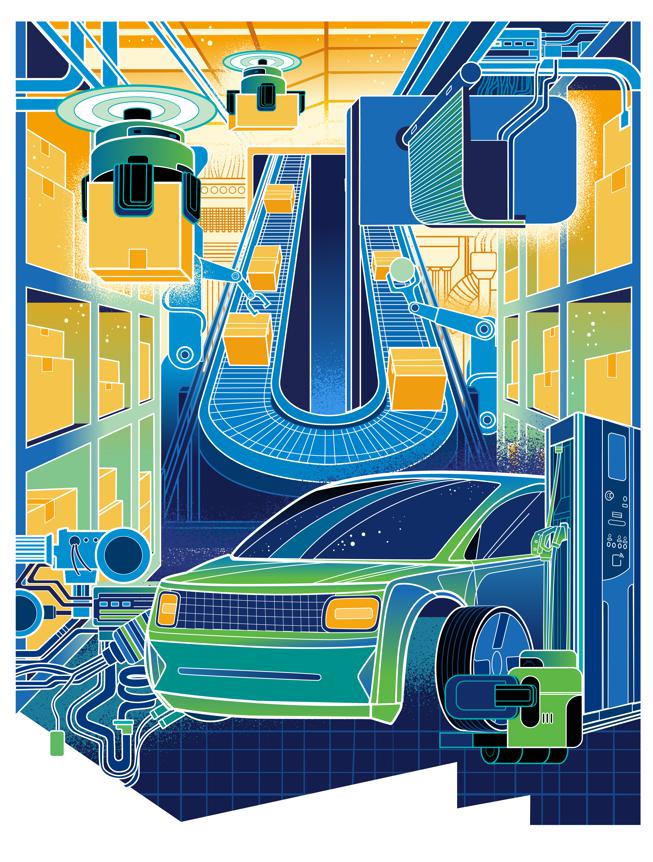
Recently, "new productive forces" has emerged as a prominent term in China, with its essence rooted in technological innovation. This concept serves as a pivotal driver for advancing high-quality economic development. The imperative for China to explore new avenues of development and facilitate high-quality development and new industrialization is pressing. To this end, China is actively integrating resources for technological innovation, leading the development of strategic emerging industries and future sectors, and expediting the establishment of new quality production capacity.
In the current global landscape, the ongoing new industrial revolution, propelled by advancements in digital technology, is disrupting traditional industries, established economic norms and long-accepted patterns of specialization. Simultaneously, countries across the world have been making greater efforts to reduce carbon dioxide emissions as a shared global goal, and easing their pursuit of fossil fuel-driven industrialization while taking measures to meet rising green demands.
Unlike some developed countries, China began its digitalization and green transformation at a relatively low development level, as it knows embracing the path of new industrialization is necessary for addressing the challenges and seizing the strategic opportunities.
New industrialization refers to industrialization of digital intelligence. The digital domain has seen a multitude of disruptive innovations, which have given rise to new industries and formats, creating novel production factors, and triggering changes in the organizational forms of production.
One manifestation of the changes in production is the substitution of labor by, among other things, automation, posing a serious challenge to labor-intensive industries and weakening the role of developing countries in the global industry chains. This has led to a reduction in China's competitiveness in labor-intensive industries and some segments of the industry chains. The essence of new industrialization lies in restructuring China's competitiveness, leveraging advanced production factors such as knowledge, technology, human capital and data to boost industrial development.
Besides, digital technology has become a crucial means to enhance technological capability and control the global value chains. To become a significant participant and a leader in the new industrial revolution, China must further integrate digital technology with manufacturing through new industrialization. For that, China has to comprehensively develop all aspects of the industry and value chains, product lifecycles, supply chains, and different segments of the business ecosystem.
Low-carbon development is what distinguishes new industrialization from traditional industrialization. And China has vowed to peak its carbon emissions before 2030 and achieve carbon neutrality before 2060.
New industrialization advances on a low-carbon path, creating new constraints and challenges as well as new opportunities. Technologies, products, services and industries capable of overcoming these new constraints will become drivers of growth in the new industrialization process, by utilizing new energy and carbon capture, and preserving the ecology.
To promote green and low-carbon development, China needs to reduce carbon emissions from industries and build a world-class green industrial system through new industrialization, thus laying the material foundation for the overall green and low-carbon transformation of the economy, and providing low-carbon technologies, products and services to achieve the "dual-carbon" goals.
China's trajectory of new industrialization neither overly emphasizes an export-driven model nor treads the path of isolationism despite rising anti-globalization sentiments in some economies. In confronting the challenges posed by a fast-changing international landscape, China's new industrialization seeks to expand opening-up, leveraging both domestic and international markets and resources. The goal is to establish a development pattern centered on a robust domestic cycle while simultaneously promoting mutual reinforcement between domestic and international cycles.
The new industrialization policy involves the further opening up of the economy. On the external front, it aims to consolidate export advantages by promoting Chinese investments, products and services worldwide. Its focus is also on strengthening international market channels, enhancing local capability, and ensuring export enterprises meet external demands. This approach will not only further strengthen the resilience and security of the industry and supply chains but also boost China's participation in international industrial division and competition.
The policy also advocates self-reliance while fostering political and policy interactions with other economies. Stressing the importance of communication in economic policies, industrial planning and regional industry chain construction, China aims to deepen regional industrial cooperation. However, its focus remains on using its vast market to attract more high-quality foreign investments.
New industrialization endeavors are expected to unleash potential demand and meet domestic consumption needs. In the world's largest potential domestic market, unleashing demand will not only bolster the resilience and security of the industry and supply chains but also ensure the benefits of industrialization reach the broader population. By making industrial production more efficient, taking measures to increase the incomes of workers, improving the social security system, and boosting domestic consumer confidence, the policy will promote the development of new materials, products and business models.
Crucially, new industrialization serves as a catalyst for autonomous innovations. As China increases its technological capability, the emphasis is shifting from imitation and catching up to originality and leadership. This transformation requires a more extensive and intensive focus on innovations at the primary levels. By prioritizing the promotion of independent innovations, the policy aims to bolster the resilience of the industry and supply chains, and safeguard national industrial security.
The policy also facilitates independent but controllable innovations in technology, clearing of the technology development "bottleneck" — which China faces despite being a major player in technological innovations — by taking into consideration the global trends in technological advancements and adjusting the direction of innovations.
While continuing to learn from developed countries, particularly in core foundational technologies, key cutting-edge technologies and "futuristic technologies", China seeks to continually improve its independent industrial technology system.
New industrialization also boosts innovation capability that leads the new industrial revolution. In the midst of the new technological revolution triggering a new industrial revolution, countries are taking measures to adapt to changes, and implement necessary reforms. Recognizing its shortcomings in basic industrial capability, particularly in critical components and core technologies, China aims to capitalize on the opportunities created by the new technological revolution. The aim is to ensure China actively participates in high-end and emerging industries, giving shape to a new international division of labor in advanced industries.
In essence, China's new industrialization is a dynamic strategy that aligns with the evolving needs of the global economy. And China is positioned to not only continue playing a key role in the global economic landscape but also address the complex challenges through collaboration with other countries and promoting innovations. By continuing on this path, China strives to create a more integrated, sustainable and mutually beneficial global economic environment.
Shi Dan is director of the Institute of Industrial Economics of the Chinese Academy of Social Sciences; and Deng Zhou is an associate research fellow at the same institute. The views don't necessarily reflect those of China Daily.
If you have a specific expertise, or would like to share your thought about our stories, then send us your writings at opinion@chinadaily.com.cn, and comment@chinadaily.com.cn.





