Nation's efforts to ensure food security praised
No 1 Central Document says this year's focus will be on improving productivity







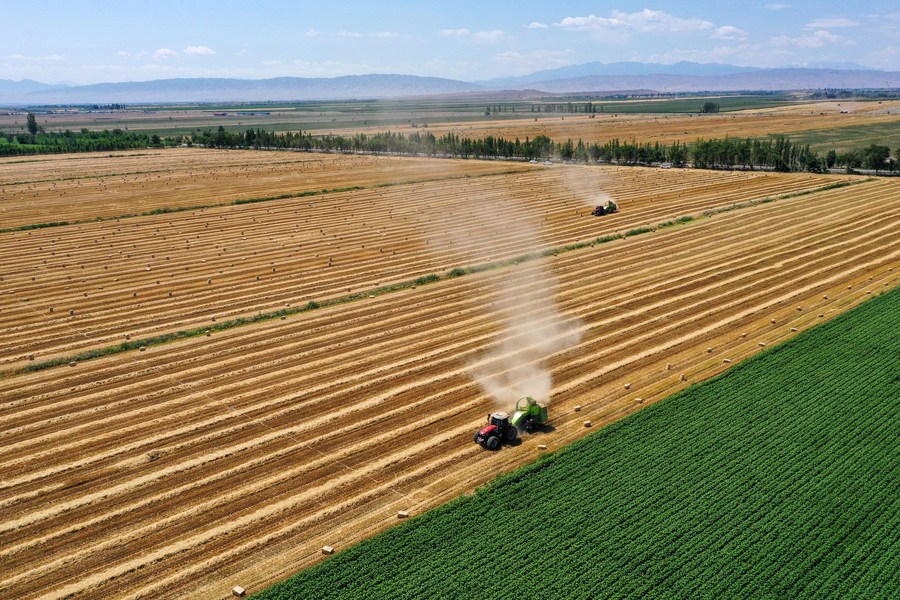
China's increased grain output and stable food prices in recent years, a result of the country's policy arrangements and decadelong preparations, stand out brightly against the bleak scenario of rising hunger and malnutrition worldwide, experts said.
"China must have done something very right," said Kevin Chen, a senior research fellow at the International Food Policy Research Institute, based in Washington, DC, the United States, when asked to comment on recent Chinese data showing a bumper harvest despite adverse factors.
He said that the country's adoption of technologies and flexible use of policy tools have incentivized food production and helped to build a food supply system that is resilient to the turmoil unfolding in the global food supply system.
China's overall grain output was a record 695 million metric tons last year, a year-on-year increase of about 1 percent, despite heavy rains, floods and droughts in some regions across the country, according to the Ministry of Agriculture and Rural Affairs.
To ensure absolute security, food supply was listed as one of the two redline requirements for rural-related work by the central authorities in the annual No 1 Central Document, which was released on Saturday.
The document is the first policy statement released each year by the Communist Party of China Central Committee and the State Council.
An indicator of government priorities, the document said that this year's focus will be on improving farmland productivity while keeping the growing area stable.
Chen Bangxun, head of the ministry's development and planning division, said at a news conference last month that the country's per capita grain stockpiles stood at more than 490 kilograms, far exceeding the international food security benchmark of 400 kg.
The country's food inventory-to-consumption ratio was also far higher than the safety level of 17 to 18 percent set by the United Nations Food and Agriculture Organization, he said.
However, a range of global factors, including extreme weather events, increasing protectionism, regional conflicts and a drought-induced export ban by India, pushed rice prices to a 15-year high.
In contrast, China's food prices remained stable in 2023, with the domestic rice procurement price in September just 0.7 percent higher than in January.
Johan Swinnen, director-general of the International Food Policy Research Institute, said the world had witnessed an undoing of improvements in food supply since 2015.
"If you look at, for example, the period from 1985 to 2015, there have been very significant improvements in the world in terms of hunger and malnutrition. And so, food security improved, and poverty went down," he said.
Then, around 2015, "everything stopped and now it's going the other way around". "That is really very, very worrying," he said.
Swinnen said that climate change was part of the reason. But regional conflicts played a disproportionate role in fueling homelessness and hunger.
"Before 2015, for almost 20 years, there were about 40 million people in the world who had to leave their homes. That's a lot of people. But that has gone up within seven years or so to 100 million," Swinnen said.
He praised China's recent efforts to wean itself off reliance on food imports by boosting domestic production, and said that an international food price hike around 2008 had served as a wake-up call for countries that used to be comfortable being dependent on food produced overseas.
"The price hike triggered a lot of concern in many countries," he said. "In China, it really woke up the government. There is no guarantee that we're going to have food at low prices all the time."
Officials said last month that China's grain imports rose 11.7 percent year-on-year in 2023.
According to the General Administration of Customs, soybeans accounted for more than 60 percent of grain imports last year, and officials said that a major factor was animal feed producers' high demand for soybean meal, a byproduct of soybean oil extraction.
Agricultural authorities said they are working to revamp animal feed formulas to use the protein-rich raw material more efficiently.
China has long relied on imported soybeans in order to create more growing areas for wheat and rice and to ensure the absolute security of staple food provisions.
More recently, the central authorities have worked to bolster domestic soybean supply to shield the country, which is the world's largest food importer by volume, from external factors ranging from trade protectionism to logistics woes caused by regional conflicts.
Deng Xiaogang, vice-minister of agriculture and rural affairs, said recently that the planting area for soybeans reached 10.4 million hectares last year, with a record yield of 20.84 million tons.
Kevin Chen from the International Food Policy Research Institute said that China's strategy of increased dependence on soybean imports to make way for staple food production had worked quite well in recent decades, and the adoption of a technology-driven approach to bolster self-sufficiency in recent years will provide a boon not only for the country but also for the entire world.
"China is so big. If we want to have global food security, we want to make sure China's food is secure," he said.



- Taiwan's DPP authorities slammed for hyping up security risks of mainland apps
- Peaceful reunification to bring opportunities to Taiwan: mainland spokesperson
- Global experts gather in Macao for talks in space, planetary sciences
- First national standard for disease classification and coding in Tibetan medicine released
- China records 697 million border crossings nationwide in 2025
- Think tank forum between KMT and CPC to be held on Feb 3: spokeswoman