


Music and mystery herald legacy of ancient caves







HONG KONG — As the orchestra filled the air with enchanting melodies that seemed to echo from centuries past, the vibrant fusion of cosmopolitan Hong Kong and the Gobi Desert oasis of Dunhuang in remote Northwest China breathed life into ancient murals, creating a mesmerizing spectacle.
At the recent opening of the Hong Kong Palace Performing Showtime Carnival, young musicians played ancient instruments, while giant murals from the Mogao Grottoes flickered on the big screen.
The performance was a testament to the enduring power of art and culture to connect the present with the past, and create a sense of wonder and awe.
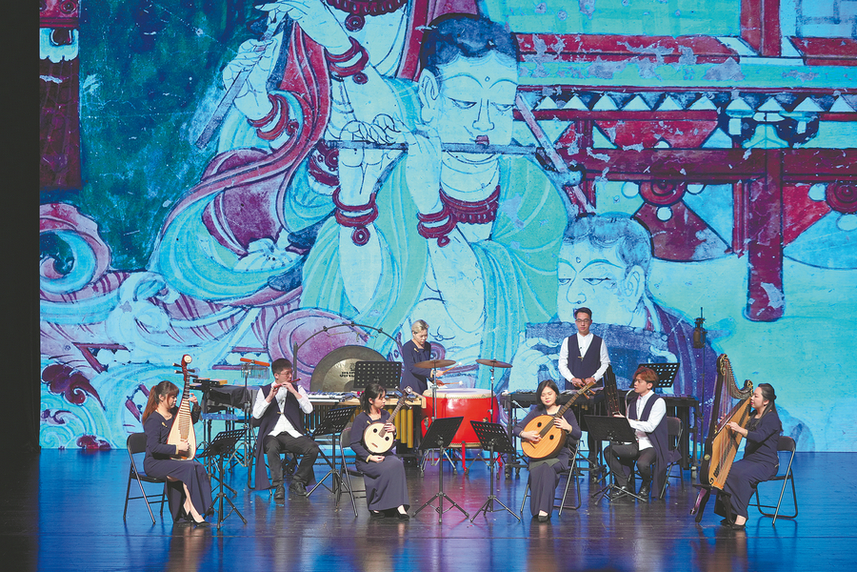
Driven by its commitment to reviving and preserving Dunhuang's rich cultural legacy, the Hong Kong Gaudeamus Dunhuang Ensemble is infusing the ancient melodies in the mural with renewed vitality.
Leonie Ki, the ensemble's honorary director and founder, fell in love with Dunhuang during her first visit in 2010, and she has been there 15 times since.
Located in Dunhuang in Gansu province, the Mogao Caves is a UNESCO World Heritage Site and home to a vast collection of Buddhist artworks. More than 2,000 pigmented sculptures and 45,000 square meters of murals are housed in 735 caves, carved into the cliffs by ancient worshippers.
In October 2017, Ki took a group of aspiring young musicians on a visit to the grottoes, many of whom were seeing them for the first time.
It was Ki's first time in Cave 112, which is dimly lit and can only be entered by four people at the same time. They had to be extremely careful not to touch or damage its murals, which feature the famous image of a figure playing a pipa (a four-stringed Chinese lute) behind its back.
In this depiction, an entertainer joyfully dances amid an orchestra, gracefully maneuvering a pipa behind her back, all while standing barefoot on a carpet.
Tears welled up in the eyes of several young women as they sat at the dinner table later. When asked the cause of their sudden outpouring of emotion, they revealed that the murals had left them astonished and deeply moved. It was at that moment that Ki, inspired by the profound experience, resolved to establish an orchestra.
She is entranced by Dunhuang's rich cultural heritage, and by the unwavering commitment of those who came before her, such as renowned painter Chang Shuhong and archaeologist Fan Jinshi. These stalwart guardians dedicated their lives to upholding the "Mogao Spirit", the epitome of perseverance amid the unforgiving desert terrain.
In May 2018, the Hong Kong Gaudeamus Dunhuang Ensemble was born. Just four months later, they took the stage as representatives of Hong Kong at the 3rd Silk Road (Dunhuang) International Cultural Expo, delivering a mesmerizing performance at the Dunhuang Grand Theater.
Their journey reached new heights when an invitation arrived from Wang Xudong, the former director of the Dunhuang Academy. The ensemble was bestowed the honor of performing in front of the grottoes' iconic nine-story building, the only ensemble from Hong Kong to receive such recognition.
Despite Dunhuang's chilly September air, the musicians, clad in lightweight performance attire, took to the open-air stage.
Ki understood the significance of the moment as a testament to the support bestowed upon the ensemble, and took it as a source of inspiration.
Echoing the many depictions of orchestras in the grottoes, the ensemble was composed of eight musicians and two composers. They meticulously replicated the wind and percussion instruments that feature in the murals, including an evocative, curved-neck lute and a resonant mouth organ, but as they gathered to perform, a question lingered: how should Dunhuang music sound when it has never been heard by contemporary ears?
In the early 20th century, a treasure trove of ancient documents, including 25 musical scores from the Tang Dynasty (618-907), were unearthed from the depths of the caves. However, the absence of comprehensive musical notation meant that the essence of the compositions remained elusive.
Kam Shing-hei, the ensemble's artistic coordinator and composer-in-residence, undertook an artistic pilgrimage to Dunhuang during his sophomore year at the Hong Kong Academy for Performing Arts.
"At that point, the stories in the murals eluded my comprehension, but their visual allure emanated a profound musical essence. The compositions, with their hues and strokes, provided me a cornucopia of melodic inspiration," he says.
Gradually, Kam came to realize that any interpretation would require not only an understanding of music theory and performance, but also a profound understanding of the cultural nuances underpinning a composition.
"At first, I relied on my knowledge of music theory and familiarity with Western music to create traditional Chinese compositions. The melodies resonated pleasingly, and the musicians appreciated them, but they encountered difficulties in execution."
For instance, Western music often adheres to a more concrete structure in composition, while traditional Chinese music accentuates rhythm, allowing ample space for musicians and instruments to express themselves freely.
Kam has begun inviting more composers to write an array of pieces. The ensemble continues to innovate, collaborating with multimedia elements on stage, and presenting interactive art installations in public spaces, engaging with a wider audience.
"In Dunhuang culture, I discovered my true identity and the stories I am able to tell through these instruments," Kam reflects. "I am grateful to have grown alongside the ensemble."
Xinhua