


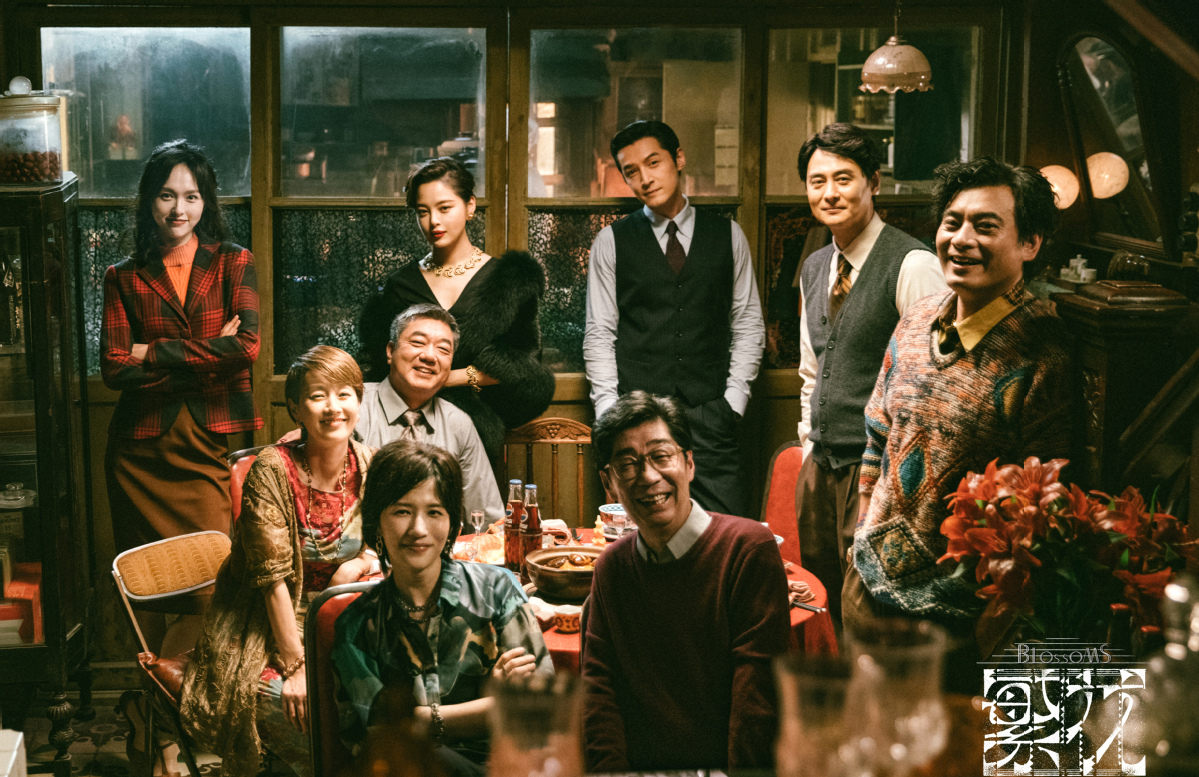
A long-awaited television series, which was released in both Mandarin and the Shanghai dialect in late December, has sparked discussions among residents, online viewers and experts over the preservation and inheritance of the declining Shanghai dialect.
Adapted from writer Jin Yucheng's award-winning novel, Fan Hua (Blossoms), the TV series Blossoms Shanghai takes audiences back to Shanghai in the 1990s, when everybody looked forward to opportunities in the new century.
The plot follows the rise of the protagonist A Bao, played by actor Hu Ge, an ambitious young man who seizes the opportunities of the early stock market to become a millionaire.
However, it is the Shanghai dialect version that has many online viewers riveted to the series, produced by legendary Hong Kong director Wong Kar-wai, who was born in Shanghai.
Some viewers are sharing short videos from the series to help others learn the Shanghai dialect, which has been greatly replaced with Mandarin in schools and workplaces.
Chen Zhongmin, a professor from the department of Chinese language and literature at Fudan University, said that most people he knows are interested in the dialect version of Blossoms Shanghai, regardless of whether they are from the city or elsewhere.
"They are curious to see how the dialect can convey the unique charm of the city's culture," Chen said, adding that the last time a television drama was made in the Shanghai dialect was probably back in the 1990s.
Some experts said they believe the series could make a big contribution to the inheritance of the Shanghai dialect, as there is general consensus among Shanghai residents that the dialect needs to be protected.
Ding Dimeng, an expert in Shanghai dialect studies at Shanghai University, noted that the dialect will become endangered if the government and society do not pay due attention to its preservation.
Many children in Shanghai do not fluently speak the dialect anymore, and for their convenience, their parents don't speak with them in the dialect either, she said.
Some residents echoed Ding's observations.
Sun Huijuan, 65, said her grandson spoke the Shanghai dialect fairly well before he joined school, and could still speak the dialect during his kindergarten years even though it was not taught in class.
"However, after he joined primary school, he lost confidence in his pronunciation. He started replying in Mandarin when we asked him something in the dialect at home," she said.
The Shanghai dialect has gained popularity among foreigners living in the city. Many like Belgian musician Tobias Gao Yue share their language skills on social media. Tobias, who has decent grasp of the Shanghai dialect, has won thousands of followers, indicating that more people are interested in learning the dialect.
Barnaby Nadler, who is from the United States and has lived in Shanghai for more than a decade, said he took special classes in the Shanghai dialect after he moved to the city, because he thought some expressions were "very interesting" and could help him "better integrate" into the local community. However, one hardly hears people talk in the dialect in public spaces these days, he added.
Latest figures from the Shanghai Statistics Bureau show that the municipality was home to nearly 24.76 million permanent residents in 2022, and more than 10 million of them came from other parts of the country.
Municipal authorities have made some efforts in recent years to preserve the local dialect. Some bus routes and a new subway line have added broadcast in the Shanghai dialect, while children's rhymes in the dialect are still part of the syllabus at most local kindergartens.
zhouwenting@chinadaily.com.cn








