Tech eye makes biodiversity tracking easier







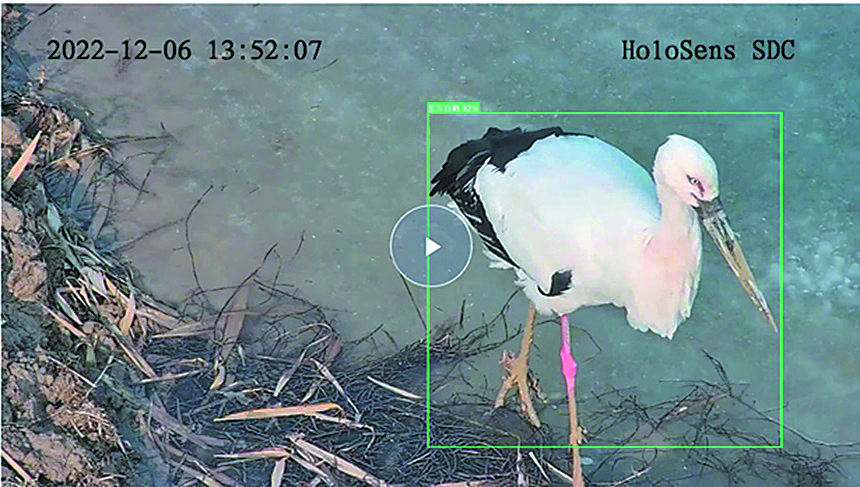
Currently, the platform can recognize species in motion and in flight, as well as perform group identification for bird species.
The identification accuracy for flagship species (species whose conservation is assumed to correlate positively with the protection of other unrelated species or communities) and large bird species has surpassed 90 percent.
With more materials brought onto the platform, the accuracy of AI identification is expected to improve, according to Huawei's Tech4All team.
In September, Huawei extended its collaboration with the Yellow River Delta national nature reserve, reaffirming its commitment to safeguarding biodiversity through state-of-the-art technologies.
These will help broaden camera capture zones and optimize the functionality of the monitoring platform to better support relevant research activities.
"We carry out intelligent monitoring of migratory birds by deploying cameras in conservation areas and leveraging 5G network and AI analysis on the backend. As a tech company, we aim to advance the digitalization and intelligence process of biodiversity conservation through such solutions," said Zhou Jianguo, head of the brand division at Huawei's China strategy and marketing department.
Collaborative efforts from the government, research institutes and tech companies are important in driving the standardization and development of digital biodiversity monitoring platforms, Zhou said.
The Chinese tech company has participated in various biodiversity conservation projects around the world, including in Europe, South America and Southeast Asia. It has also introduced a slew of initiatives, such as the protection of rainforests in tropical regions and the preservation of rare species in Northern Europe, Zhou added.
"With intensified global efforts, we are gaining a deeper understanding of our role in building an ecological civilization," he said. "At the forefront of global digital advancements, China has a distinct edge in this process, particularly in the construction and innovation of digital infrastructure."
As the government has set high goals for the comprehensive advancement of a green and intelligent ecological civilization during the 14th Five-Year Plan (2021-25) period, the country aims to establish an intelligent and efficient digital governance system for the ecology.
Meanwhile, the effect of China's technological efforts on sea creatures' living environment is also becoming obvious.
With the support of digital twin technology, Chinese scientists are offering innovative solutions for marine biodiversity conservation in Latin American countries.
At an exhibition hall inside the China (Hainan) Museum of the South China Sea in Qionghai, Hainan province, a large screen displays a digitalized underwater world of the Caribbean Sea.
Through the digital twin system showcasing marine biodiversity on the screen, visitors can witness the continuous growth of diverse sea creatures.
Carried out by a scientific cooperation platform jointly led by China's Beihang University and Colombia's Santiago de Cali University, the digital twin technology simulates marine ecosystems, contributing to research on the protection of marine ecological environments in Latin American countries.
"If we build a digital-twin fish model corresponding to a real fish species in the Caribbean Sea and provide real environmental data for the digital creature, we can easily acquire the species' simulated growth performance results just like that from nature," Luo Xun, Chinese director of the cooperation platform, said in a previous interview.
Both tropical oceans, the South China Sea and the Caribbean Sea share similar latitudes and marine conditions and host a diverse array of sea species.
With the aim of collaborative innovation under the Belt and Road Initiative, the cooperation platform has partnered with various research institutions from the two sides to undertake marine biodiversity conservation research.
So far, the Chinese and Colombian researchers have collaborated to create digital models for over 100 species of fish, coral, and mangroves in the Caribbean Sea region, significantly improving the efficiency of marine ecological conservation and restoration efforts.
Meanwhile, the National Forestry and Grassland Administration and Chinese tech heavyweight Tencent signed a strategic cooperation agreement in May, aiming to develop the world's first photo-realistic digital panda model through cutting-edge digital technologies.
With Tencent's photo-realistic 3D model restoration and real-time cloud rendering tools, the digital panda has achieved millimeter-level precision in replicating an authentic panda's skeleton, muscles, skin, fur and other details, presenting a remarkably lifelike representation for education and research.
"All parties should pay more attention to solutions based on the protection of ecological species, promote technological innovation in the field of natural conservation, and establish effective and smart natural conservation plans with Chinese characteristics," said Yang Chao, chairman of the China Green Carbon Foundation.
lijiaying@chinadaily.com.cn