Forest farm worker leaves behind proud legacy







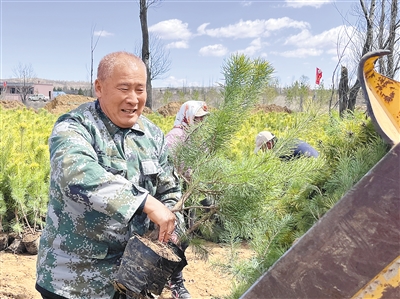
Jia Dorj, a 63-year-old retiree, often returns to Ejin Horoo Banner forest farm in Ordos, Inner Mongolia autonomous region, where he worked for over four decades.
He started working at the Khoroo branch of the State-owned farm in 1980, when he was 19. By Jia's rough reckoning, he planted over one million tree seedlings and walked nearly 100,000 kilometers around the farm.
Ejin Horoo Banner is located at the northeast end of the Mu Us Desert where large-scale afforestation was carried out in the late 1970s.
"Through the tireless efforts of generations, what used to be a flowing sand dune has been transformed into this lush forest farm," said Jia.
"In the beginning, we mainly planted Salix. Since the farm had no large machinery at that time, we could only rely on manpower," Jia recalled.
During planting season, Jia and his fellow workers went out before dawn, each carrying over 50 kilograms of tree seedlings, and walked for about an hour to reach the planting area. They then dug with a shovel until they saw wet soil — usually about 70 centimeters deep — inserted a seedling in the hole, back filled it with soil and trampled it down.
They repeated this procedure until the sunset, only taking a break for lunch to eat corn cakes that they carried with them.
"I told myself to keep planting. I was thinking that if we cover this area with bushes and trees, we will not suffer from sandstorms anymore," said Jia, who still remembers when the sandstorms were severe, and sand piled up higher than their houses overnight.
After finishing planting one area, Jia and his fellow workers would continue to the next one. With no fixed abode, he said he made a decision not to marry as he did not want his family to share his hard life.
However, he finally met his wife who was willing to stay with him despite their transient existence.
Their two daughters were both born and grew up at the forest farm. Later, when they moved to live in an urban area, Jia took his family back from time to time, telling them stories about the past, and reminding them how difficult it was to achieve the green environment.
In the early 1990s, the Khoroo branch farm's Khalaash operating area, where Jia worked, was almost fully covered with Salix psammophila and other sand-fixing plants.
With the reduction in sandstorms, the native plant Sabina vulgaris expanded rapidly.
Jia later became a forest ranger and changed from fighting sand to fighting illegal logging.
"It was very hard. The surface temperature could reach 60 C during the day but it was pitch black and cold at night," Jia recalled. "But I was determined to protect these trees no matter what happened."
At that time, there was no video surveillance or transportation at the farm. Jia walked more than 10 km every day to check every corner of his operating area.
After the forest farm built cement and asphalt roads, Jia could finish inspecting the area within an hour by riding a motorcycle.
However, he found a new problem: many of the Salix that had lived for many years had died.
After several coal mines were built and put into production at the Khalaash operating area, the groundwater level began to drop. Jia anxiously reported the situation to Li Xiaoguang, head of the Khoroo branch farm, who came up with a solution.
They began planting Mongolian scotch pine, which requires less water, has a higher survival rate and has more ecological benefits than Salix.
They also communicated with coal mining companies and asked to use the treated wastewater from the mines to irrigate the forest farm.
In recent years, the forest farm has installed cameras.
Watching the young forest rangers surveilling the forest on their computers and mobile phones gives Jia a feeling of gratification. "Forest protection is no longer hard work. It has become meticulous work," he said.






- 10 dead and 84 injured in explosion at steel plant
- China unveils flexible urban planning rules to improve lives, foster new industries
- Ex–China Construction Bank executive gets 18 years for bribery, loan violations
- First batch of eco-friendly pioneer zones for construction of beautiful countryside unveiled
- Woodpeckers, finches captured in Jilin winter scenes
- Mainland reiterates 1992 Consensus as foundation for resuming cross-Strait dialogue