Science key to digging up the past







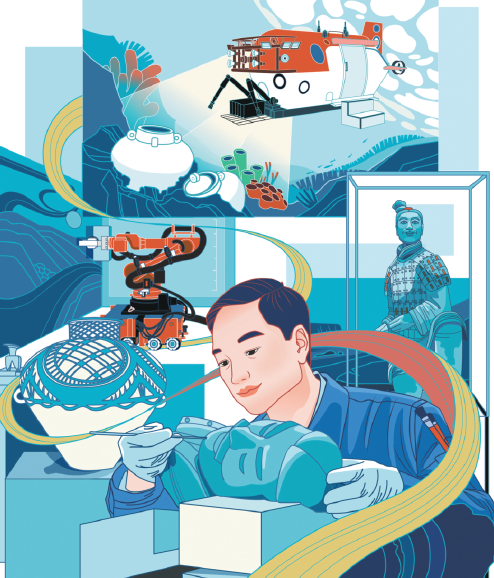
Guideline urges innovation, better training to advance archaeological research, protection
For nearly four decades, scholars from the University of Science and Technology of China in Hefei, Anhui province, have carried out interdisciplinary research at the Jiahu site — a Neolithic settlement that dates back 7,500 to 9,000 years — to unearth its multifaceted significance to the country's development.
They have used technology to study bone flutes, carbonized rice and animal bones unearthed at the site in Wuyang county, Henan province, and along the way identified its importance to the birth of music, agriculture, animal husbandry and written characters in China.
"Our studies show ancient people of the Jiahu culture were not only excellent hunters, fishermen and craftspeople, but also brilliant musicians," said the head of the university, Bao Xinhe, who is also an academician at the Chinese Academy of Sciences.
The fact that the Jiahu site studies have received so much international recognition is due to the participation of different scientific disciplines and technology-based archaeological methods, said Zhao Zhijun, a researcher at the Institute of Archaeology at the Chinese Academy of Social Sciences.
Progress in the use of technology in archaeological research was highlighted at a national conference on cultural relics and technology in November. It was held days after the Publicity Department of the Communist Party of China Central Committee, the Ministry of Culture and Tourism, the National Cultural Heritage Administration and 10 other government bodies issued a guideline stressing the important role of technology and innovation in archaeology.
"When looking back on history, technology has played a revolutionary role in the protection and inheritance of cultural heritage," Li Qun, director of the National Cultural Heritage Administration, said at the conference.
Carbon-14 dating, which can determine the organic age of material as old as 60,000 years, has opened up a new chapter in archaeometry — scientific methods and technology used in archaeological study — in China, Li said. Analysis of ancient DNA has also helped reconstruct the history of human origin and migration. Breakthroughs in deep-sea technology have allowed underwater archaeology to explore depths ranging from 50 meters to 2,000 meters, he added.
Stumbling blocks
Despite these advances, problems such as the limited capacity of cultural relics research institutions, talent shortages, uneven allocation of scientific and technological resources, and inadequate management systems and mechanisms are constraining the development of technological innovations in the field, the guideline said.
To address these issues, the guideline recommends the establishment of multiple national and regional scientific cultural relics research institutions, the setting of clear directions for research, and the formation of a well-structured talent pool by 2025.
Technological breakthroughs should be made in key areas of cultural relics protection and archaeology, resulting in systematic solutions to problems, it said.
By 2035, theories, methodologies, and technology with Chinese characteristics for scientific and technological innovation in the cultural relics field need to be developed.
The guideline highlights four areas to realize these goals: optimizing innovation plans; strengthening innovation platforms; building teams of professionals; and improving incentive mechanisms.
A major problem to be solved is lack of talent in the discipline.
Through improving the discipline and its mechanisms and expanding enrollments, the number of professionals will be enhanced. The structure of museums and cultural institutes should also be optimized to offer more positions for professionals, the guideline said.
Provinces acting
Some provinces have already been complying with some of the measures mentioned in the guideline.
For example, since 2022 Shanxi has carried out a plan to cultivate cultural relics professionals, Bai Xuebing, deputy director of the Shanxi Provincial Cultural Heritage Administration, said at the conference.
The province has more than 50,000 immovable cultural heritage sites, of which about 28,000 are ancient buildings.
It has 531 national-level key cultural relics protection units. The list of units is issued by the State Council, China's Cabinet, and Shanxi has the highest number of all Chinese provinces. However, the number of grassroots professionals protecting the relics is nowhere near enough, Bai said.
In response, the province has entrusted Shanxi University in Taiyuan to train 600 cultural relics professionals drawn from 117 counties, cities and regions from 2022 to 2027.
They will be required to learn about archaeology, museum work and ancient buildings.
Local governments pay for the tuition, accommodations, living expenses and internships for the students. After they graduate, they will be employed by county, city, regional and lower-level cultural relics protection institutions in Shanxi.
The first batch of 112 students has completed the first year of education at Shanxi University, Bai said.
Liu Gang, an official at Shanxi's cultural heritage administration, told Beijing News that each county will add five professionals on average.
"Together with the original staff, they can basically support the protection work in the local location," Liu said. "If they remain in their jobs long-term, they are expected to support cultural relics protection at the grassroots level in Shanxi for 30 years."
Fresh ideas
Scholars and officials also highlighted the guideline's push to promote the invention and production of specialized equipment that can be used in protecting and studying cultural relics.
Wang Zhen, an official at the Ministry of Industry and Information Technology, said more than 90 types of such equipment have been produced, including intelligent showcases for museum collections, archaeological excavation cabins, and mobile laboratories for archaeological sites. The intelligent showcases have been exported to more than 80 museums overseas.
"The archaeological excavation cabins used at the Sanxingdui site in Guanghan, Sichuan province, have solved the problem of newly unearthed artifacts often being damaged when their surrounding environment changes," Wang said.
A movable platform in the cabin, which is similar to a basket, can suspend archaeologists wearing protective clothes in the excavation pit for elevated operations. The moving platform can change position at any time to minimize disruptions to the artifacts and the pit caused by excavation work, said Xie Zhenbin, a researcher at the Sichuan Provincial Institute of Cultural Relics and Archaeology.
wangru1@chinadaily.com.cn




- China ramping up Nipah virus surveillance
- Shanghai to host embodied intelligence expo in July
- Chongqing sets GDP growth target of over 5% for 2026
- Xinjiang strengthens economic, cultural ties with Hong Kong, Macao
- Former senior political adviser sentenced to 12 years for bribery
- Hubei's government becomes first in China to add 'emotional value' to work report