



Green industrialization support







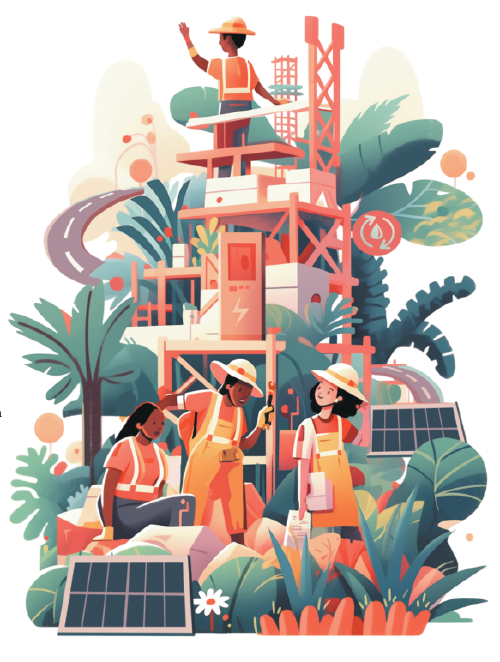
China is a vital partner for Africa as the continent seeks to accomplish the goal of economic transformation in harmony with its climate needs
Running along the land of Africa, the Congo, the Zambezi and the Nile rivers, three of the world's largest rivers, power most of the electricity-generating capacity on the continent. As of 2022, the hydropower capacity in Africa reached 38.8 gigawatts but only 7 percent of its potential has been developed. Hydro resources not only serve residents, but also provide energy and electricity for industry.
The world's largest dam has generated hydropower for millions in Zambia and Zimbabwe since the 1960s, with the Export-Import Bank of China providing the $319-million loan for its upgrading in 2013. However, a lack of rainfall along the Zambezi River has led to the water level of Lake Kariba dropping to a record low of below 1 percent of the reservoir capacity by the end of this year.
Zimbabwe relies on the dam which contributes nearly 70 percent of its electricity. Some major cities in the country are experiencing rolling blackouts that can last for up to 20 hours per day, leading to a rethinking of the value of hydropower. Meanwhile, the abnormal drought also led to a cholera outbreak across Zimbabwe due to the lack of clean water. The official figure shows nearly 6,000 cases and 123 suspected deaths by October this year.
The recent cross-issue effects related to climate change in Zimbabwe are only the epitome of the continental challenges. Africa has suffered widespread losses and damages, including biodiversity loss, higher mortality and morbidity from heat waves, and reduced food production, which are all crucial to its economic growth.
Africa is making efforts to address the challenges. For example, in early September, Kenya hosted the inaugural Africa Climate Summit and UNFCCC Africa Climate Week in Nairobi. The Nairobi Declaration states that Africa must "accomplish the vision of economic transformation in harmony with Africa's climate needs". It set out clear action goals, including increasing renewable energy capacity from 56 GW in 2022 to at least 300 GW by 2030.
To fulfill the climate agenda, African countries must think strategically and design an engagement approach to communicate, negotiate and collaborate with multiple partners, especially with China, a world-leading player in green industries and a close friend of Africa.
China has provided $25 billion in loan financing to Africa's clean energy sector since 2000. Since the Eighth Forum on China and Africa Cooperation in 2021, China-Africa cooperation on climate change has reached new heights with the launch of the China-Africa Declaration on Climate Change. The climate consultancy Development Reimagined has tracked public announcements and we found that 95 projects with contributions from China have been initiated since the FOCAC, covering renewable energy, climate-friendly infrastructure, clean technology and transportation areas, as well as capacity building.
However, the to-do list is still long for the climate cooperation between China and Africa, especially since Africa expects a more sustainable approach to building climate-resilient economies from its infancy while China is also adapting to the pains and gains from green transitions.
First, environmental goods manufacturing and trading that contributes to the energy transition and green development is crucial for Africa's green industrialization and the world's climate actions, which should be prioritized by both sides.
A recent report by Development Reimagined found that as the leading global manufacturing hub, China is the top environmental goods exporter, accounting for 17.3 percent of global volume in 2020, while African nations only accounted for 1 percent. Some African countries are now taking steps to localize the opportunities by banning raw material exporting and providing incentives for renewable energy products investments, leaving a policy window for Chinese manufacturers to expand their business in Africa. Africa possesses critical minerals such as bauxite, cobalt, lithium and more, which provide a unique opportunity to leverage Africa's strategic role in the global renewable and clean technologies manufacturing supply chain. Thus, African stakeholders should prioritize the technology transfer and job creation in the contracts on minerals development, ensuring that local communities benefit from it and it drives actual progress on industrialization and economic development.
Second, unlocking climate financing through an innovative approach remains crucial, especially for large-scale green energy and infrastructure projects. Analysis shows that National Determined Contributions (NDCs) from African countries are more robust than the global average, while finance access is far behind. To take meaningful climate actions, Africa needs $2.8 trillion, implying more than 90 percent of Africa's annual GDP, leaving significant financing gaps. Take 2020 for an example, the annual climate finance is $30 billion, accounting for 12 percent of the amount needed. During the third Belt and Road Forum for International Cooperation in October in Beijing, China launched a new Green Investment and Finance Partnership (GIFP) to promote green energy. China could consider strategically targeting a high proportion of the new funding to unleash Africa, which only accounts for about 3 percent of the world's installed renewables-based electricity generation capacity in 2021. It is also crucial to accurately calculate the performance of those projects, especially when it comes to hydropower projects.
Last but not least, the recent Belt and Road Forum also demonstrated that Chinese stakeholders are now navigating more granular interests from the host countries in the context of building more "small yet smart" projects. Though recent data shows that there was no green finance issued from Chinese development banks in 2022, Development Reimagined data tracks that Chinese private sector has been participating in green development in Africa proactively, showing some breakthroughs compared to the traditional engineering, procurement and construction models. For example, in Africa, Huawei is launching smart clean energy solutions and research labs for solar energy in cooperation with local academia. The consultancy's recent report on Chinese overseas climate investment has also revealed that Africa is not yet the major destination for Chinese foreign direct investment compared to Asia, meaning there is huge potential for Chinese private sectors to explore. More initiatives to connect different kinds of Chinese investments into the targeted African projects should be addressed to create solutions based on African contexts and further unlock the potential from bottom to up, leading to solid and innovative cooperation.
The Global Stocktake at the 28th Conference of the Parties to the United Nations Framework Convention on Climate Change emphasizes the urgency of implementing adaptation solutions and addressing loss and damage — areas where many African nations find themselves at the forefront of the climate crisis, which further emphasizes the significance of shaping a climate-resilient economy, not just for Africa but also the world as a whole.
Wu Yunong is a climate analyst with the international development consultancy Development Reimagined. Fu Yike is a climate program manager and policy analyst at the consultancy. The authors contributed this article to China Watch, a think tank powered by China Daily.
The views do not necessarily reflect those of China Daily.
Contact the editor at editor@chinawatch.cn





