Forgotten Chinese in US salmon canning industry







Like Chinese railroad workers whose backbreaking labor contributed to the development of the United States' West, Chinese workers who toiled at salmon canning factories built the canning industry of the US Northwest and Alaska. However, their role remains forgotten.
"They brought their work ethic and skill set during a time when the US depended on immigrant labor, yet they faced fierce discrimination and their story was largely ignored," said James Chiao, a retired electrical engineer in the Silicon Valley and an activist committed to raising the awareness of Chinese workers' contribution to the US salmon canning industry.
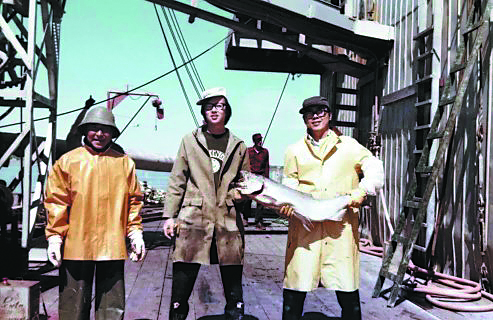
Chiao and his twin brother Philip, a retired architect in Pasadena, California, worked at Alaska canneries for a few summers during their college years in the early 1970s.
"At that time, there were no Chinese except us," James said. "So when we accidentally learned seven years ago that thousands of Chinese had worked there more than a century ago, we were shocked."
Then the brothers began researching the history of Chinese workers in the salmon canning industry. They have built a website, published a book and given talks in museums and online.
The canning industry was one of the most important in US Northwest and Alaska before World War II, and Chinese workers made up most of the workforce while enduring harsh conditions and discrimination, Philip said.
The Chinese laborers in salmon canneries far outnumbered Chinese railroad workers, and they worked for far longer periods than the latter, he said.
The brothers' experience of working in canneries makes it easy for them to relate to those laborers.
"My job was pulling salmon eggs out of the opening of the fish," James said. "The job environment was wet, damp and noisy. We wear raincoats and rain boots."
He could imagine how hard the life would be for Chinese workers more than 150 years ago, who processed four fish per minute using long, thin knives. It required great skills, otherwise it could be dangerous.
"One Chinese worker processed about 2,000 fish a day. Only those young and strong could handle such hard work," James said. "White workers disdained working in canneries because they thought it was dirty and demeaning."
Despite the grueling work, the Chinese workers were provided with substandard housing, poor food and low wages.
Beginning in the 1870s, Columbia River canneries in Oregon employed mostly Chinese laborers to clean, chop, can and cook salmon, the Oregon Historical Society said.
An 1880 census taken at the peak of salmon season showed that out of a total population of 7,055 people in Clatsop County in the state, 2,045 were Chinese. But Chinese people were excluded from fishing jobs, which were held primarily by Euro-American immigrants.
Despite their critical role in the canning industry, Chinese workers were hated and threatened by many locals, who felt that well-paying jobs were being taken away from them.
Enduring hostility
In addition, many labor unions were hostile to the Chinese. After the 1882 Chinese Exclusion Act banned the immigration of Chinese workers for 10 years, the number of Chinese workers dramatically declined. While Chinese laborers worked in canneries into the 1950s, most were replaced by Japanese, Mexican, Filipino and women workers.
"I feel regretful that I didn't know this history when I worked in the canneries; otherwise, we could have collected more valuable data," Philip said.
The Chiao brothers are now on a mission to educate people about the contribution of the Chinese to the salmon canning industry as well as the discrimination, exploitation and the unjust working conditions they endured.
"I think it's relevant to tell this story especially at a time when anti-Asian hate is rising in this country."