A rural success story







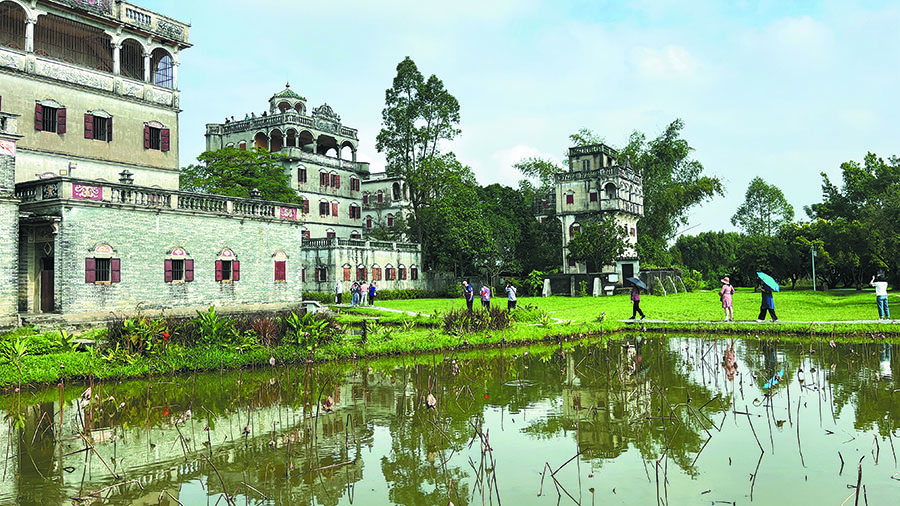
At first, Li and Qian went to the villages to see diaolou, including the one used in Chinese film director Jiang Wen's Let the Bullets Fly. In the movie, the most powerful man in the fictional city of Echeng, Huang Silang, lives in a building that is, in reality, Mingshi Building, a six-story diaolou built in 1925 by Fang Runwen, a local man who returned with money he earned in the United States.
At the end of the Qing Dynasty (1644-1911), work opportunities in places such as North America, Southeast Asia and Latin America attracted many impoverished people in Kaiping to travel across the sea to pursue their dreams in foreign lands, despite various dangers, including fatal infectious diseases en route, terrible work conditions, and, in the case of the US, the Chinese Exclusion Act of 1882.
While many Chinese workers lost their lives overseas, others, having seen a bigger world, sent their savings and ideas about what a good residence should be — postcards printed with foreign buildings, photos of buildings or blueprints — back to Kaiping to build houses, to which they would return, get married and have children.
Starting from the end of the Qing Dynasty, in the 1920s and '30s, the construction of houses using money sent from overseas peaked.
At first, returned Chinese built traditional houses, but later they turned to other types of residences, due to different needs — diaolou, Western villas, schools, and commercial arcade houses.
Diaolou are unique due to their defensive functions. At that time, in such a poverty-stricken place as Kaiping, following in the returning footsteps of overseas Chinese were bandits. The houses were thus fortified, built with steep walls and equipment to fire weapons and escape.
Overseas experiences also brought an exotic aesthetic to the architecture, which often fuses Chinese styles with those of Europe, Southeast Asia or North America — colonnades, stone carvings in the European style and spires, for example.
In the most representative work of Kaiping diaolou, the Panli Building in the Liyuan Garden built in 1926, visitors are amazed when they see the vivid floor tiles imported from Italy, the steel windows and doors from Germany, and water pipes, water pumping devices, flush toilets and bathtubs from the US.
As Kaiping is located in the coastal south, in summer, storms often flooded the area, so diaolou was designed with this in mind. There is a kitchen on each floor, so that when the lower floors are flooded, people could still cook. Although concrete was largely used in the building of diaolou, the traditional red or blue bricks were also used in certain areas, because they are better at absorbing moisture.
Today, a total of 1,833 diaolou are scattered across Kaiping, with the highest concentration found in the towns of Tangkou, Chikan, Baihe and Xiangang.
Five years ago, while traveling around to visit the diaolou, at the end of his journey, Qian was impressed by the "Tianxia Liangcang" (literally meaning the world's granaries), the five giant white-walled granaries that stand beside a paddy field at the center of Tangkou town.
Light and spacious, they fully satisfied Librairie Avant-Garde's requirements for a public space, Qian says.
"At that time, the granaries were in a poor condition, but Qian made a clever choice, because granaries store physical food, while bookstores are repositories of spiritual food," Li says.
After visiting the bookstore's branches in Shaxi and Chenjiapu, and it's headquarters in Nanjing, the local officials decided to introduce Librairie Avant-Garde to Kaiping in 2020 and the granaries were the final choice.
After a year and a half of design and construction, on Nov 11, Jiangmen Kaiping Avant-Garde Bookshop was opened, covering an area of 1,553 square meters.
A total of 38,000 books are displayed throughout the five granaries, arranged according to different themes — poetry, social sciences, literature, life and children, and arts.
In the second granary, as in other branches, the bookstore stocks many books related to Jiangmen, including those about Chinese emigrants, the Maritime Silk Road, diaolou, Lingnan (a southern region in China with a distinctive cultural, historical and economic identity), and renowned people from Guangdong, like Liang Qichao.