Housing woes: There's no comparison between China, Japan







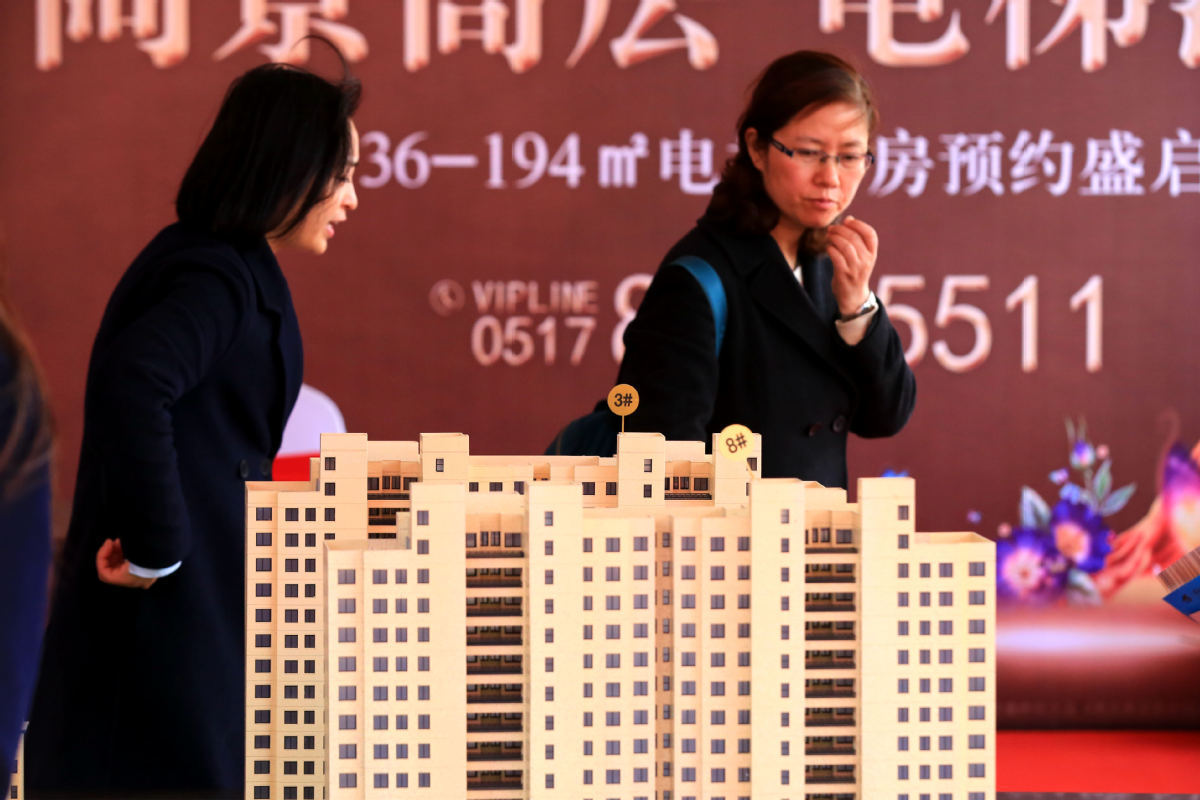
In recent years, China's real estate market has experienced some major adjustments and shown a downtrend. Some analysts have been quick to draw comparisons with Japan's housing bubble that burst in 1991. But such arguments are untenable, given that the current situation of the Chinese economy is quite different from that of Japan back then.
So, the popular "balance sheet recession "theory, which is applicable to some developed countries and can provide some reference for China, may not work well in finding solutions to China's current economic situation.
Balance sheet recession
The phrase "balance sheet recession" was coined by US economist Richard Koo, chief economist at Nomura Research, in 2003, to describe Japan's long-term economic recession in the 1990s.
According to Koo, after Japan's housing bubble burst, Japanese companies shifted their focus from profit maximization to survival maximization, and chose to repair the balance sheets through aggressive debt repayments.
For an individual company, this was a rational debt repayment option. However, at the collective corporate level, Japan's private sector went from being a net borrower to a net saver. As a result, there was no longer a net borrower in the market economy, greatly weakening Japan's aggregate demand.
Koo's theory and analysis have since entered the framework of macroeconomics and can provide good lessons for other economies that may face problems similar to Japan's in the 1990s. Koo tried to apply the theory to China's economic situation on several occasions recently.
Different scenarios
Both Koo's theory and policy recommendations are based on developed economies. But China is not yet a developed economy. So, if we want to use the "balance sheet recession" theory to analyze the Chinese economy, we need to first identify the differences between China today and Japan in the 1990s.
First, the housing bubbles in the two countries are different in terms of the degree of asset damage, the type of asset damage, and the willingness and ability of the parties with damaged assets to repay.
In the early 1990s, Japan suffered huge declines in both stock and land markets, with the Nikkei index dropping 78 percent from its 1989 high to its 2002 low, and land prices across the country falling 54 percent between 1991 and 2005.
In contrast, China's stock market has been relatively flat over the past few years, and its average housing price decline has been far less severe.
Besides, Japan's housing bubble mainly covered six major metropolitan areas and was concentrated in commercial real estate, while in China's current round of housing price adjustment, small and medium-sized cities have seen the biggest changes in residential property prices.
Moreover, despite the housing market woes that savaged their earning ability, many Japanese companies actively expanded into global markets due to the rapid pace of globalization in the 1990s. Eventually, overseas revenues gave these companies the ability to repair their balance sheets.
In China, the entities hardest hit by the recent housing turmoil are property developers and local government financing vehicles, which indeed lack the ability to repay.
Second, China and Japan have very different levels of economic development. As one of the most developed countries in the world, Japan already had a higher GDP per capita and a higher degree of urbanization in 1990 than China today. Besides, it was already highly open at that time, with a high degree of financial liberalization and almost no cross-border capital controls.
Third, unlike what happened in Japan in the 1990s, China's real estate market decline hurts its economy mainly by reducing the income of related entities rather than affecting the balance sheets.
Fourth, the reasons for China's sluggish economic recovery are more diverse than those of Japan in the 1990s. Currently, major economies have entered an interest rate hike cycle, resulting in China's weak external demand, and the increased geopolitical risks have led to a significant decline in foreign direct investment in China. Besides, Chinese private entrepreneurs' confidence has taken a hit over the past few years for various reasons.
Potential solutions
Taking into account both Koo's theory and China's current conditions, it is reasonable to say that the Chinese government can improve its economic policies in terms of the following three aspects.
First, China needs to increase its central government expenditure to further ensure the timely delivery of housing projects and to solve the problem of insufficient aggregate demand. This can help restore public confidence in the government, banks and property developers, and increase the demand for construction, which, in turn, will likely have knock-on effects.
Second, China's real estate regulatory system needs further adjustment and optimization. The recent decline in China's real estate market is not only due to the bursting of its housing bubble, but also due to the over-regulation and the inapplicability of some controls to the regulated situations.
Since August, the Chinese government has made some improvements in this area, with many cities relaxing their restrictions on home purchases, home sales and housing prices to a large extent, but there still exists room for improvement.
Third, China should promote structural reforms in the real estate sector and develop a more effective allocation mechanism for land resources.
The amount of urban land supplied for the construction of commercial, residential and public projects should be closely matched with indicators such as the number of employees and the household population.
Besides, the supply of residential land in central cities and urban agglomerations needs to be increased and the supply of land for stockpiling in small and medium-sized cities can be moderately reduced.
The writer is chief China economist at Nomura Securities Co Ltd.
The article is a translation of the writer's speech at a recent seminar of the China Macroeconomy Forum, a Beijing-based think tank.
The views do not necessarily reflect those of China Daily.