Discovering surprising shades of green from the field







Pandas overcome trauma inflicted by earthquakes in Sichuan province. Nomads swap sheep for emu to preserve vanishing grasslands in the Inner Mongolia autonomous region. Impossible farms rise from the desert like mirages in Qinghai province. These are just a few of the often-surprising stories I've personally encountered while discovering how China is innovating to advance environmental and ecological protection and restoration.
That is, while traveling through every province in the country, exploring its deserts, forests, grasslands and tundra over the past 17 years as a China Daily journalist.
This is a primary theme in my book, Closer to Heaven: A Global Nomad's Journey Through China's Poverty Alleviation, published in English, Chinese and Italian.
While it is ultimately about poverty alleviation, large sections are dedicated to how China has prudently navigated the relationship between economic prosperity and environmental protection in ways that are complementary rather than contradictory.
I visit a project in Inner Mongolia's Alxa League where nomads raise emu rather than herd sheep — since these large birds generate more income while causing less environmental damage than their four-legged counterparts — and plant suosuo (a drought and salt-resistant tree) and congrong (a kind of herb planted in the roots of suosuo trees) to reverse desertification while growing traditional herbal medicines.
I visit IT businesses in Wuxi, Jiangsu province, to discover how authorities reconfigured the area's industrial composition to restore Taihu Lake after the chemical plants that sprang up in the early years of reform and opening-up left 1 million people without usable water. And I sleep in remote stations with conservation officers tasked with protecting Tibetan antelope. And much, much more.
In addition to experiencing these stories in the country's wildest corners, I've seen policies adopted at their source. That is, while attending events such as the annual meetings of the legislature and top political advisory body, and the Party Congresses in the Great Hall of the People.
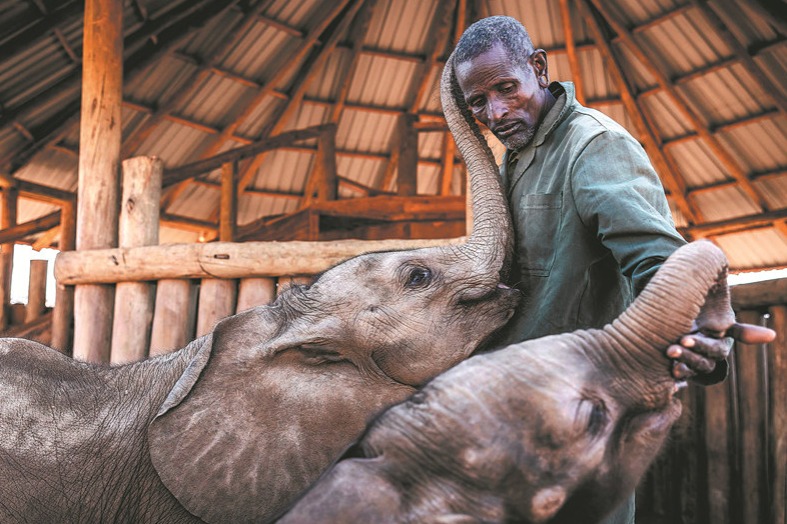
And last year, I hosted a one-on-one video discussion with China's Minister of Ecology and Environment and COP 15 president Huang Runqiu, just before the second phase of the 15th meeting of the Conference of the Parties to the UN Convention on Biological Diversity in Montreal. The theme of biodiversity inspired me to reminisce about the dozens of rare species I've encountered in China, from elephants in the jungle to wolves on the tundra.
This year, I was particularly honored that my mission to uncover China's unexpected shades of green from the field was recognized when I became the first foreigner to be named as a Special Observer of China's celebrations to mark the World Environment Day since the commemoration was established in 1985. I believe the presentation of this national award to a foreigner indicates not only China's growing inclusiveness, but also its recognition that even the most local environmental problems and progress are ultimately global.
Pollution doesn't need a passport to cross borders. In fact, it doesn't heed any formal immigration procedures whatsoever.
I remember, years ago, when Beijing's smog blotted out the city's skies. Authorities in the capital and nation have cleared up this problem and have also planted the Great Green Wall to block the sandstorms that once assailed the city from Inner Mongolia.
Yet this spring, Beijing was nonetheless again sandblasted by gales from the Gobi that clogged the skies with sallow dust — this time originating from outside the country.
This serves as yet another reminder of the importance of international — ideally, global — cooperation to protect the natural systems upon which every member of our — and every other — species depend.
I've been particularly awestruck by the headway I've witnessed on the Qinghai-Tibet Plateau, where I started a poverty-alleviation initiative in 2011 that initially focused on installing solar panels in schools without electricity. This work regularly brings me to the no man's land that is nomad's land on the "planet's third pole", aka, the "roof of the world".
Given the scarcity of electricity in my early years there — since punishing natural conditions severed the highlands from the fossil-fuel power grid — I never fathomed that, years later, the region would set new global records as a literal powerhouse for clean energy.
Qinghai ran entirely on renewables for 360 hours in June 2019, beating records it had set in 2017 and 2018. The western province even produced a surplus of power that it shared with central and eastern regions, including megacities like Shanghai.
And in 2018 alone, it increased its grass coverage by over 25 percent after herding restrictions had constrained livelihoods on prairies with virtually no resources other than the grass that feeds yaks and sheep that, in turn, feed nomads.
Indeed, I look forward to seeing firsthand how China will continue to color its environmental and ecological legacies, as it turns gray skies blue, transforms yellow sands into green grass and makes murky waters clear.
?
?
?
?
?
?