



Global bodies must stop Japan's water release







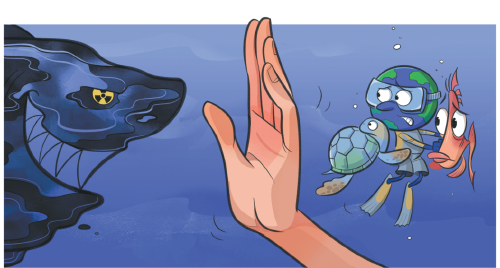
Japan has started the third batch release of the nuclear-contaminated water from the damaged Fukushima Daiichi nuclear power plant into the sea, ignoring the strong and persistent protests of the international community. Some Asia-Pacific countries, including China, Samoa, the Democratic People's Republic of Korea, the Solomon Islands and human rights organizations renewed their criticism of Japan at the 78th session of the UN General Assembly in September and the 54th session of the UN Human Rights Council in October, asking Japan to stop the discharge of the nuclear-contaminated water into the sea.
Overseeing Japan's discharge of the nuclear-contaminated water is not only an affair of the International Atomic Energy Agency, but also other related international organizations such as the United Nations Environment Programme, the Food and Agriculture Organization and the International Maritime Organization.
The powers and limitations of these organizations are clearly laid down in their statutes. As an autonomous organization, the IAEA does not have the authority to approve Japan's plan to discharge the nuclear-contaminated water into the sea. It can only technically review and monitor the discharge of the radioactive water according to its "Safety Standards".
According to Article 2 of the IAEA statute, the objective of the IAEA is to accelerate and enlarge the contribution of atomic energy to peace, people's health and prosperity throughout the world. Some articles authorize the IAEA to apply safeguards, at the request of the parties, to any bilateral or multilateral arrangement, or at the request of a state, to any of that state's activities in the field of atomic energy. Some others say the IAEA "shall not make assistance to members subject to any political, economic, military, or other conditions incompatible with the provisions of this Statute". This limitation confines the IAEA's work to technical functions.
More importantly, the IAEA should consult and collaborate with the competent organs of the United Nations and specialized agencies when it "establishes or adopts standards of safety for protection of health and minimization of danger to life and property… and provides for the application of these standards,… at the request of a State, to any of that State's activities in the field of atomic energy". The IAEA should do so with at least the IMO, the UNEP and the FAO, since consultation and collaboration among them have not been sufficient.
As part of the United Nations, the UN Environment Programme is the leading global authority on the environment. Its primary goal is to catalyze action on the environment and find solutions to the triple planetary crisis of climate, nature and pollution — more elaborately, climate change, environmental degradation and biodiversity loss, and environmental pollution and waste creation. The UNEP helps protect the seas and oceans, drills down to the root causes of the pollution, strengthens "environmental governance" and safeguards ecosystems. It helps humanity to live in harmony with nature and forge a pollution-free future, in line with the 2030 Agenda for Sustainable Development.
The UNEP should have closely followed Japan's discharge of the radioactive water into the sea, including compelling Japan to take measures to minimize harm to human health and environmental damage and respect the right of all people to a clean, healthy, and sustainable environment, among other relevant human rights. But it hasn't made necessary decisions or issued any technical guidelines yet.
Therefore, it is necessary that the UNEP take the needed measures to prevent the marine environmental and ecological damage caused by the radioactive water.
As one of the specialized agencies of the UN, the FAO's responsibilities include ensuring food security. And a main responsibility of the Fisheries and Aquaculture Division of the FAO is to ensure fisheries are environmentally friendly and sustainable, and aquatic products are contamination-free and safe for consumption.
Since radioactive pollution in the sea will contaminate seafood, many countries, including China, the Republic of Korea, Malaysia and Thailand, are more strictly testing seafood for radiation following Japan's release of the radioactive water into the sea. So the FAO should take immediate actions, including issuing policy and technical guidelines for the discharge of the nuclear-contaminated water, to prevent people from further panicking.
The IMO, as a specialized agency of the UN, is responsible for maintaining the safety and security of shipping and preventing ships from causing marine and air pollution, and the IMO Secretariat is in regular contact with the London Convention/London Protocol focal point over monitoring radioactive water and other wastes in the sea.
The Convention on the Prevention of Marine Pollution by Dumping of Wastes and Other Matter of 1972(the London Convention for short), and the 1996 London Protocol provide the specific global framework for the protection of the marine environment from waste-dumping. The contracting parties to the LC and the LP have discussed the issue of the Fukushima radioactive water over the past years, with several delegations, including from the IAEA and Japan, and have given presentations on the issue at the annual meetings of the parties to the two treaties.
And now the international community expects the IAEA, UNEP, FAO and the IMO to take separate and collective actions to fulfill their responsibilities of safeguarding the marine environment, preserving the marine ecology and ensuring food safety in the wake of Japan's discharge of the huge amount of radioactive water into the sea.
The author is a research fellow at the Institute of International Law, Chinese Academy of Social Sciences. The views don't necessarily reflect those of China Daily.
The opinions expressed here are those of the writer and do not necessarily represent the views of China Daily and China Daily website.
If you have a specific expertise, or would like to share your thought about our stories, then send us your writings at opinion@chinadaily.com.cn, and comment@chinadaily.com.cn.





