


Words for the song
A grand project to record a millennium of cultural achievements, initiated in the 10th century, still makes an impression today, Zhao Xu reports.







Feng has contributed her expertise to an ongoing exhibition at Beijing's Palace Museum showcasing solely Song Dynasty (960-1279) rubbings.
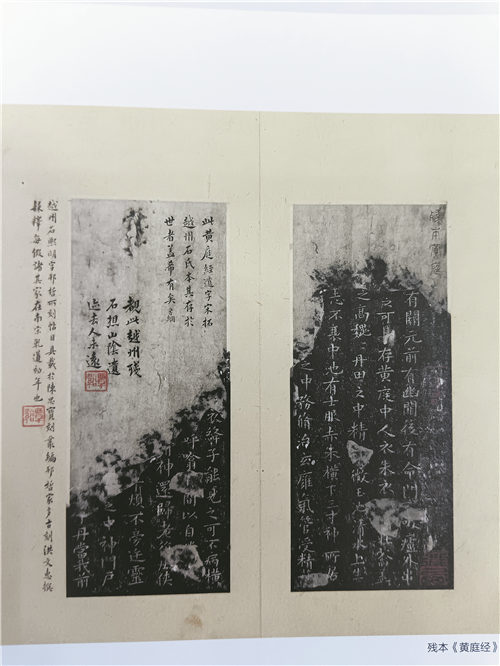
Forty pieces are on display — half from the Palace Museum, half from the Art Museum of the Chinese University of Hong Kong. And the gargantuan effort by Emperor Zhao Guangyi, and the fruits it bore — a huge compilation titled Model Calligraphy From the Chunhua Era (990-994) — are highlighted in a section focusing on fa tie.
Divided into 10 chapters, Model Calligraphy was composed of 420 pieces from 103 calligraphers, the majority of whom lived during the millennium preceding the founding of the empire of Song. Many emperors and their scholar-officials were duly represented, and for all the right reasons, yet the real stars were 4th-century master calligrapher Wang Xizhi and his son Wang Xianzhi, who between themselves proudly took up the latter five of the 10 chapters.
"Consensus may not have been reached as to whether Model Calligraphy was the earliest fa tie ever made with a royal edict, but it was undoubtedly the most influential one," says Ho Pik-ki, the curator from the Hong Kong side.
A little more than a century later, in 1109, Zhao Ji, or Emperor Huizong, the eighth emperor of the Northern Song Dynasty, ordered what was essentially a remaking of Model Calligraphy. New stone slabs were inscribed for every piece that had been in the original version, and new rubbings made subsequently.
But there were differences. The latter, known as Model Calligraphy From the Daguan Era (1107-1110), was historically held in higher esteem. Later scholars lauded the superb engraving and were also not unaware of all the reviewing, revising and correcting done to increase the accuracy and therefore the cultural and historic value of the texts.
Such endeavors were often indispensable, due to the very process whereby rubbings were made.
"Chinese scholar-collectors for centuries have collected rubbings of these inscribed pillars (stone steles or tablets), in a manner comparable to that in which prints have been collected in the West," wrote Kenneth Starr, the late curator of East Asian archaeology and ethnology at the Field Museum of Natural History in Chicago, home to the largest and one of the best collections of rubbings outside of China.
"And just as there are prestige factors present in the possession of 'first impressions', so also there is prestige value in the possession of an early copy of a rubbing. Thus, a Ming-period (1368-1644) rubbing of a Tang-period (618-907) inscribed monument is prized above one made during the Ch'ing period (Qing, 1644-1911)," he wrote. "Lest such desires be charged purely to snobbery, it is well to note the practical fact that the earlier copy generally is sharper and more clear."