



EU's 'de-risking' policy could become a risk itself







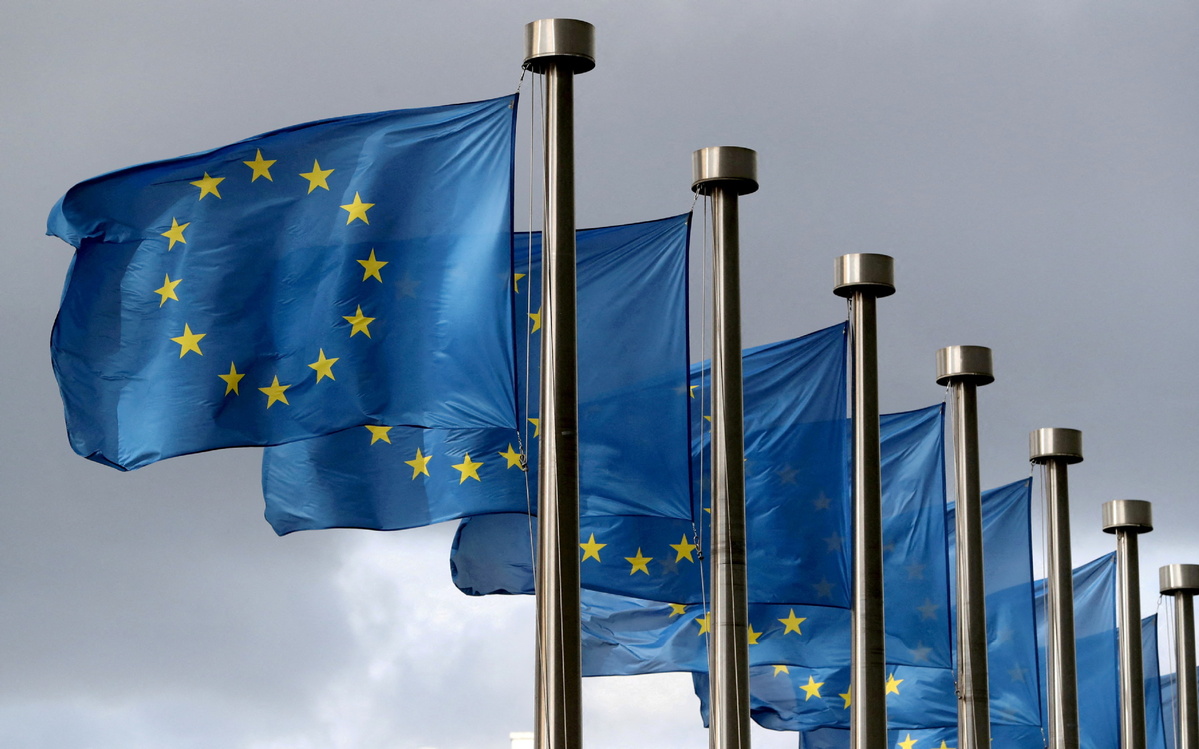
The adoption of a recommendation on critical technology areas for the European Union's economic security, for further risk assessment with EU member states by the European Commission on Oct 3, is seen by many as a concrete move by the EU to "de-risk" its economy from China's.
The EU has said the recommendation relates to the assessment of technology risk and technology leakage. After being referred to by European Commission President Ursula von der Leyen in March this year, "de-risking", as a term, has gained in popularity in the EU's policymaking circle, as well as among British politicians. When von der Leyen put forward the idea in a speech on EU-China ties in March, she might not have expected it to become so catchy.
Over the past few months, there have been intensive discussions on China in the European Union, with "de-risking" finding mention in some of the most important policy documents on China, including the European Economic Security Strategy, German National Security Strategy, and European Council statements.
"De-risking" is also becoming the preferred term, instead of "decoupling", for US politicians when referring to future Sino-US relations. Other G7 leaders, too, are using the term "de-risking" to describe their countries' future ties with China. Even the latest G7 Summit communique mentions "de-risking". For the EU, "de-risking" seems to have become the new prism through which to look at its relations with China.
But while everybody is talking about "de-risking", few have paid attention to the risks inherent in the "de-risking" approach itself, because it has psychological, practical and political dimensions.
At the psychological level, the term "de-risking" carries negative connotations for both Chinese and European people. Since "de-risking" is mainly associated with China, it puts China in an uncomfortable position, giving the Chinese people the impression that their country itself is a risk. It sounds like another form of "China threat" theory which, according to Joseph Nye, Harvard political scientist, could become a self-fulfilling prophecy.
Although von der Leyen has emphasized that most of the trade between the EU and China does not pose a risk, ordinary people in EU states might not be well aware of that fact. Also when the EU adopts a policy of "de-risking" from China, it will reinforce the negative perception about China, which in turn will force the block to resort to "de-risking" in every decision it makes vis-à-vis China.
On the practical front, there is a risk of the "de-risking" strategy turning into protectionism and spilling over into areas of common interest. The EU's "de-risking" strategy has been developed in the context of the US aggressively pushing for "decoupling" from China in the tech sector.
By pursuing a "de-risking" strategy, the EU has been trying to distance itself from the "de-coupling" approach of the United States, because the European bloc thinks it is neither possible nor desirable. Still, the concept remains ambiguous and poorly defined, leaving ample room for interpretation.
What is the difference between "de-risking" and "de-coupling"? Who defines the "risks", the government or the enterprises? How far will the EU proceed in its pursuit of "de-risking" from China?
Although the EU claims to have devised its "de-risking" strategy in a targeted way, in practice it could be used as a cover for protectionism, the proposed anti-subsidy investigation by the EU against Chinese EVs being a case in point.
Obviously, there is a subsidy race in the green industry, with China, the EU and the US all engaged in it, and China appearing more successful in its industrial strategy. In this context, the EU has legitimate concerns, but the EV industry is too important to be subjected to zerosum thinking. The anti-subsidy investigation launched by the EU risks sparking a trade war between China and the EU, which doesn't serve their common goal of green transition.
Politically speaking, "de-risking", if not managed carefully, could backfire on EU-China relations. Trade has been the cornerstone of EU-China relations. But if the EU does not properly implement its "de-risking" strategy, it could turn into de facto "decoupling", which the EU has been seeking to avoid.
In defining and implementing the "de-risking" strategy, Germany will certainly be a benchmark for other EU states as it is the largest European economy and has the closest economic relationship with China among all EU states. Therefore, how Germany carries out its "de-risking" strategy will be closely watched by the other EU states as well as China.
The first test of Germany's "de-risking" agenda will be its attitude toward Chinese telecom giant Huawei. Germany's Interior Ministry is reportedly considering banning Huawei from the country's 5G networks as part of its "de-risking" strategy, ostensibly to reduce its dependence on China. If not properly implemented, this move could exact a huge cost on German telecom operators and delay and/or disrupt the rollout of 5G in Germany, while further undermining the already fragile trust between China and Germany.
Given Huawei's importance to China's efforts to break through the US' containment policy, a ban on Huawei by Germany would be seen by the Chinese people as a provocative move, a move indicating it supports the US' tech strategy to contain China.
Moreover, if the strategy of "de-risking" from Huawei extends to other tech sectors and other countries, China would probably be under pressure to take retaliatory action.
So, how to deal with the risks associated with "de-risking"? There is no easy answer. As a strategy, "de-risking" may continue to be part of the EU's overall trade and economic strategy, especially with regard to China. But the EU should be aware of the psychological, practical and political risks associated with it, and ensure "de-risking" does not become a risk in itself.
The author is a researcher at the Center for China-Europe Relations, Fudan University.
The views don't necessarily reflect those of China Daily.





