



Experts share views on Belt and Road Initiative







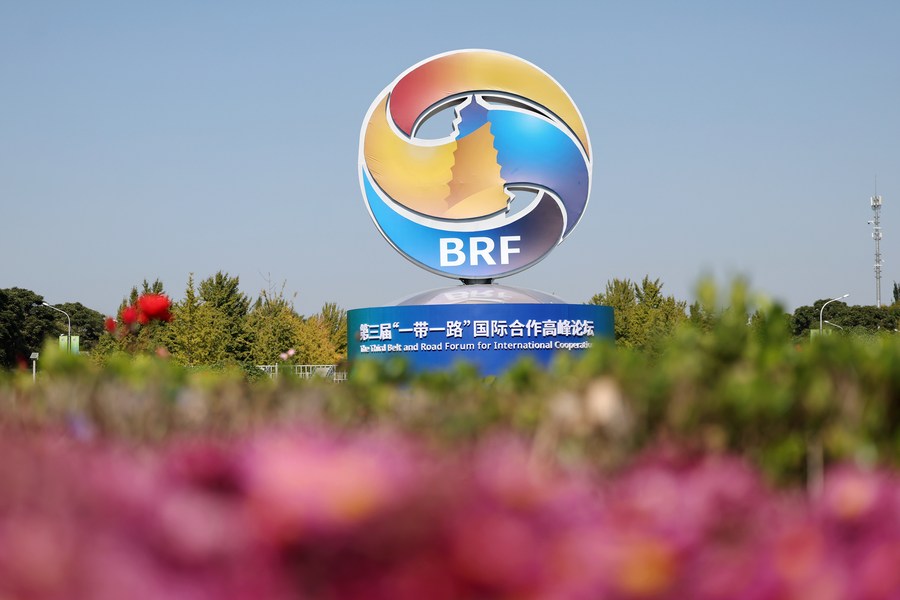
Editor's note: After fruitful 10 years of the Belt and Road Initiative, the initiative enters into another golden decade with efforts to achieve modernization for countries and build an open and inclusive world. Eight major steps are delivered to bring Belt and Road cooperation to a new stage of higher-quality and higher-level development. Three experts share their views on the issue with China Daily.
Initiative rooted in history but oriented toward future
By ZHAO ZHONGXIU
Editor's note: After fruitful 10 years of the Belt and Road Initiative, the initiative enters into another golden decade with efforts to achieve modernization for countries and build an open and inclusive world. Eight major steps are delivered to bring Belt and Road cooperation to a new stage of higher-quality and higher-level development. Three experts share their views on the issue with China Daily.
Since its launch 10 years ago, the Belt and Road Initiative has evolved from a general framework to concrete, successful projects. The initiative not only optimizes resource allocation to improve productivity, but also helps strengthen production relations among countries through policy coordination, and by forging closer people-to-people ties. And cooperation on industrial development has strengthened the economic foundation of the Belt and Road countries, while helping improve global governance.
During the past 10 years, China and other Belt and Road countries have promoted policy coordination, with more than 150 countries and 30 international organizations signing Belt and Road cooperation agreements with China. The BRI has established cooperation and coordination with a wide range of policies and initiatives, including Russia's Eurasian Economic Union framework, Kazakhstan's Bright Road economic policy, Turkmenistan's strategy of reviving the Silk Road, and Indonesia's Global Marine Fulcrum initiative.
In the 10 years of its existence, basic connectivity over land, sea, air and cyberspace has been established based on the principles of "six corridors, six routes, and multiple countries and ports". As the flagship project of the Belt and Road cooperation, the China-Europe Freight Train now covers more than 200 cities in 25 European countries, and has been hailed as a "steel camel fleet" running through the Eurasian continent.
Also, China's goods trade with other Belt and Road countries increased from $1.04 trillion to $2.07 trillion in the past 10 years, with an average annual growth of 8 percent, much higher than the global average growth.
The Belt and Road Initiative advocates equality, mutual learning, dialogue and inclusiveness among civilizations, while promoting the shared values of humanity. It has charted a path of exchanges and mutual learning to forge closer ties among peoples and link up cultures and hearts across continents.
Second, the initiative has helped accelerate the industrialization of other Belt and Road countries, and boost their industrial cooperation and economic growth. China has also been upgrading its industrial structure, and has helped other Belt and Road countries upgrade and bolster their industries, so as to ensure their economic complementarity yields mutual benefits.
Cooperation between the Belt and Road countries has helped alleviate poverty in a large number of Belt and Road countries, with the World Bank estimating that by 2030, Belt and Road-related investments could lift 7.6 million people out of extreme poverty and 32 million people out of moderate poverty.
In keeping with its climate promises and to fulfill its responsibilities as a major country, China announced in 2021 that it would stop building new coal-fired power plants overseas.
Third, the initiative has helped China work out a new development model to promote globalization. Which could help tackle the rising tides of de-globalization, unilateralism and trade protectionism in some countries. The multilateral trading system, with the World Trade Organization at the core, is facing daunting challenges, and the initiative's new development model could also help China to address some of those challenges.
It is called the international division of labor. Yet most of the developing countries involved in the BRI are excluded from it. By gradually changing the domestic and global economic landscape, the initiative has ensured that those countries can enjoy some of the benefits of the international division of labor. This is the basic difference between the BRI and the West-led unfair and unbalanced global cooperation and development model.
And fourth, the initiative has provided new solutions to global governance problems. Although the BRI has injected new impetus into the global governance system, global governance can be improved only after the mechanism undergoes major reforms.
Besides, the economic foundation of many developing countries is weak and hence they cannot pursue rigorous industrial development, so they focus on achieving general economic development under the Belt and Road framework. This is how the initiative meets the demands of and provides new development paths for developing countries.
The BRI is rooted in history but oriented toward the future. It has been proposed by China but belongs to the world. The initiative is a means to build a community with a shared future for mankind.
President Xi Jinping unveiled eight major steps to elevate cooperation under the Belt and Road framework to a new stage of higher-quality and higher-level development. They will further consolidate the foundation for cooperation and common development.
The author is president of the University of International Business and Economics. The views don't necessarily reflect those of China Daily.





