Israel-Palestine conflict and 50 years of failed military policies







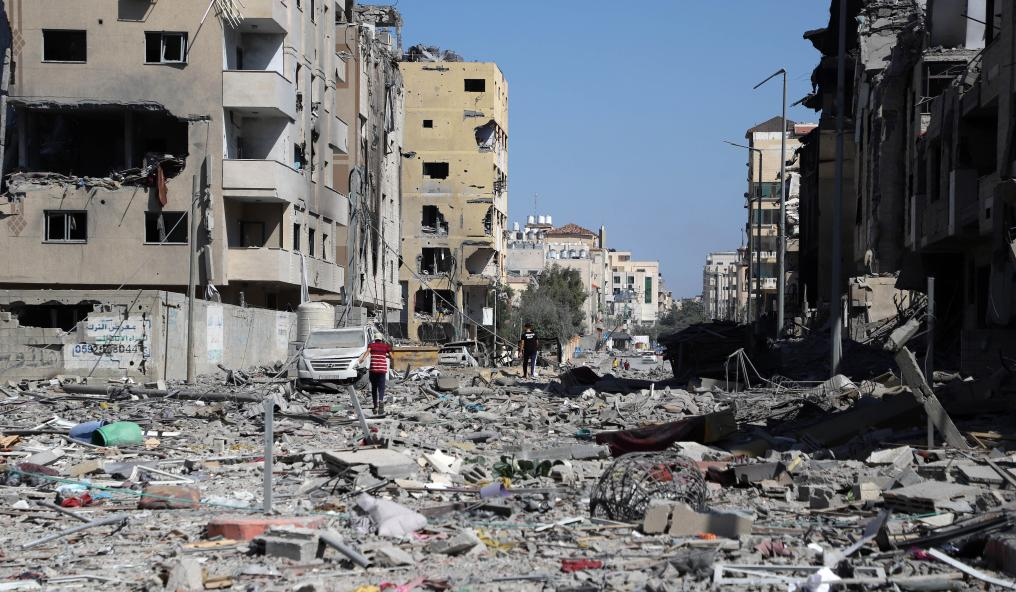
Despite massive aid, US policies have failed to achieve peace in Israel, West Bank and Gaza thus eroding US credibility in the region. Why did US policies fail? Could Chinese policies contribute to peace?
On Saturday, Palestinian militant groups, led by Hamas, launched a brutal coordinated offensive against nearby Israeli cities, Gaza border crossings, and adjacent military installations. It was a lethal twist after a volatile year as the far-right government's descent toward autocracy has been challenged by mass demonstrations in Israel.
As Israel declared a state of emergency and war and began to bomb Gaza, China's permanent UN representative Zhan Jun spoke for de-escalation to prevent "further casualties of civilians." Yet, in Beijing, Senate majority leader Chuck Schumer blasted China's cautious stance in Beijing.
Extraordinarily costly in terms of Israeli casualties, wounded and captured, the Hamas offensive is the first direct conflict within Israeli territory since the country's founding. According to Hamas, it is in response to all the atrocities the Palestinians have faced over the decades, and the "desecration of the Al-Aqsa Mosque" by the Israeli far-right.
The status quo has long been untenable. Israel is sitting on a 50-year time bomb.
Economic dead-end
Even in 1994, amid the peace talks in Oslo, Palestinian per capita income was just 15% relative to the Israeli level. But hopes for peace died with the Jewish far-right assassination of Prime Minister Yitzhak Rabin.
Despite all the hoopla by the Trump and Biden administrations that the Middle East is at the cusp of peace and prosperity, Palestinian per capita income has fallen and is now only 12.9% relative to the Israeli level; lower than decades ago (Figure 1).
Figure 1 Per capita income in Israel and West Bank/Gaza, 1995-2023
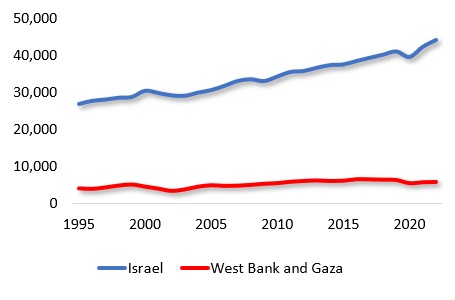
GDP Per Capita PPP: Israel Vs West Bank and Gaza (1995-2023). Data from World Bank
Source: Author; data from World Bank
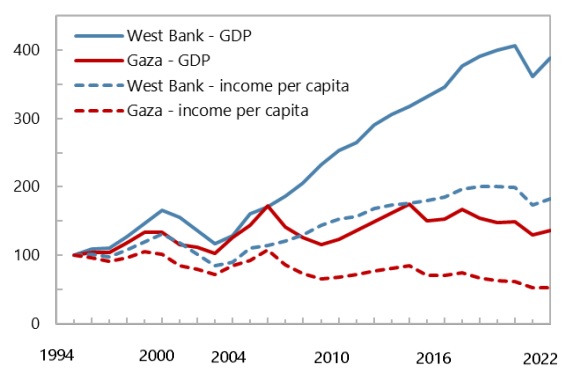
As bad as these aggregate figures are, they reflect Palestinian averages, not Gaza's hell. Years of isolation and recurrent conflicts have left the local economy far behind the West Bank's, due to the Israeli-imposed blockade, four wars, and domestic divisions. Today, Gazan per capita income is less than a third of that in the West Bank. Almost half of the labor is unemployed, and over half of the population lives below the national poverty line (Figure 2).
Figure 2 Economic Divergence Between the West Bank and Gaza
Source: IMF
Palestine under apartheid
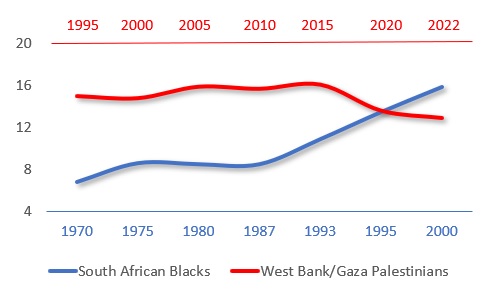
Well before the ruthless Hamas offensive, the Palestinian stagnation reflected economic devastation that exceeded that of apartheid South Africa. During the period of apartheid (1948-94), the blacks' per capita income relative to the whites climbed from 8.6% to 13.5%. In relative terms, the Palestinians' starting point was almost twice as high after the Oslo Accords. But today it's behind that of the blacks at the end of the apartheid. The reversal took place under the watch of the Trump and Biden administrations (Figure 3).
Figure 3 Two kinds of apartheid: From South Africa to Palestine
Source: Author; data from IMF
Farsighted Israeli leaders no longer deny the reality of apartheid. Last year, former attorney general Michael Ben-Yair called Israel "an apartheid regime." Recently, the parliament's former speaker Avraham Burg and renowned historian Benny Morris were among more than 2,000 Israeli and American public figures who signed a public statement that "Palestinians live under a regime of apartheid."
And in early September, Tamir Pardo, the former chief of Mossad (2011-16), said to the Associated Press that Israel's mechanisms for controlling the Palestinians matched the old South Africa. "There is an apartheid state here," Tamir warned.
From US militarization to Chinese development?
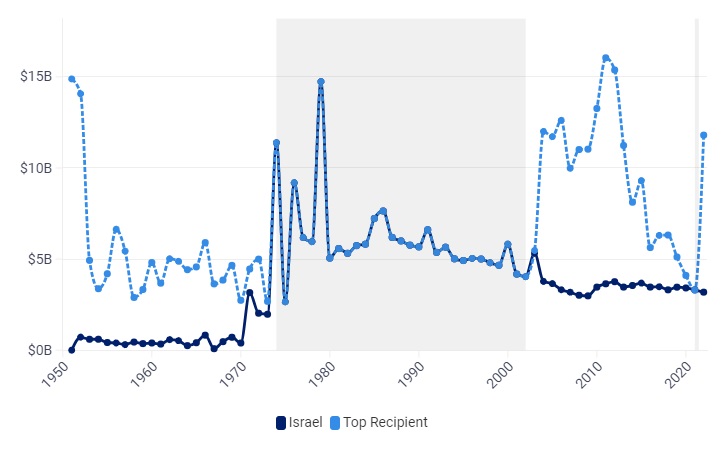
Ironically, the erosion of Israeli economy has gone hand in hand with soaring US economic and military aid, which took off after the 1973 War. Until 2002, Israel was the top recipient of US aid, and it has stayed among the top three with Iraq, Afghanistan, and Ukraine. Overall, US has given Israel over $260 billion in military and economic aid, and $10 billion more for missile defense systems (Figure 4).
Figure 4 US aid to Israel since 1950
Source: ForeignAssistance.gov
Nonetheless, the Israeli economy is more polarized than ever before. Worse, Netanyahu's government is further undermining Israeli economy. In May, 280 senior economists warned that the government's budget allocations to the ultra-religious Haredi-groups, in exchange for their coalition support, "will transform Israel in the long run from an advanced and prosperous country to a backward country."
Yet, the Democratic Biden administration has continued Trump's Middle East policies, which effectively ignore the Palestinian nightmare. Washington's bipartisan consensus is driven by the priorities of the Pentagon and the Big Defense.
Stressing the importance of peace and development, China has called for an "immediate cease-fire" and repeated its support for a two-state solution with an independent state of Palestine as a way out of the conflict.
By contrast, President Biden dispatched Blinken to Israel in show of support, while both struggled to portray the United States as the neutral intermediary it has not been for decades in the Middle East. Meanwhile, Republican hawks, such as Lindsey Graham, said they were ready to "support the bombing of Iran," with or without any evidence on the links between Hamas offensive and Iran.
The war is manna for heaven for Israel's far-right government, as well.
Netanyahu and the rise of Hamas and far-right
After the Yom Kippur War, Israel's Labor coalition began to expand security boundaries of Jerusalem eastward. That led a group of Messianic settlers to create a foothold in the West Bank. I had no doubts of their final objectives after a mid-'70s meeting in Jerusalem with Meir Kahane, the US-born rabbi and far-right politician who advocated ethnic cleansing of Palestinians until his violent death.
Afterwards, the Madrid Conference in 1991 and the subsequent Oslo Accords offered a glimpse of a more peaceful two-state future; until Rabin's assassination. In Israel, Kahane's politics gave rise to new far-right movements and assassins, killings of Palestinians and political parties like Itamar Ben-Gvir's "Jewish Power." As Netanyahu's minister of national security, he calls for expulsions of Arab citizens and in part sparked the Hamas offensive by a provocative visit to the Temple Mount.
Launched in 1988 in Gaza, Hamas refused to accept Israel's existence. But for over a decade before, Israeli authorities tacitly enabled its rise, hoping to exploit it against Arafat's Palestinian Liberation Organization (PLO). While PLO coped with Israeli repression, the Islamists' activities were allowed in Gaza. One of their adherents was the wheelchair-bound Sheik Ahmed Yassin. Just as the US nurtured Islamists like Osama bin Laden prior to 9/11, Israel allowed Yassin's Hamas to expand, according to the Wall Street Journal.
When the peace process began, Hamas launched attacks against civilians, which contributed to the rise of Netanyahu and the Israeli far-right in 1996. Yet, as Prime Minister, Netanyahu ordered Yassin to be released from prison, despite a life sentence. Perhaps the idea was that the Islamists would sabotage the Oslo accords. Yassin fought Israel until his killing. And in 2007, after an election victory that rankled both the West and Fatah, Hamas took over Gaza.
Today, Netanyahu government's strategic solution seems to be sheer destruction. Hence, the Dahiya Doctrine, tested in the 2006 Lebanon and 2008-09 Gaza wars. It is premised on the demolition of the civilian infrastructure and the deployment of "disproportionate power," which critics call "state terrorism."
Give peace and development a chance
Unlike Washington, Beijing is seen in the Middle East as a more neutral intermediary whose primary focus is on economic development rather than multi-billion-dollar weapons sales. In March, China brokered discussions between Saudi Arabia and Iran, enabling a diplomatic rapprochement. In June, China outlined its vision for brokering peace between Israel and the Palestinians.
Historically, China has had close diplomatic ties with Palestinian leaders. This year the president of the Palestinian Authority, Mahmoud Abbas, made his fifth official visit to China. But Beijing has also deepened relations with Israel, investing in infrastructure and the country's vibrant technology sector. China is seen largely as a positive force by most Israelis.
In the past half a century, no US-brokered initiative has achieved enduring peace in the Middle East. Washington has a geopolitical interest in the region as an energy reserve and US defense contractors' lucrative client. By contrast, China's approach is paced by stability and cooperation necessary for economic development.
Both the US and China have a role in the Middle East. But it is time to give peace and development a chance.
Dr. Dan Steinbock is the founder of Difference Group and has served at the India, China and America Institute (US), Shanghai Institute for International Studies (China) and the EU Center (Singapore). The original version was published by China-US Focus on October 13. The views don't necessarily reflect those of China Daily.
If you have a specific expertise, or would like to share your thought about our stories, then send us your writings at opinion@chinadaily.com.cn, and comment@chinadaily.com.cn.