



West's 'China collapse' theory has collapsed







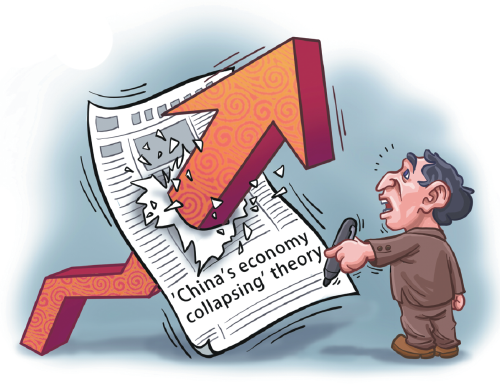
China and other major economies such as the United States, Japan, Germany and India are facing a host of economic challenges due to a diverse range of factors, two of the main ones being the global economy's lack of growth momentum and the geopolitical turmoil globally.
Against this background, each time China responds to a new challenge affecting its economy, the West's infamous "Chinese collapse" theory rears its ugly head.
For example, an article in a US newspaper, The Hill, last month was headlined "China's economic collapse carries a warning about our own future" as if the "collapse" were a fait accompli. While one article published recently in a Western media outlet (East Asia Forum) said "Has the Chinese economy hit the wall?", another (in The Strategist) posed the question: "Is China's economy about to go bust?"
One of the best-known proponents of the infamous "China collapse" theory is Hong Kong-born, US-based historian Gordon H. Chang, who published "The Coming Collapse of China" in 2001. He predicted, albeit wrongly, that China would collapse in 2011. When 2011 was almost over, Chang admitted that his prediction was wrong, but insisted it was off by only a year. He made it to the magazine's list of "10 worst predictions of the year" twice.
What a record for an academic?
I would suggest that Chang, who is in his 70s, write a book titled "The Collapse of My 'The Coming Collapse of China' Theory", in which he could explain why he got it so horribly wrong, twice.
On the other hand, Richard McGregor, an Australian expert on China, wrote an article titled "The collapse of the 'Chinese collapse' theory" back in 2018, in which he said: "In Japan, they call it 'the collapse of the 'Chinese collapse' theory.' The line, which harks back to more than a decade of dire predictions about China, is a joking way to describe the state of the Middle Kingdom's economy."
Yet the "collapse of the Chinese collapse theory" isn't a "joke"; it's a fact.
The "Chinese collapse" theory is sheer bunkum. Needless to say the collapse of any major economy such as the US' or China's would be a disaster for people not just in that country but also the rest of the world.
The fact is that China's economy is going through a development adjustment process — its transformation from high-speed growth to high-quality development, apart from its ongoing recovery from the impacts of the three-year-long COVID-19 pandemic.
Despite all this, China's GDP grew by 5.5 percent in the first half of the year, the fastest among the world's major economies. And the International Monetary
Fund has predicted that China's economy will grow by 5.2 percent this year, contributing about one-third of global growth.
Moreover, Luigi Gambardella, president of the China-European Union Business Association, said in a recent interview that "the resilience of the Chinese economy can be attributed to targeted policies designed to bolster growth, such as the recent unveiling of 31 measures by the central government to stimulate the development of private companies".
In a similar vein, Nasdaq Vice-Chairman Robert McCooey told the US-China Business Forum in New York recently that people in China are continuing to set up innovative businesses "and it shows why the Chinese economy continues to be strong for decades to come".
And British online magazine Spiked said in a recent article that China's resilience to economic disruptions is different from that of the West primarily because of the strength of its production fundamentals. The article pointed out that China now leads the world in the production of electric vehicles, electric car batteries, 5G telecommunication equipment, commercial drones, internet of things devices, mobile payments and solar voltaic panels, which all are "indicators of China's continuing economic durability".
I have cited these articles to show how nonsensical the West's claim of the "Chinese economy's collapse" or China's economy being a "time bomb" is. In other words, China's post-pandemic economic growth, which has its inherent twists and turns, continues to defy Western doomsayers.
My personal experience, after living and working in Chinese cities including in Hong Kong and Macao for over four decades, is that China's economic development is based on three main factors: strong resilience, great potential and remarkable vitality.
I hope that more and more people in the West, political decision-makers and business leaders in particular, realize that the "Chinese collapse" theory is just a wishful thinking, jealousy or an expression of sheer ignorance. The West, rather the US-led West, should understand that without the cooperation of China, the world cannot address the pressing problems, such as climate change, public health and poverty.
President Xi Jinping rightly told a delegation from the US Senate on Monday that China-US relations would impact humanity's destiny. Xi told the bipartisan US delegation led by Senate Majority Leader Chuck Schumer in Beijing that how China and the United States get along with each other in the face of a world of change and turmoil will determine the future of mankind.
Let's hope the US senators got the message. The message, if followed, will help build the world into a community with a shared future for mankind, which is one of China's top foreign-policy goals.
The author is director of The Macau Post Daily.
The views do not necessarily reflect those of China Daily.
If you have a specific expertise, or would like to share your thought about our stories, then send us your writings at opinion@chinadaily.com.cn, and comment@chinadaily.com.cn.





