



Initiative for cooperation







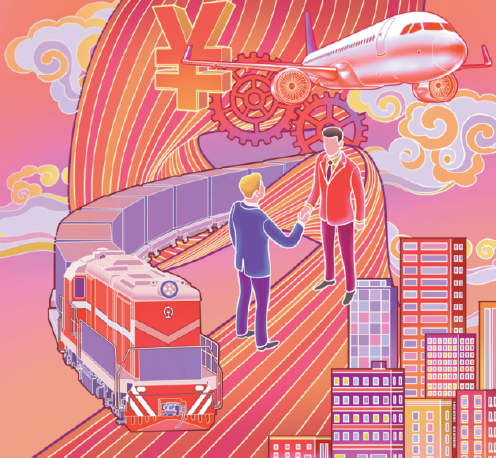
Development in a changing landscape is a top priority of Eurasian countries, providing new opportunities for the Belt and Road
This year marks the 10th anniversary of the Belt and Road Initiative. Over the past decade, the initiative has become a widely welcomed international public good and a platform for international cooperation.
The situation in the Eurasian region has never been so complex since the dissolution of the Soviet Union, marked by heightened tensions among major powers, increased regional security risks and a more challenging environment for economic development. Even China's cooperation with Eurasian countries under the framework of the Belt and Road Initiative is facing new tests and pressures.
First, the negative impact of geopolitical factors has become more pronounced. Against the backdrop of intensified great power competition in the Eurasian region, the United States has increased its efforts to contain Russia and undermine China. The US has labeled the Belt and Road Initiative as a geopolitical tool, while running a smear campaign after the Ukraine crisis that plies significant pressure on China's Belt and Road cooperation with Eurasian countries.
Second, infrastructure development and connectivity face significant challenges. Russia's railway network is a crucial component of the Eurasian Land Bridge and the New Eurasian Land Bridge, and Ukraine and Belarus are key transit points for the Silk Road Economic Belt extending to Europe. These three countries are crucial to transportation between China and Europe. However, because of ongoing conflicts and sanctions, the Ukrainian section of the China-Europe freight trains has been disrupted, and routes passing through Russia and Belarus also face potential risks. This has presented new challenges to outcomes already secured in the development of China-Europe freight trains. Besides, railway transportation, road transport, maritime shipping and air transport have also faced various degrees of disruptions, necessitating a restructuring of the logistics chain between Asia and Europe.
Third, foreign investment and trade are facing greater uncertainties. During the early stages of the Ukraine crisis, port closures, rising oil prices, the devaluation of the rouble and financial sanctions increased freight costs and exchange rate risks in cross-border settlement between Europe and Russia. This led to risk-averse behavior among trade participants, resulting in a decline in trade between China and Eurasian countries. With the prolonging of the crisis, risks of host countries adopting protectionist policies are threatening international trade. Some countries are facing mounting problems of public well-being and unemployment. This has fueled protectionism in the Eurasian region, and stimulated extreme nationalism, potentially endangering the implementation of Belt and Road projects.
Despite geopolitical turmoil and the impact of the COVID-19 pandemic, the Chinese economy has remained vibrant, serving as a powerful force driving global and regional economic recovery. There are opportunities behind crises as China and Eurasian countries jointly advance the Belt and Road Initiative.
In 2022, China's trade with countries participating in the initiative amounted to 13.83 trillion yuan ($1.9 trillion), a year-on-year increase of 19.4 percent, which accounted for 32.9 percent of China's total foreign trade volume. China's Belt and Road cooperation with the Eurasian region is also embracing many new opportunities and favorable conditions.
First, there has been frequent interaction and exchanges between Chinese leaders and leaders of Eurasian countries. In September 2022, President Xi Jinping attended a summit of the Shanghai Cooperation Organization in Samarkand and paid state visits to Kazakhstan and Uzbekistan. In May, the heads of state of China and five Central Asian countries gathered in Xi'an in northwestern China's Shaanxi province for the first China-Central Asia Summit. China will host the third Belt and Road Forum for International Cooperation in October.
Second, economic ties between China and the Eurasian region are being strengthened on a regular basis, with the scope for cooperation becoming increasingly broader. In 2022, China's trade volume with Eurasian countries saw a steady increase. The nation's trade with the five Central Asian countries, Russia and Belarus saw a year-on-year increase of 45.4 percent, 29.3 percent and 33 percent, respectively. New growth engines and highlights have also emerged in the economic cooperation between China and Eurasian countries. Win-win cooperation is particularly thriving in areas such as the grain trade, e-commerce, automobile manufacturing, clean energy, information technology, biotechnology and other high-tech industries.
Third, the operation of the China-Europe freight trains has demonstrated strong resilience thanks to the flexible adjustments made. New routes bypassing Ukraine were opened by Chinese cities after the outbreak of the Russia-Ukraine conflict. In 2022, a total of 16,000 trips were made by the freight trains, up by 9 percent year-on-year.
Fourth, the trend of domestic currency settlements is driving the internationalization of the renminbi. Western countries imposed unprecedented financial sanctions on Russia, partially excluding Russian banks from the SWIFT system, which created difficulties and obstacles for cross-border settlements involving Russia. It has become a strong consensus and practical need for China and Eurasian countries to mitigate financial sanction risks, broaden cross-border settlement channels, and establish and improve a diversified payment system in non-US dollar currencies. In this context, the internationalization of the renminbi has embraced new opportunities. Bilateral settlements between China and Russia with their own currencies have grown significantly, covering approximately 50 percent of their trade volume in 2022. In the future, China and Russia will also try to use their own currencies in natural gas exports to China. In addition, the renminbi has become a recognized safe-haven currency in Eurasian countries.
The high-quality building of the Belt and Road is a major strategic plan to achieve high-quality economic development in China. The Eurasian region is not only China's neighboring region and a place of strategic depth but also a critical area for China to connect with the world from its western border and raise the level of openness in its central, western and northeastern regions.
The Belt and Road Initiative transcends Cold War thinking and adheres to the principle of extensive consultation, joint contribution and shared benefits. The spirit of win-win cooperation and the concept of a community with a shared future are highly valued and accepted by countries that treasure their sovereignty and independence in the region. The orientation of the initiative toward cooperation aligns closely with the pragmatic needs and interests of each country. The Belt and Road Initiative focuses on development issues, and seeking development in a changing landscape is the top priority and the greatest expectation of the Eurasian countries. In this new context, stronger political mutual trust and a stronger consensus for cooperation provide new opportunities for the high-quality and sustainable development of the Belt and Road Initiative.
Deng Hao is secretary-general of the China Center for Shanghai Cooperation Organization Studies and a research fellow at the China Institute of International Studies. Li Yan is a research assistant at the China Institute of International Studies. The authors contributed this article to China Watch, a think tank powered by China Daily.The views do not necessarily reflect those of China Daily.
Contact the editor at editor@chinawatch.cn.





