



China-Europe freight trains energize connectivity and commerce







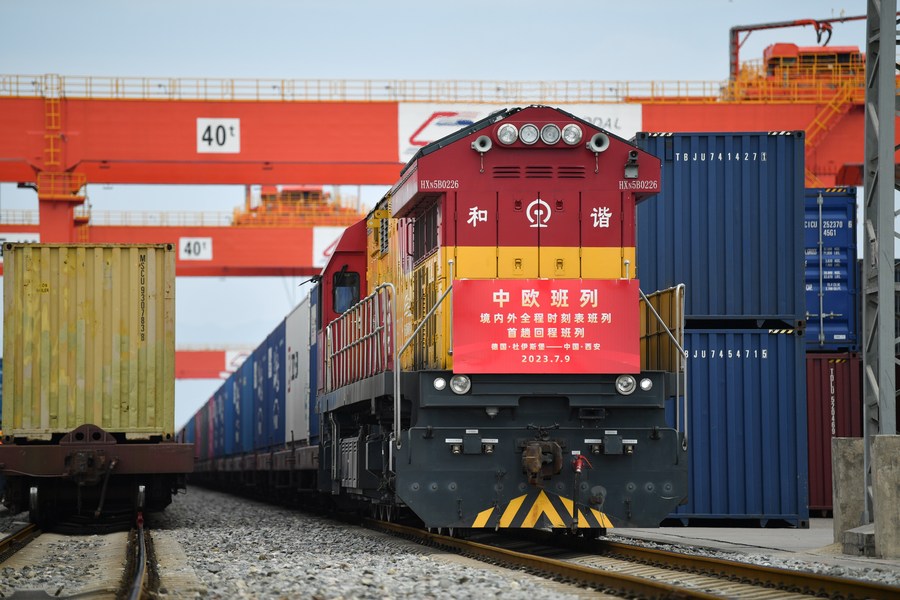
As the celebrated ancient Silk Road once spurred flourishing trade and cultural exchange between the East and West, a new "steel Silk Road" has emerged in modern times - the China-Europe freight train network. Traversing remote frontiers along the Eurasian landmass aboard this high-tech carriage, East meets West again in a new era of burgeoning prosperity.
A decade since conception, China's visionary Belt and Road Initiative (BRI) is delivering tangible benefits across continents, propelled by infrastructure development and closer economic linkages. Among its many milestones, the extensive rail routes connecting China and Europe stand out as a logistical marvel. Ferrying everything from smartphones to wine bottles, autos to avocados, the trains snake through snow-capped landscapes and desolate deserts, traversing 11 countries over a 12,000 kilometer journey.
In 2021 alone, around 15,000 trains made the trip, more than triple the volume in 2019. They transported 1.46 million twenty-foot equivalent units (TEUs), a 31% year-on-year rise. This impressive growth shows no signs of slowing – the network now boasts over 60 routes serving 200 cities in two dozen countries. Chongqing, Chengdu, Zhengzhou and Xi'an serve as major hubs on the Chinese side, while Duisburg, Hamburg, Warsaw and Vienna are among top destinations in Europe.
The formidable progress was no accident – significant investments laid down physical and digital infrastructure, enabling seamless connectivity. Chinese cities poured over $300 billion into high-speed railways and logistics facilities tailored to support surging trade volumes. European countries also sponsored collaborative platforms and upgraded port capacities to smooth customs and enhance regional benefits. Memorandums of understanding formalized long-term road-maps, aligning diverse stakeholders toward shared prosperity.
The payoff from these efforts has been remarkable. Shipping freight by rail costs nearly 80% less than air transportation, while being 5-10 times faster than maritime routes. Supply chains are more responsive and reliable, inventory needs lower and working capital is freed up. For European customers, it unlocks convenient access to premium Chinese products, from household goods to machinery and tech gadgets. For Chinese exporters, it opens avenues into the European common market.
Notable examples illustrate the reach: Duisburg's freight hub serves as German gateway into Europe, handling volumes up 300% since 2013. IKEA facilities in Moscow stock over 2 million items transported from China by rail. Under two days, fresh seafood from eastern China reaches markets in Budapest to delight food connoisseurs. Spain's winemakers tap emerging sophisticates across China, exporting over 2.4 million bottles annually. Intermodal solutions combining rail, road and sea transport create versatile end-to-end logistics tailored for enterprises of all scales and sectors.
Fundamentally, the prolific China-Europe rail exemplifies connectivity's power to uplift economies and societies. While technology shrinks distances, shared humanity has never drawn closer when afforded conduits enabling constructive exchange. Just as ancient silk caravans spawned dialogues that shape civilizations today, every freight train crossing Eurasia brings prosperity through partnership and deepened affinity between peoples. By channeling collaborative energies to pave new conduits, the BRI rekindles the spirit of the historic Silk Road - not merely a trade corridor, but an open passage bridging cultures.
The author is a Beijing-based commentator. The views don't necessarily reflect those of China Daily.
If you have a specific expertise, or would like to share your thought about our stories, then send us your writings at opinion@chinadaily.com.cn or comment@chinadaily.com.cn.





