



BRI lays new foundation for healthy Africa







The year 2023 marks the 10th anniversary of the Belt and Road Initiative (BRI) and the principle of sincerity, real results, amity and good faith for China's Africa policy. It also marks the 60th anniversary of China's medical aid to African countries.
Africa faces long-standing medical and health challenges. Due to multiple factors such as poverty, inadequate infrastructure and a shortage of human resources, Africa is one of the regions in the world suffering from grim medical and health conditions. Africa has not yet established a well-structured public health prevention and control system and medical service system that can respond timely and run efficiently. For example, in 2021, it was estimated that there were 247 million cases of malaria globally, with approximately 95% occurring in Africa. Four African countries accounted for over half of all malaria deaths worldwide: Nigeria (31.3%), the Democratic Republic of the Congo (12.6%), United Republic of Tanzania (4.1%) and Niger (3.9%). Africa also bears 23% of the world's tuberculosis burden, with over 500 cases per 100,000 people in countries such as the Central African Republic, Gabon and Lesotho.
Furthermore, various tropical diseases pose threats to Africa, including Lassa fever, dengue fever, river blindness (onchocerciasis), schistosomiasis, trypanosomiasis and leprosy to name a few. While these infectious diseases have been largely eliminated in developed countries, they still prevail in African nations. According to the WHO, Africa bears over 25% of the global disease burden, is home to only 3% of the global health workforce and spends less than 1% of the world's financial resources on health, making it the region with the highest disease burden in the world.
Our world today is living through accelerating changes unseen in a century. Global macroeconomic imbalances have been exacerbated, and the North-South divide is widening even further. In particular, the COVID-19 pandemic has eroded the gains of the last decade in global development and dealt a heavy blow to developing countries.
African countries face the following situations and challenges: On one hand, the pandemic has plunged African economies into the most severe recession in fifty years. Although there has been a rebound, the recovery is still relatively slow, and governments are burdened with increasing debt. As a result, many African countries have reduced their domestic health budget, relying heavily on external health assistance funds.
On the other hand, during the COVID-19 pandemic, Africa also faced epidemics including monkeypox, Ebola, plague, yellow fever and Lassa fever. The continent has also long been burdened by diseases such as HIV/AIDS, tuberculosis and malaria, which have continued to threaten its population and pose even greater challenges.
For example, according to a report by the WHO, the COVID-19 pandemic caused a 4.3% decrease in malaria case detection rate in Africa, with a 13% increase in malaria deaths in sub-Saharan African countries. This has further widened the global health development gap and seriously hindered the implementation of the United Nations (UN) 2030 Agenda for Sustainable Development.
The 2022 annual report released by the Bill & Melinda Gates Foundation states that "nearly every indicator of the UN Sustainable Development Goals (SDG) is off track at the halfway point for achieving them by 2030". A report released by the WHO in May this year points out that "the toll of the COVID-19 pandemic on global health contributes to the ongoing decline in progress towards the SDGs".
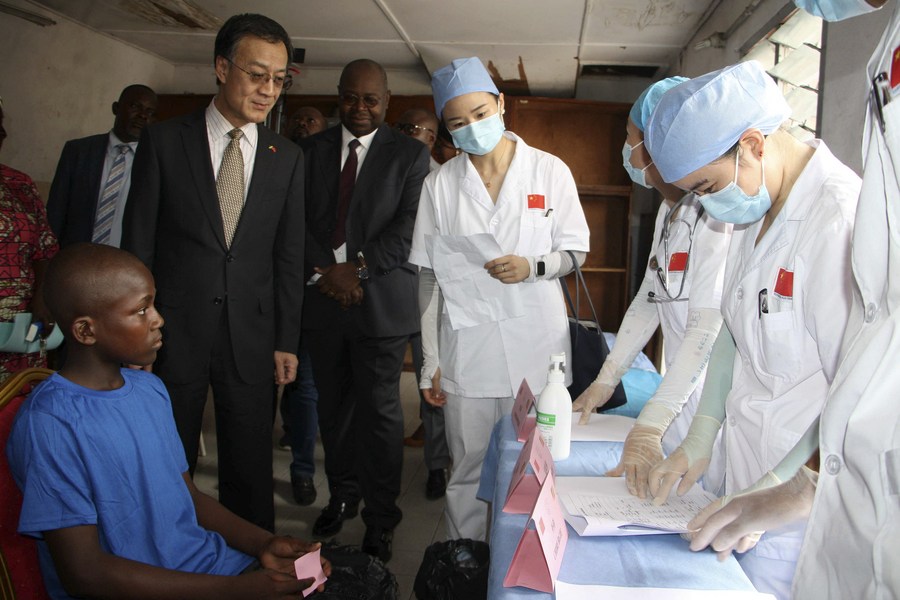
China has always been a staunch supporter and important partner for Africa's development and medical and health cooperation is a shining name card of China-Africa cooperation. Since 1963, China has been constantly dispatching medical teams to Africa. Currently, nearly 1,000 medical personnel from 46 medical teams have treated over 230 million local patients at 100 sites in 45 African countries. Since 2015, China has established twinning relations with 46 hospitals in 41 African countries, aiming to train local medical specialists and enhance specialized medical services. In addition, China has dispatched short-term medical expert groups to over 40 African countries to provide free clinic service. It has also launched maternal and child health demonstration projects relying on Chinese medical teams and China-aided hospitals, and assisted African countries in upgrading modern medical and healthcare infrastructure.
In the field of public health, China actively helps African countries respond to various infectious diseases and major public health crises. Especially since the outbreak of the COVID-19 pandemic in 2020, China and Africa have continued to provide mutual support, setting a fine example for international cooperation against COVID-19.
Overall, China's health assistance to and cooperation with African countries mainly focus on promoting the provision of medical services, engaging in health workforce cooperation and improving access to essential medicines. However, there is relatively less cooperation in providing health financing, strengthening health information systems and enhancing the capacity-building of partner countries in health governance. In light of the new situations and challenges faced by African countries and the WHO's definition of healthcare systems, China and Africa can deepen and expand their cooperation in the following areas to make new contributions to the building of a China-Africa community of health for all.
First, deepen cooperation in public health systems between China and Africa. This can be achieved through participating in the construction of the Africa CDC, supporting the African Union (AU) and individual African countries in establishing robust mechanisms for major epidemic prevention and control, and public health emergency management systems. Additionally, China and Africa should coordinate and integrate relevant medical assistance resources, conduct joint research on the prevention and control of major infectious diseases in Africa, implement relevant prevention and control plans, and effectively improve the overall health of the population in the region.
Secondly, promote the sharing and coordinating of health information between China and Africa. The COVID-19 pandemic has highlighted the urgent need for health informationization in developing countries, and the rapid development of communication networks in Africa in recent years has made the above mentioned cooperation possible. China can provide appropriate products, technologies and services to meet the real needs of Africa. By employing mobile health, telehealth and other methods, we can move diagnosis, treatment and other offline activities online; bring high-quality medical resources to the grassroots level; and effectively improve primary healthcare in Africa.
Thirdly, expand partnerships and enhance global discourse power. It is suggested to strengthen practical trilateral and multilateral cooperation with international organizations, international development partners, and domestic civil society organizations, leveraging more international resources to support South-South health cooperation. At the same time, China and Africa should fully utilize multilateral mechanisms and platforms to contribute their wisdom and experience to the setting of relevant global health agendas, formulation of rules and establishment of technical standards, thus enhancing the global discourse power of both sides.
The author is an assistant research fellow with Institute of West-Asian and African Studies, Chinese Academy of Social Sciences. The views don't necessarily reflect those of China Daily.
If you have a specific expertise, or would like to share your thought about our stories, then send us your writings at opinion@chinadaily.com.cn or comment@chinadaily.com.cn.





