China's drive to modernize boosts global supply chains







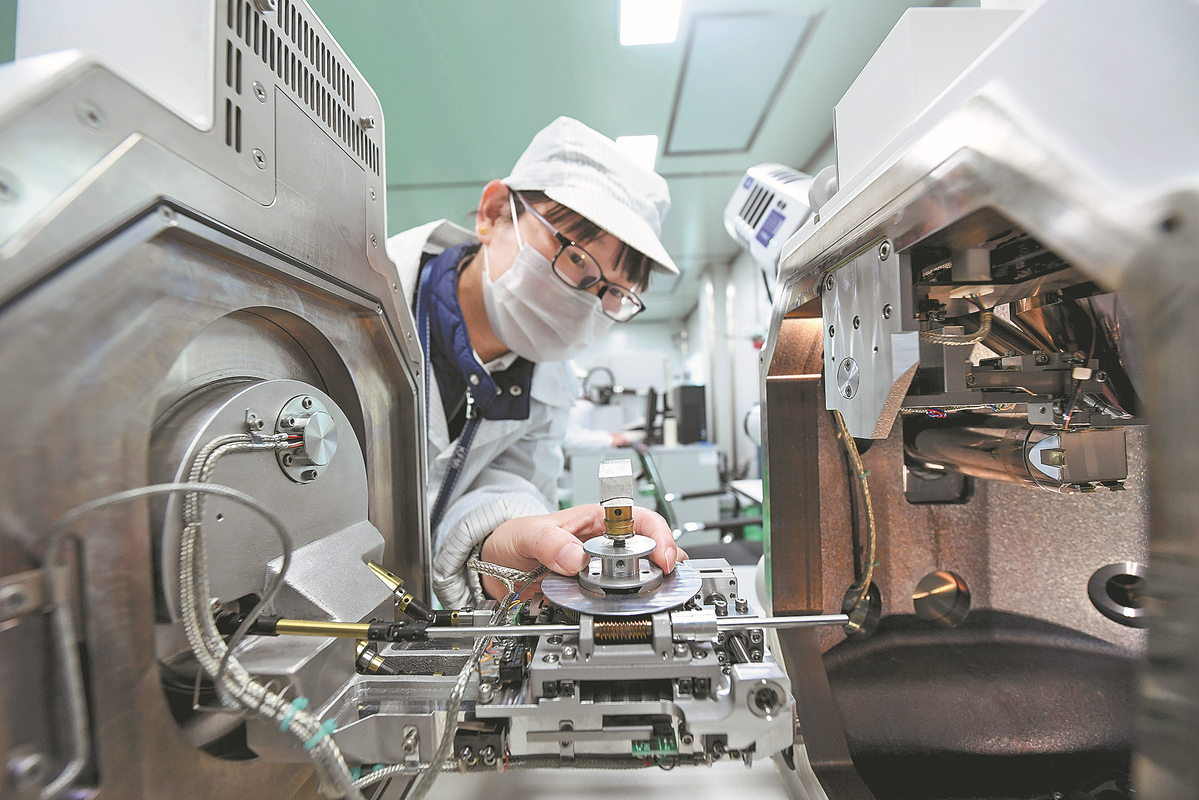
China's efforts to build a modern industrial system will help the world better deal with potential future disruptions in supply chains, and will ensure the smooth running of the global economy amid challenges and uncertainties, economists and corporate executives said.
Noting that industrial decoupling poses a huge risk to global economic recovery, they said China holds great appeal for multinationals, because the country boasts a complete supply chain support system, a strong logistics system, a big market and favorable government policies that spur innovation.
The term "modern industrial system" has become a key phrase in China, with the top leadership highlighting it as a priority for the country's economic development and a key to underpinning modernization.
President Xi Jinping has emphasized that a modern industrial system is the material and technological foundation of a modern country. He also said the focus of economic development should be placed on the real economy to provide solid material support for China to realize its Second Centenary Goal, which is to turn China into a modern socialist country that is prosperous, strong, democratic, culturally advanced, harmonious and beautiful by the time the People's Republic of China celebrates its centenary in 2049.
Xi, who is also general secretary of the Communist Party of China Central Committee and director of the Central Commission for Financial and Economic Affairs, made the remarks while presiding over the first meeting of the commission under the 20th CPC Central Committee in May.
The Political Bureau of the CPC Central Committee also said at a meeting in late July that it is imperative to further advance the modernization of the industrial system, cultivate and strengthen strategic emerging industries and develop more pillar industries.
Hans-Paul Burkner, global chair emeritus of Boston Consulting Group, said China's efforts to advance industrial modernization will help the country move up the value chain, rendering its economy "more innovative, talent-intensive, consumption-driven and green".
Such a transformation will help China maintain its important position in global supply chains amid headwinds such as geopolitical tensions and talk of relocating production back to developed countries, Burkner said.
Craig Allen, president of the US-China Business Council, said China "is an attractive location for supply chain integration", as the country's scale motivates United States-based companies, and its ecosystem is strengthened greatly by investments in infrastructure and talent.
Isabel Ge Mahe, vice-president and managing director of Apple Greater China, said, "Over the past 30 years, Chinese suppliers have grown very fast and become an indispensable and particularly important part of our supply chain."
Apple is very happy and willing to promote China's transition to intelligent manufacturing, despite reports in foreign media that the company is considering moving part of its iPhone production to India, she said.
Last year, Apple launched the $50 million Supplier Employee Development Fund to offer employees of its suppliers training in automation and advanced manufacturing techniques, including programming and robotics.
In the semiconductor industry, in which the US government has tried to promote decoupling, US chip companies remain committed to the Chinese market.
Patrick Gelsinger, CEO of Intel Corp, who has visited China three times so far this year, said: "China plays an incredibly important role in Intel's business strategy. The company has established a long-term relationship with Chinese partners and customers, which spans nearly 40 years."
In late July, Intel and the Nanshan district government in Shenzhen, Guangdong province, launched the Intel Greater Bay Area Innovation Center, which focuses on technologies such as artificial intelligence and chip applications.
Behind foreign companies' enthusiasm is the fact that China has the most complete industrial system in the world. China ranked as the world's largest manufacturing country for the 13th consecutive year in 2022, when its manufacturing output accounted for nearly 30 percent of the world's total, according to the Ministry of Industry and Information Technology.
More than 570 Chinese industrial companies have made it to the global top 2,500 companies in terms of R&D investment, boosting their ability to support supply chains, the ministry said.
Meanwhile, as China moves up the value chain, the country is becoming more of an exporter than an importer of intermediate goods used by manufacturers elsewhere, helping strengthen the connectivity and thus the competitiveness of global supply chains, according to a report released by banking and financial services group HSBC earlier this year.
In Asia, intermediate goods imports from the Chinese mainland now account for close to 20 percent of all component imports on average, the report said. Furthermore, exporters in the Association of Southeast Asian Nations increasingly rely on components from the Chinese mainland rather than other sources.
However, China still faces bottlenecks in crucial technologies such as semiconductors, and more efforts are needed to move toward greener, smarter and higher-end manufacturing, experts said.
Jeffrey Sachs, a renowned economist and director of the Center for Sustainable Development at Columbia University, said: "China's strength right now is that it is on the cutting edge of many of the most important technology innovations for the future, which will be very good for China's manufacturing industry in the future."
The evidence is already clear. China dominates on the Global Lighthouse Network list, a project launched in 2018 by the World Economic Forum in collaboration with consultancy McKinsey & Co to track advanced manufacturing plants, known as lighthouse factories, that apply state-of-the-art digital technologies.
To date, China houses 50 such lighthouse factories, the highest number of any country and accounting for more than one-third of the world's total.
Huang Qunhui, head of the Chinese Academy of Social Sciences' Institute of Economics, said manufacturing is the field with the most innovation activity, and more efforts are needed to hone China's industrial prowess in foundational materials, manufacturing processes, software and other areas.
Denis Depoux, global managing director of consultancy Roland Berger, said, "The quality and depth of China's industrial clusters, the flexibility and the ability to quickly put a lot of people to work and to launch a new product in consumer electronics, are all impressive and cannot be replaced easily."
Andreas Mueller, CEO of Georg Fischer, a Swiss industrial company, said that although many discuss diversifying supply chains on the "talk" level, there is a need to see what happens on the "walk" level.
In late April, GF held opening ceremonies for its two factories in Yangzhou, Jiangsu province, and Shenyang, Liaoning province. The move showcased GF's commitment to China.
"We feel very at home in China," Mueller said.