BRI has helped boost partners' growth in Southeast Asia







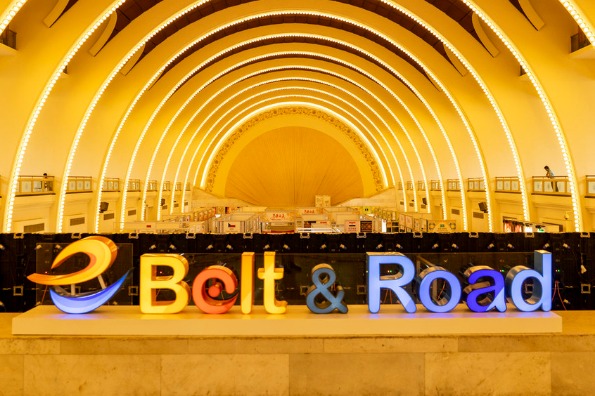
Many accusations have been leveled against the Belt and Road Initiative since it was proposed by President Xi Jinping in 2013. The most common among them are: the initiative is a "debt trap" for developing countries and a form of "new colonialism", and it causes environmental destruction.
However, the attitude of the Association of Southeast Asian Nations toward the Belt and Road Initiative shows the accusations are simply baseless. ASEAN and its member states have been important Belt and Road partners since 2013, and the sheer number of projects completed and under construction under the initiative's framework shows the benefits have been mutual.
For example, a high-speed railway has been built in Laos. The about 142-kilometer-long Bandung-Jakarta high-speed railway in Indonesia was completed this year. The East Coast Rail Link (ECRL) is a 665 km standard gauge double-track railway link infrastructure project in Malaysia. And the massive Malacca Port project was launched two years ago which, after completion, would help ease the burden of the ever-busy Singapore port.
In Myanmar, Belt and Road projects including high-speed railways, highways and dams were launched in 2021. These infrastructure facilities will not only facilitate the movement of goods from and to China's landlocked Yunnan and Guizhou provinces and the Xinjiang Uygur autonomous region, but also bring immense benefits for Myanmar.
Thailand, Cambodia and Vietnam are partnering the Belt and Road Initiative in various ways including the building of railways and highways. Singapore's status is vital for the initiative, especially in investment, environmental protection, finance and legal services. And despite being a relatively small country, Brunei is an important player in the fields of finance and oil. Therefore, it is a valuable partner of the initiative.
In case of the Philippines, the development of Belt and Road projects has been slow, yet China is the top trading partner of the Philippines. Former Philippine president Rodrigo Duterte was in favor of joining the Belt and Road Initiative. But after Ferdinand Marcos Jr won the presidential election in May 2022, the initiative couldn't make headway in the Philippines, mainly because he decided to revive the military agreement with the United States and has again intensified tensions over China's Ren'ai Jiao, or Ren'ai Reef. Overall Sino-Philippine ties suffered setback when the Philippines allowed the US military to rebuild naval bases on its soil with the aim of containing China's rise.
Nevertheless, the Belt and Road Initiative has made many remarkable achievements. First, Belt and Road projects have facilitated economic growth and social development in many countries. Railways, roads and ports have improved transportation, and form the backbone of growth, for they connect cities with towns and rural areas, even remote villages, expediting the movement of products, including agricultural produce, and thus enlarge markets, reduce unemployment and promote education, especially in the countryside.
Second, Belt and Road projects have helped expand many countries' foreign trade thanks to the construction and improvement of ports, airports and highways. This is most evident in countries such as Laos, Cambodia, Myanmar, Malaysia and Indonesia. Such projects have also helped ASEAN to become China's largest trading partner.
Third, the initiative has also helped restore political stability in some countries. By building and improving infrastructure under the Belt and Road framework, some countries have expedited economic development, creating huge numbers of jobs and reducing unemployment, which in turn have reduced public anger and blunted the opposition's attack against the government of the day.
Fourth, the Belt and Road Initiative has consolidated the centrality of ASEAN in the Asia-Pacific region, by helping promote long-term development in ASEAN member states through Chinese investments and trade. Only economic stability can ensure political stability. And for that, ASEAN should maintain its politically neutral stance and oppose outside interference in the region's affairs.
And fifth, coming back to the "China threat" theory that the US and its allies have been spreading, the strong relationship ASEAN and China have built over the past few decades shows that the ASEAN members are against the US' divisive strategy. The US has failed to lure the Southeast Asian countries to join its "Indo-Pacific strategy", which is aimed at suppressing China, because they know they tend to benefit from their economic and trade relations with China.
As Singapore Prime Minister Lee Hsien Loong has said, ASEAN as a whole cannot survive without trade with China.
Unhappy with this fact, US presidents have skipped the ASEAN summits. Former president Donald Trump was the first to do so. Incumbent President Joe Biden has decided to follow in his footsteps, and skip the Sept 5-7 ASEAN Summit in Jakarta.
To quote Lee Hsien Loong again, ASEAN cannot afford to take sides in the Sino-US confrontation. As a result, the "China threat" theory has no takers in Southeast Asia.
The author is the dean of Taima Journalism and Information Academy, Malaysia.
The views don't necessarily represent those of China Daily.