Experts share views on the BRICS Summit







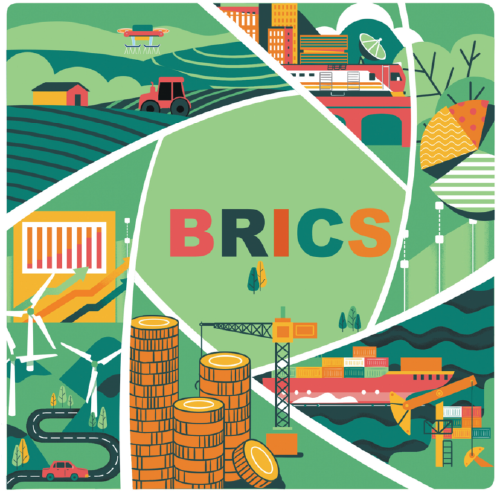
Editor's note: Many have said that the just-concluded BRICS Summit in Johannesburg can be compared with the Bandung Conference because, like the meeting between Asian and African countries in 1955, it brought together developing countries to build a fair, just and equitable world order. Three experts share their views on the issue with China Daily.
Expansion shows importance of BRICS
By Francisco José Leandro
Goldman Sachs estimates that Asia's GDP in 2050 will reach $90.6 trillion (except developing markets) and the total global GDP will be $227.9 trillion. Similarly, the International Monetary Fund's World Economic Outlook estimates that in 2028, the BRICS countries' GDP(in terms of purchasing power parity) will account for 33.65 percent of global GDP, with the G7 countries' GDP declining to 27.77 percent. It seems the future will be driven by Asia's economic development, and in five years, BRICS will become a leading economic force.
Amid all these forecasts, the just-concluded BRICS Summit in Johannesburg announced the inclusion of six new members in the grouping. What should the international community read from these developments?
To begin with, the international community has recognized the importance of BRICS. The BRICS mechanism began with the meeting of the BRIC(Brazil, Russia, India and China) ministers of foreign affairs on the sidelines of the UN General Assembly in 2006. In 2009, it was upgraded to summit level to be held once a year. And in April 2011, South Africa participated as a full member for the first time in the BRICS Summit in Sanya, Hainan province, which changed BRIC into "BRICS". In 2014, the BRICS countries established the New Development Bank and the Contingent Reserve Arrangement.
Besides, the 2022 BRICS Summit, chaired by China and held via video link, put the fight against poverty and the pursuit of sustainable development at the center of South-South cooperation in the context of the United Nations' Sustainable Development Goals.
This sequence of events, culminating in the accession of Argentina, Egypt, Ethiopia, Iran, Saudi Arabia and the United Arab Emirates, shows the consistency, sense of purpose and political commitment of the grouping.
Second, BRICS is seeking a new equilibrium. According to a BRICS Trade and Investment Working Group report in 2022, BRICS is the world's most important economic bloc, accounting for more than one quarter of global GDP and 42 percent of the world's population. Last year, BRICS accounted for 23 percent of the global economic flows, 18 percent of global trade in goods and 25 percent in foreign investment, with its GDP (PPP) surpassing that of the G7.
The NDB and CRA support a number of projects including renewable energy projects in Brazil, railway network upgrade programs in India and new toll roads in Russia. The NDB has approved more than 80 projects and disbursed about $30 billion in loans.
Since the NDB does not impose harsh conditions while providing infrastructure financing for the member states and other developing countries and has been operating as a complement to the Bretton Woods financial institutions, it could help BRICS to have a bigger say in global financial governance.
BRICS has been working on sectoral cooperation in many areas including science and technology, trade, banking, investment, energy, agriculture and healthcare, as well as the fight against transnational crime. As part of sectoral cooperation, Brazilian President Luiz Inacio Lula da Silva proposed in Johannesburg that BRICS create a "common currency" to settle trade deals among the member states. This means the BRICS countries will intensify its de-dollarization efforts by, for instance, promoting the use of their own or other currencies in bilateral and multilateral trade, in order to end the US dollar's hegemony.
Addressing the Johannesburg summit, President Xi Jinping pointed out the new areas of cooperation, which include the digital economy, the green economy, supply chains, artificial intelligence, education, and cultural and people-to-people exchanges.
True, the developed countries still dominate the global governance mechanism for some years, but BRICS has made the world realize that the voice of developing countries can no longer be ignored. And the expansion of BRICS will help its member states to seek a new equilibrium, particularly in the global financial architecture.
And third, BRICS represents inclusive multilateralism. The five BRICS members are dispersed geographically, as would be the 11 members from 2024, when the six new members will become full members. To be sure, the member states are in different stages of development and have different political systems.
But despite the differences, BRICS has opened the door to six new members. BRICS is committed to promoting new possibilities and adopting innovative approaches to resolve knotty issues.
BRICS is asserting a new level of political and economic influence in ways that have caught many skeptics off guard. The BRICS countries are walking together on a mutually beneficial path to build an alternative mechanism to the Bretton Woods organizations — the IMF and the World Bank, and at the same time push for reforms at the IMF, the World Bank and the World Trade Organization.
As President Xi said in his address to the Johannesburg summit, "We need to act on the BRICS spirit of openness, inclusiveness and win-win cooperation to bring more countries into the BRICS family, so as to pool our wisdom and strength to make global governance more just and equitable."
The author is an associate professor at the University of Macau, China. The views don't necessarily reflect those of China Daily.