



Up to no good







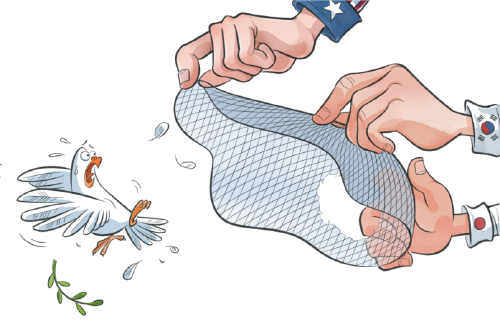
Strengthening of US-Japan-ROK trilateral relations bodes ill for stability of Northeast Asia
The reshaped and improved trilateral relations among the United States, Japan and the Republic of Korea have brought drastic changes to the geopolitical landscape in Northeast Asia and divided the region into blocs, which will threaten regional peace and stability. On Aug 18, the three countries held a summit meeting at Camp David, releasing three purported outcome documents called the "Spirit of Camp David", "Principles of Camp David" and "Consultation Agreement". These documents aim to expand trilateral strategic cooperation into broader areas.
There have been multiple high-level meetings between the three countries since May 2022. At their Phnom Penh meeting in November 2022, they issued a joint declaration on the "Indo-Pacific" trilateral partnership to expand the scope and role of the cooperation to cover a wide range of issues in addition to the purported threat from the Democratic People's Republic of Korea, which marks a key milestone in their trilateral relations.
On June 15, the three countries engaged in consultations on the DPRK, regional security and trilateral cooperation plans. They agreed to further strengthen trilateral cooperation in order to "promote peace and stability in the Indo-Pacific region".
Currently, the trilateral relations among the US, Japan and the ROK are focused on three areas.
First, policy coordination and military deterrence toward the DPRK. In response to the DPRK's ongoing enhancement of its nuclear and missile capabilities, the US, Japan and the ROK are closely coordinating countermeasures to prevent the DPRK from exploiting any disagreements among them to weaken the alliance.
Moreover, the three countries have resumed most of the joint military exercises that had been suspended since 2017. It is expected that military drills targeting the DPRK will be held regularly as an institutionalized arrangement.
Second, supply chain coordination and economic security. In 2022, the US released new tools and mechanisms to address its economic security concerns. Following this lead, the three countries have pledged to initiate an economic security dialogue mechanism, which covers key and emerging technologies, as well as supply chains and data transparency issues.
It can be anticipated that their future cooperation in economic security will focus on restricting Japan and the ROK from transferring advanced chips and chip manufacturing equipment to China, with more control policies expected covering artificial intelligence, biotechnology and quantum computing.
Finally, aligned policies to counter China. On June 11, 2022, the US, Japan and the ROK issued a joint ministerial-level meeting statement, emphasizing the importance of peace and stability across the Taiwan Strait. This was the first time that Taiwan was mentioned in a statement at this level.
During the Camp David summit, not only was the Taiwan question mentioned, but there was also more emphasis on the South China Sea issue, baselessly accusing China. It can be seen that as the US keeps playing the "Taiwan card" and the "South China Sea card", both Japan and the ROK will continue to adjust their stances. Consequently, the scope of trilateral security relations has expanded from the DPRK threat and Northeast Asia security to broader "Indo-Pacific issues", which is a significant change.
For the US, both Japan and the ROK are important allies in the Asia-Pacific region and key partners in its "Indo-Pacific strategy". The joint statement signed at Camp David this time extensively mentions the Association of Southeast Asian Nations and Pacific Island countries, aiming to enable Japan and ROK, two countries deeply involved in these regions, to exert influence and ultimately align ASEAN and Pacific Island countries toward the US, in order to deepen the "Indo-Pacific strategy". The improved Japan-ROK relations are beneficial for the US-led trilateral security cooperation, as well as its "Indo-Pacific Economic Framework for Prosperity".
The ROK is eager to enhance its international influence and become part of Western multilateral institutions. To achieve this, support from the US alone is not enough; it also needs Japan on its side.
For Japan, better Japan-ROK relations will strengthen the trilateral alliance, allowing for more effective long-term containment of China, thereby bolstering US influence in Northeast Asia. Japan also needs to normalize the Japan-ROK military intelligence protection agreement in order to counter what it perceives to be a threat from the DPRK. In terms of discharging Fukushima nuclear wastewater, Japan needs the ROK's acquiescence.
The rapid warming of trilateral relations is driven by the mutual needs of the three countries. However, the ties are unlikely to grow into an alliance or a quasi-alliance due to persisting differences.
The Japan-ROK relations are fraught with enduring issues such as territorial disputes, historical issues and high-tech competition, and the two countries are unlikely to completely abandon past grievances. Shortly after ROK President Yoon Suk-yeol's visit to Japan, the Japanese textbook controversy regarding the Dokdo islets, or Takeshima as they are known in Japan, stirred heightened anti-Japanese sentiments within the ROK.
Both ROK President Yoon and Japanese Prime Minister Fumio Kishida have relatively low levels of domestic support. Pressed by opposition parties in parliament and public opinion, they could be challenged by strong domestic reactions if their diplomatic policies go wrong.
Influenced by the US-Japan-ROK trilateral dynamics, confrontation and rivalry between the DPRK and the ROK have taken shape. The DPRK has conducted multiple missile launches, significantly advancing its missile technology. It is now fully prepared as international relations shift to a new Cold War era.
Due to the Ukraine crisis, ROK-Russia relations have cooled down, while the DPRK and Russia are rapidly warming up ties. After the ROK joined Western countries to sanction Russia, Russia put the ROK on its list of "unfriendly countries".Meanwhile, the DPRK has firmly sided with Russia.
For the US and the DPRK, restarting a dialogue has become difficult and mutual hostilities are mounting.
The deepening of the US-Japan-ROK trilateral security relations has led to the continuous escalation of tensions in Northeast Asia, undermining peace and stability in the region.
The new situation in Northeast Asia has brought about new uncertainties. Stalemate and confrontation seem to have become the norm, and the frequency of crises has greatly increased. In light of this, relevant countries in Northeast Asia and others need to discard the mentality of the Cold War and promote peace, stability, and the common well-being of the region through mutual respect, peaceful development, and win-win cooperation. They should refrain from forming blocs and regional divisions, and work together to advance peace, stability, and regional development in Northeast Asia.
The author is a researcher at the Institute of American Studies at the Chinese Academy of Social Sciences. The author contributed this article to China Watch, a think tank powered by China Daily. The views do not necessarily reflect those of China Daily.
Contact the editor at editor@chinawatch.cn.





