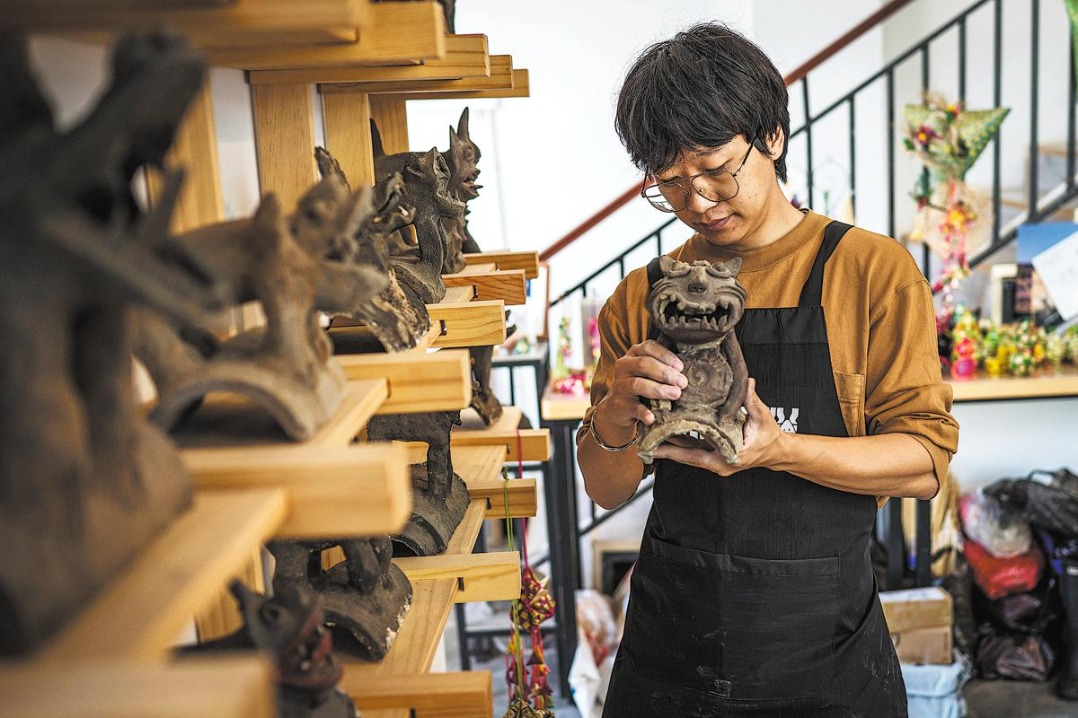
Guideline protects Yangtze culture







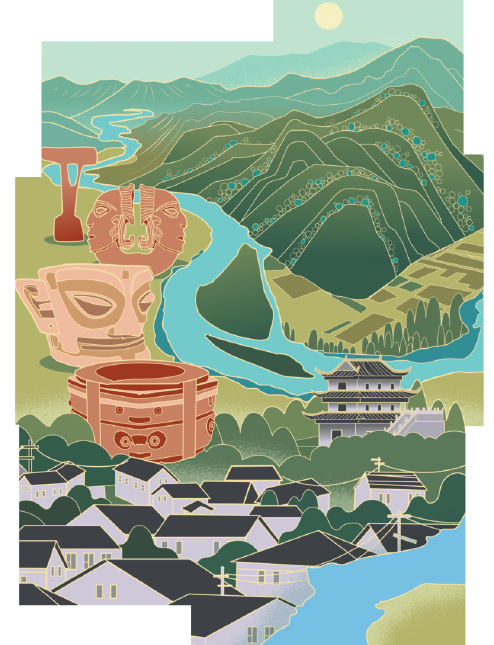
Document looks to preserve river's heritage, promote tourism
Stemming from the bottom of snowy mountains and glaciers in Northwest China's Qinghai province, the Yangtze River runs through a variety of landforms, from deep valleys to peaks, before flowing down the plains of its middle and lower reaches.
Spanning more than 6,300 kilometers from west to east, it has nourished some of the country's most crucial economic zones.
Since the 1980s — and particularly over the past decade — the nation has attached great importance to the integral economic development and ecological conservation of areas along the Yangtze.
To that end, high-level design is taking into account preservation, inheritance and promotion of the abundant cultural heritage in these regions, from primitive men's remains dating back more than 1 million years to innovations being achieved in modern society. Along the river, there are more than 40 UNESCO World Heritage sites, around 3,200 sites that are under State protection and another 5,000-odd under provincial protection. The regions also feature irrigation engineering, agricultural and industrial heritage, historical cities and cultural relics, as well as intangible cultural heritage items, according to Liu Yuzhu, head of the China Foundation for Cultural Heritage Conservation.
They have collectively made the Yangtze River Basin a treasure trove of cultural resources, Liu said at a seminar concerning the basin earlier this month in Yichang, Hubei province. The city is where the Three Gorges Dam, the world's largest hydropower project, is located.
To better revive and preserve these cultural heritage, a national-level guideline was recently released by the Ministry of Culture and Tourism, the National Cultural Heritage Administration and the National Development and Reform Commission.
The guideline aims to shore up the insufficient systematic protection of the cultural relics and heritage along the Yangtze. It also looks to address the lack of in-depth research, interpretation and promotion of these objects, and of related artistic works and products, according to a statement released by the ministry. It prioritizes cultural heritage protection, emphasizing the establishment of a systematic and coordinated preservation mechanism, and seeks consistency in the development of national parks with Yangtze River culture as their theme.
Moreover, it aims to give full play to the key role of the cultural and tourism industries in the high-quality development of the Yangtze River Economic Belt, the statement said.
Other major tasks noted in the guideline include improving public services aimed at enriching people's spirituality and cultural knowledge, upgrading the integrated development of the cultural and tourism industries in the basin, and promoting the river's diverse cultures around the world.
Key historical role
He Yun'ao, a professor at the Department of Archaeology and Cultural Relics at Nanjing University in Jiangsu province, said that while the Yellow River Basin played a major role in the early development of the Chinese civilization, the Yangtze River Basin has gradually become China's economic backbone beginning in the middle of the Tang Dynasty (618-907).
He and a group of scholars, including noted historians Li Xueqin (1933-2019) and Zhang Zhengming (1928-2006), have been studying regional cultures along the waterway since the 1980s and have come to view the Yangtze River culture as a whole.
He said their studies have helped them learn about the cultural diversity seen in different regions of China, and they are now able to understand the pattern of civilizational development and its features, connotations and motivations, which will ultimately benefit the high-quality development of the Yangtze River Economic Belt.
Archaeological discoveries have indicated that rice growing originated in the Yangtze River Basin, fueling population growth and contributing to social organization as collective efforts were needed to build paddy fields and water injection and drainage systems, resulting in ancient people dwelling in groups. Among the 16 rice-growing sites found in China that date back more than 8,000 years, 14 were located along the Yangtze, according to Fu Caiwu, head of the National Institute of Cultural Development at Wuhan University, Hubei province.
At the Chengtoushan site in Lixian county, Hunan province, remains of paddy fields with irrigation facilities dating back some 6,500 years have been discovered. And the Hemudu culture at the Yangtze River Delta had developed a relatively mature agricultural civilization as early as around 7,000 years ago.
Since the Sui (581-618) and Tang dynasties, further advancement in rice growing techniques and farming tools helped the middle and lower reaches of the Yangtze gradually become major suppliers of rice and cloth, as well as the main source of tax revenue, Fu said.
Modern achievements
In modern times, He said, the earliest domestic industrialists emerged in the basin, including textile pioneer Zhang Jian (1853-1926), alkali industry founder Fan Xudong (1883-1945) and the Rong clan, which was also prominent in the textile industry as well as in flour production.
The waterway also played a major role in the nation's revolutionary culture, according to Ren Hui, a researcher at the Chinese National Academy of Arts. The basin includes key areas such as Zunyi, Guizhou province, and Jinggangshan, Jiangxi province, and bore witness to historical events such as the founding of the Communist Party of China in 1921 and the Long March (1934-36).
Currently, the region boasts the South-North Water Transfer Project — the world's largest — and the Three Gorges Dam, a bustling aquaculture industry, boat lifts and the Five-hundred-meter Aperture Spherical Radio Telescope, among other notable fixtures and achievements. There are also large bridges and smart ports and more than 50,000 reservoirs, which make up over 50 percent of the nation's total.
They're all modern industrial legacies, said Chen Jin, former deputy head of the Changjiang River Scientific Research Institute, adding that it's necessary to conduct further multidisciplinary studies of the connotations and main characteristics of the Yangtze River culture by combining natural sciences and humanities.
Cultural studies of the river should contribute to the modernization of the country, and the basin, with its economic base and diverse environments and populations, can serve as a precious demonstration area of China's path to modernization, He said.
The professor added that cultural preservation efforts of provincial-level administrative regions along the Yangtze should be recognized, but there's still work to be done to promote the waterway as a whole. "It requires joint efforts of central and local governments, academia and all sectors of society," he said.
Wang Kaihao and Deng Zhangyu contributed to this story.
fangaiqing@chinadaily.com.cn


- Shanxi ends province-wide blanket fireworks ban
- Audit: China fixes bulk of fiscal problems tied to 2024 budget
- China reports major gains in circular economy
- Chinese lawmakers review draft revision to banking supervision and regulation law
- Top legislature to study draft laws on environment, ethnic unity, national development planning
- Administrative organs must secure people's interests: senior judge