



Failing and ailing
Global trade governance is mired in difficulties, creating a grim outlook for the multilateral trading system







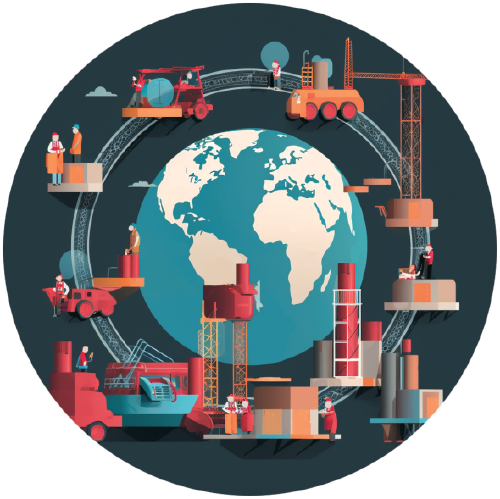
Global trade governance is mired in difficulties, creating a grim outlook for the multilateral trading system
The ongoing transfer and restructuring of the global industrial chains triggered by intensifying geopolitical tensions has aroused wide attention. The restructuring of the global industrial chains will be affected by the long-lasting tussle between political interventions and market forces. In the short run, the political factors will have a stronger influence over the global industrial chains; but in the long run, economic and market forces will be the decisive factor shaping the overall landscape of the global industrial layout.
The rapidly worsening China-US relations after 2017 and the intensifying strategic competition between the two nations are among the most important factors driving the changes. The United States has not only launched a trade war to undermine China-US bilateral trade and a technology war to constrain China's industry upgrading, but also attempted to isolate China through its alliance system.
The COVID-19 pandemic that broke out in 2020 and the Ukraine crisis that erupted in 2022 have also exerted significant impacts on the restructuring of global industrial chains. The pandemic has wreaked havoc on businesses' supply chain management. The most efficient just-in-time supply has exposed huge risks amid the crises, and businesses across the globe have had no choice but to shrink their supply chains. From the perspective of the supply chain layout, it signals a transformation from globalization toward localization, nearshoring and regionalization.
The reshaping of the global industrial chains will inevitably shock the global trade governance system, which will in turn exert a significant impact on the global industrial chains.
The leader and major creator of the global governance system after World War II, the US has become the biggest variable in the transformation of the global trade governance system in recent years.
Since the outbreak of the subprime mortgage crisis in the US in 2008, alongside the decline of US global leadership, the country's attitude toward the global governance system has undergone noticeably profound changes.
A fundamental change in the US trade policy occurred after Donald Trump was inaugurated as US president in 2017. Relying on the US' economic and trade power, the Trump administration attempted to coerce China and other trading partners to make concessions in many areas and open markets wider by unilaterally imposing numerous tariffs. Consequently, the global trade governance system based on trade liberalization, mutual opening-up and exchanges, and the World Trade Organization trade rules that discipline member countries' trade policies were cast aside.
If the Trump administration's trade policy was more or less casual and sudden, the Joe Biden administration's trade policy recalibration is more systemic and well-designed, which better reflects the new attitude of the US toward the global trade governance system. The US elites no longer believe that globalization based on free trade, free markets and free competition serves the country's interests. Instead, they believe the US should create its own internal circulation system and a partial external circulation system in collaboration with its allies, so as to prevent strategic competitors such as China from benefiting from globalization.
The global trade governance system is bound to experience heavy shocks from the change in the US trade policy, as the country is the major creator of the system. Right now, the global trade governance system is mired in turbulence as a result.
To start with, the multilateral trading system is failing, and has a grim outlook. The multilateral trading system, which is highly legalized and based on a huge system of rules formulated by all members through multilateral negotiations, is the most representative example of the so-called rules-based international order that the US claims it wants to safeguard. However, this system is the biggest victim of the US' unilateral actions and the "new Washington consensus". The Barack Obama administration abandoned the WTO's multilateral negotiation platform, the Trump administration crippled the WTO's dispute settlement mechanism, and the Biden administration has discarded the WTO's common understanding of trade liberalization.
It's too early to say the WTO is outdated or even "dead", as it is still running as usual, with its rules generally effective, and most of the market access commitments and other rules reached upon at the Uruguay Round respected and implemented. However, the organization is faltering and can hardly move forward.
Second, despite their growing importance, the regional trade mechanisms are faced with numerous challenges. Under the circumstances of a teetering multilateral trading system, regional trade agreements are gaining more traction and attention. In general, regional trade agreements are compatible with the multilateral trading system; moreover, the larger scope of a regional trade agreement, the more it can promote globalization.
However, in recent years, regional trade arrangements are increasingly exclusive and discriminatory. In particular, the US-led "Indo-Pacific Economic Framework for Prosperity" is designed to advance US geopolitical strategy. Another example is China is actively applying to join the Comprehensive and Progressive Agreement for Trans-Pacific Partnership, but countries such as Japan claim that the CPTPP is a free trade arrangement for countries sharing fundamental values. Although Japan is not opposed to China's application, it clearly echoes the US' attempts to politicize trade issues and to promote friend shoring. Such changes are detrimental to the further development of regional integration that is in line with market principles.
Third, despite a consensus on the necessity of industrial policies, countries have huge disagreements over how such policies should be formulated. Currently, all governments wish to strengthen their countries' respective weak links in industries by actively formulating industrial policies, be it seeking the first-mover advantage in emerging industries or making up for weaknesses in areas critical to national security. Developed countries have displayed an extremely drastic and noticeable change in the attitude toward industrial policies.
The Biden administration has unveiled a slew of industrial policies since 2021 to reduce the US' dependency on China and strengthen control over critical industries, amid mounting anxiety over the rapid increase in Chinese manufacturing industry's competitiveness and the relative decline in the US' own manufacturing industry. The European Union, Japan and the Republic of Korea have taken similar actions as well, resulting in competition among countries over the use of industrial subsidies to spur domestic industries.
In the current trade governance system, the WTO is the only mechanism that could systemically deal with disputes over subsidies, but its existing rules have certain flaws. Given the current state of the WTO and a lack of trust among WTO members, each country will fight his own battle for a certain period to come, creating chaos in industrial policies across the world.
Last, so-called values-based trade has fragmented the global trade system. Over the past few years, certain countries have deliberately integrated values, such as national security, human rights, environmental issues and women's rights, into trade policies and the trade governance system, making trade relations more confrontational and further complicating global trade governance.
The author is dean of the China Institute for WTO Studies at the University of International Business and Economics. The author contributed this article to China Watch, a think tank powered by China Daily. The views do not necessarily reflect those of China Daily.
Contact the editor at editor@chinawatch.cn.





