



The BRICS alternatives to the US dollar







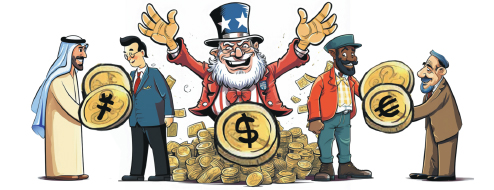
Whenever there is a serious economic situation — such as the mismatch between the price of gold and the reality of the US economy in the late 1960s, the two oil crises of the 1970s, the various financial problems throughout the 1990s, the creation of the euro in the early 2000s and the 2008 global financial crisis — many expect the dollar to lose its importance.
Those expectations have proved to be extrapolative.
It is true that there has been an increase in the relative weight of other currencies as a means of trade, as well as part of foreign exchange reserves for a number of economies. But the US dollar remains the predominant reference in the international market: it still accounts for about 85 percent of all foreign exchange transactions, 61 percent of official foreign exchange reserves (although down from 77 percent in 1970), 40 percent of international payments, and half of all international securities and cross-border loans issued by non-US residents.
The US dollar being universally accepted provides liquidity to private transactions, which many other currencies do not do. No other monetary system offers an equivalent number of “investment grade” government bonds as the United States’. And potentially competing currencies are handicapped by the absence of adequate regulation in the financial system of the country they represent.
A broad global use of a dominant funding currency has benefits, as it generates economies of scale and network effects, thus reducing the costs of transferring capital and risks around the financial system. For foreign economies, this allows borrowers to have access to a broad pool of lenders and investors, reducing funding and transaction costs.
But it also stimulates a synchronized behavior of actors in the global financial system, increasing the transmission mechanisms of shocks stemming from the US monetary policy and credit conditions.
This has led to frequent manifestations with regard to the “exorbitant privilege” enjoyed by the US economy, which can finance itself using the domestic currency at a cost lower than other economies, which impose a burden on other economies. Trade in US dollars requires a double conversion from the domestic currencies of two countries other than the US into dollars and back to the domestic currencies.
Why shouldn`t there be other, more direct, ways to trade, avoiding such costs?
This issue was resolved in Europe by the creation of the euro. But the European Union’s is in a very peculiar situation, because despite two-thirds of the EU’s trade by the participating countries being among themselves, it took several decades and a number of experiments to achieve a common currency. Yet not all EU countries use the euro and often doubts are raised about the survival of the euro.
Nevertheless, the discomfort with the role of the US dollar remains, which has been aggravated by the recent sanctions imposed on Russia: the weaponization of access to foreign exchange reserves in dollars. This has stimulated the search for an alternative global financial and payment system.
Any given group of countries is expected to create mechanisms to facilitate trade and investment within the group as a means to assure homogeneity and attractiveness. This holds true also for BRICS.
There is an increasing demand within BRICS for other mechanisms to facilitate and reduce trade costs, including a reduction in the use of the dollar to settle trade deals. Also, the present scenario is seen by some as an opportunity for creating conditions to broaden the use of other currencies, as well as a stimulus for building new, different payment systems.
But it is unrealistic to talk about a common BRICS currency now, not least because the eurozone, even with very unique characteristics, including geographic proximity, faces frequent problems and the euro has not achieved the expected importance in global markets.
Yet some progress can be achieved. The alternative is to create a mechanism, such as periodic settlements, so that bilateral trade can take place and the actual disbursement of hard currencies is required to only pay for the amount corresponding to the imbalance in bilateral positions.
So instead of talking about a common BRICS currency, efforts should be made to try and design a mechanism that facilitates bilateral trade and, at the same time, substantially reduces the demand for US dollars, therefore, reducing trade costs.
As for an alternative currency to the US dollar, this has been the desire of some policymakers in many countries and regions since at least the 1960s. The problem is that there does not seem to be any natural candidate to fulfill all the present functions of the dollar in the short run. Expectations of economic agents are a determining element, and at present all the indicators are suggestive of a still wide acceptance of the US dollar.
Needless to say, the above arguments refer to a world without digital currencies. From the moment there is widespread adoption of such currencies, a good deal of the above arguments will require strong qualification, and the relative weight of some currencies might change. But that is something still to be seen.
The author is coordinator, Studies in External Economic Relations at the Institute of Applied Economic Research, Brazil.
The views are the author’s personal and don’t necessarily reflect those of the IPEA or China Daily.





