



'CRISPR' crops more resilient in climate crisis







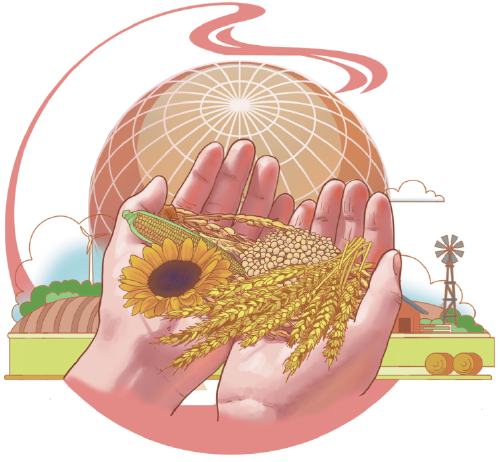
The ongoing scorching summer is pushing up global food prices, once again putting the food security in spotlight. And CRISPR (clustered regularly interspaced short palindromic repeats) crops could be part of the needed response, assuming governments allow them to be grown.
In the 1990s, when a novel transgenic method for improving crops was commercially introduced, governments in Europe placed tight restrictions on these "genetically modified organism (GMO)" crops, requiring them to be separately approved, segregated from conventional crops, separately labeled, and traced through the marketplace with audit records kept for five years. These burdensome regulations were copied at least in part by many other governments, driving GMO foods out of most farm fields and markets, not just in the European Union but around the world as well. As of 2019, 84 percent of all GMO crop acres were in just four western hemisphere countries (the United States, Brazil, Argentina and Canada), and 97.2 percent of the total acres were used to grow just four crops used mostly as animal feed or for industrial purposes: soybean, yellow corn, cotton and canola.
GM staple food crops such as rice, wheat and potato have scarcely been grown anywhere.
The social panic that drove this regulatory response was not supported by scientific evidence. The Royal Society of London, the British Medical Association, the French Academy of Sciences and the German Academies of Science and Humanities have all said they found no convincing evidence of any new risks to human health or to the environment from any of the GMO crops developed for commercial use.
Even the European Commission endorsed this consensus. In 2010, the Research Directorate of the European Union said "biotechnology, and in particular GMOs, are not per se riskier than e.g., conventional plant breeding technologies".
Government regulators now have a second chance to get things right on agricultural biotechnology. Scientists have discovered a new crop improvement technology known as "genome editing", which uses non-transgenic methods such as CRISPR, which do not introduce "foreign DNA" from unrelated organisms into crop plants. CRISPR simply edits out or amplifies genetic traits already contained in a plant, similar to a common natural mutation process.
In addition, genome editing methods are much faster and cheaper than transgenic methods, so they can be more easily done by scientists outside of corporate labs, making it more difficult for private companies to control the benefits. Wageningen University in the Netherlands, a world leader in agricultural research, has announced it will waive its patent rights on CRISPR technology for non-commercial use, which will allow benefits to more quickly reach poor farmers, benefits that can help in the face of climate change.
A review published in 2021 emphasized that gene editing can increase the resistance of corn crops to drought, and can help rice plants survive salinity from coastal flooding.
It seemed at first that the CRISPR crops would escape GMO-type regulations, but in 2018 advocacy groups in the EU used technical legal arguments to convince the European Court of Justice that the new crops should be regulated just as strictly as GM crops. If other governments follow this lead, the latest advance in agricultural science might be stifled as well.
Fortunately, most other countries are not following the EU's example this time, having decided that genome-edited crops with no "foreign DNA" do not need to be treated as being exceptionally risky.
In 2020, Japan approved the sale of genome-edited tomatoes. China and India, which had not approved any significant GM crops except for cotton, also went ahead with genome editing. China's Ministry of Agriculture and Rural Affairs released preliminary guidelines in 2022 exempting gene-edited crops from GMO regulations if the crops had no "foreign DNA". Also in 2022, India exempted genome-edited crops from GMO regulations so long as they had no exogenous ("foreign") DNA, and India's National Agri-Food Biotechnology Institute has continued to develop a gene-edited wheat, higher yielding rice, and a banana, which is rich in beta carotene.
Even in sub-Saharan Africa, leading countries are distinguishing gene-edited crops from GM crops. Both Nigeria and Kenya have published guidelines reassuring CRISPR scientists that crops and animals with no "foreign DNA" will probably not be regulated the same way as GMO crops.
This broad global acceptance for CRISPR crops has left agricultural advocates in the EU feeling isolated and fearful of falling behind the rest of the world in an important new scientific field.
Facing a climate crisis, the world needs to give farmers access to CRISPR crops.
The author is an associate in Sustainability Science at the Harvard Kennedy School and Harvard's Weatherhead Center for International Affairs, and the author of Food Politics: What Everyone Needs to Know. The views don't necessarily reflect those of China Daily.
If you have a specific expertise, or would like to share your thought about our stories, then send us your writings at opinion@chinadaily.com.cn, and comment@chinadaily.com.cn.





