



Japan pushes militarization of Asia-Pacific region







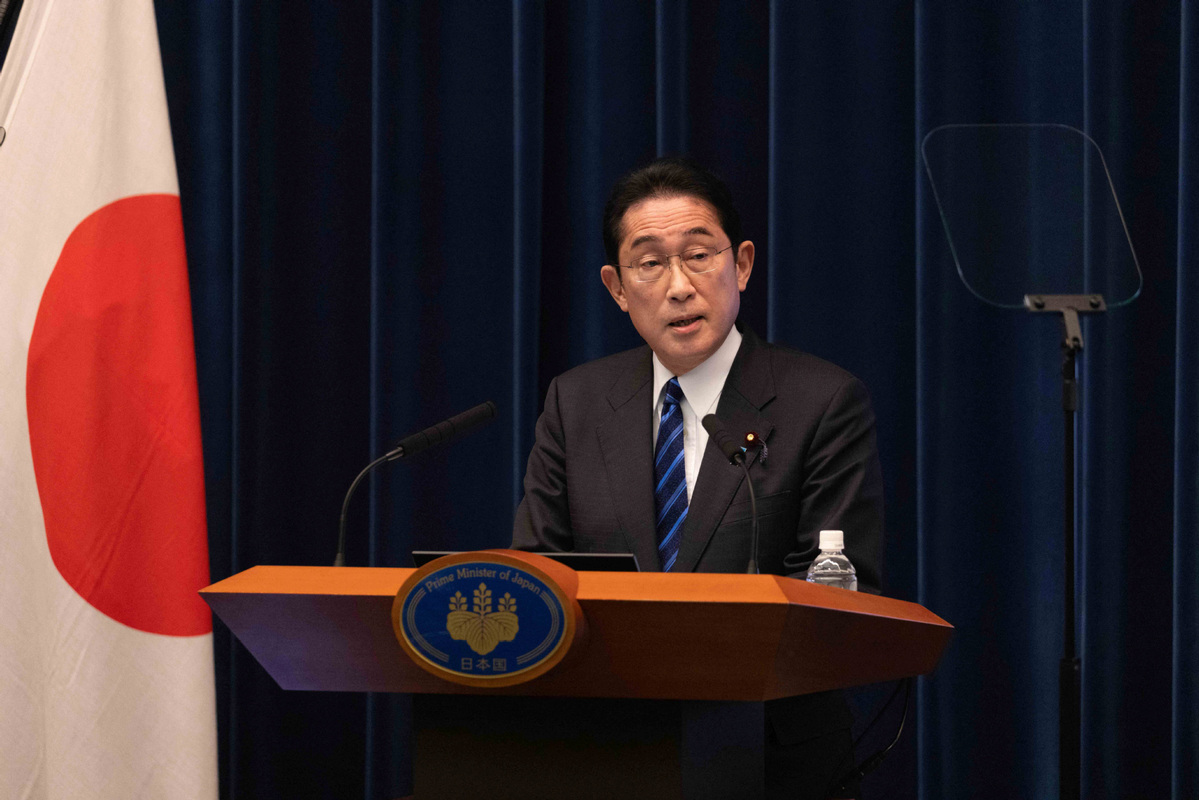
Japanese Prime Minister Fumio Kishida's decision to attend the NATO Summit in Vilnius, Lithuania, on July 11-12 is another proof of Japan's attempt to establish closer ties with the North Atlantic Treaty Organization. To be sure, Japan has been playing an important role in NATO's eastward expansion and strengthening its military. But since the transatlantic military alliance is a Cold War legacy, Japan-NATO military cooperation will create more turmoil and trigger new confrontations in the region, threatening the security of not only other countries but also Japan.
The Japanese government and NATO have been exchanging high-level visits in recent years and their cooperation has become almost normal and institutionalized.
In fact, Japan has been cooperating with NATO for a long time. It became one of NATO's nine "partners across the globe" in 2008, and the two sides signed the Partnership Interoperability Initiative in 2014. Four years later, in 2018, Japan established a permanent mission and designated an ambassador to NATO. And with the two sides' cooperation expanding from nontraditional security to traditional security, Japan has been flexing its military muscle.
For example, Japan Maritime Self Defense Force and NATO conducted a joint anti-piracy drill as early as 2014. They also conducted a joint exercise in the Baltic Sea in 2018, and Japan became a contributing participant in NATO's Cooperative Cyber Defense Centre of Excellence in 2019. Besides, last month, Japan attended a large-scale NATO air exercise called "Air Defender 23", reflecting its military ambitions.
NATO may open a liaison office in Japan, the first of its kind in Asia, although opposed by French President Emmanuel Macron. If established, the office will not only put the two sides' stamp on a "quasi-alliance" but also signal NATO's further expansion to the east and push forward the "Indo-Pacific" strategy of the United States, the real driver of NATO.
NATO will use the liaison office as a tool to intensify its interventions in the Asia-Pacific region, and strengthen its security cooperation and alliances with the Republic of Korea, Australia and New Zealand.
Also, the NATO office in Tokyo will link the US' transatlantic and Asia-Pacific alliance system, making it easier for NATO to intervene in Asia-Pacific affairs, as well as lead or participate in multilateral security activities, including cyber attack and defense drills.
Worse, the liaison office could prompt NATO to interfere and intervene in more issues in the Asia-Pacific, triggering camp confrontation and intensifying competition among major countries, which could lead to conflict.
It is clear that Japan is deepening ties with NATO to build a more powerful military, become a global military power again and broaden its international influence. Last year, the Kishida government approved the revision of three national security documents, authorizing the country to launch (preemptive)"counterstrikes" on enemy bases. This means Japan is slowly abandoning its pacifist Constitution.
The Japanese government has approved a record defense budget for the 2023 fiscal year and plans to raise the amount to 2 percent of GDP within five years to meet NATO's 2 percent minimum defense spending requirement. As such, this year's hefty defense budget is the first step in its five-year, 43-trillion-yen ($315-billion) military spending plan. Needless to say this will disturb the region's strategic balance and spark a new arms race.
Unfortunately, Japan has also been claiming that "today's Ukraine is tomorrow's Taiwan" in order to justify NATO's eastward expansion, while NATO continues to hype up the so-called security threats the Russia-Ukraine conflict has created in East Asia. Also, major European powers, along with Japan and Australia, have been taking part in frequent US-led military drills in the Western Pacific, reflecting their aim to trigger a new Cold War or bloc confrontation so the US could maintain its hegemony.
The Asia-Pacific enjoys stability and economic growth. As a matter of fact, the Asia-Pacific has been driving globalization since the end of the Cold War by, among other things, introducing regional cooperative frameworks such as the Asia-Pacific Economic Cooperation, the Regional Comprehensive Economic Partnership and the Comprehensive and Progressive Agreement for Trans-Pacific Partnership.
But NATO's eastward expansion and the US-led West's move to draw in Japan as a military alliance partner have ruined the cooperative atmosphere in the Asia-Pacific. And the provocative moves of NATO and Japan pose a serious risk to the hard-won peace and stability in the region.
As a major regional economy, Japan's development and prosperity after the end of World War II are inseparable from the peace and stability in the Asia-Pacific region. By aiding NATO to expand eastward, Japan is deviating from the path of peaceful development, raising the international community's concerns about history repeating itself.

The views don't necessarily reflect those of China Daily.
If you have a specific expertise, or would like to share your thought about our stories, then send us your writings at opinion@chinadaily.com.cn, and comment@chinadaily.com.cn.





