


Deep-sea exploration mission ends on wave of success








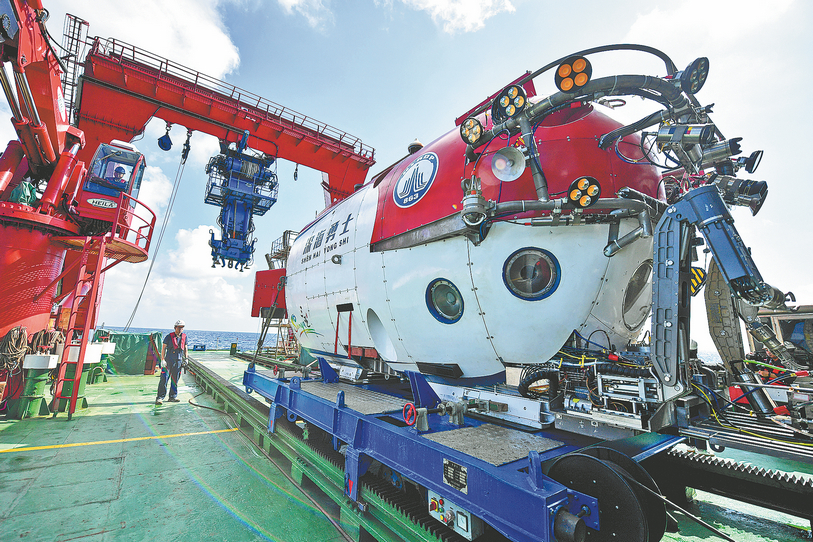
ABOARD TANSUO 1 — Early on the morning of June 11, China's scientific research ship Tansuo 1 (Discovery One), carrying the crewed submersible Shenhai Yongshi (Deep Sea Warrior), reached Sanya, South China's Hainan province, marking the successful conclusion of a groundbreaking deep-sea archaeological investigation mission.
Over the past 20-plus days, the submersible, carrying members of a joint archaeological team, secured more than 200 cultural relics dating back about 500 years from the site of two ancient shipwrecks, which are located about 1,500 meters beneath the waters of the South China Sea.
Among the discoveries were an iron anchor measuring about 1 meter in length, a box that appears on first inspection to be made of wood, two pieces of timber, and various ceramic items, such as a blue-and-white porcelain jar, a blue-and-white porcelain dish and a white-glazed bowl.
Unprecedented discovery
The submersible mission was the first stage of a broader underwater archaeological investigation focused on the two shipwrecks, being conducted by Chinese scientists and technicians on board the research ship Tansuo 1.
The wrecks were first discovered in October 2022 by Shenhai Yongshi after about 500 exploratory dives. They were identified as being from the Ming Dynasty (1368-1644) and were later named the No 1 and No 2 shipwrecks near the northwest continental slope of the South China Sea.
The relatively well-preserved wrecks contain a large number of cultural relics of important historical, scientific and artistic value. The discovery is not only a major breakthrough for China's deep-sea archaeology, but also a significant archaeological discovery on a global level.
According to Yan Yalin, director of the archaeology department of the National Cultural Heritage Administration, the discovery demonstrates the historical fact that Chinese ancestors had developed, utilized and traveled to and from the South China Sea. It contributes to the research on China's maritime history, ceramic history, overseas trade history and study on the Maritime Silk Road.
To conduct the archaeological investigation, a joint archaeological team consisting of about 30 people, including archaeologists and experts in geophysics, marine geology, marine biology and electromechanics, was assembled and a three-stage archaeological investigation launched.
The mission is an unprecedented one.
China started its underwater archaeological explorations in the 1980s, but most of the missions were conducted in shallow coastal areas, about 40 meters below sea level. In 2018 and 2022, the country conducted two deep-sea archaeological investigations, opening a new chapter for the country's deep-sea archaeology.
However, this most recent mission is particularly challenging.
For one thing, the extensive nature of the archaeological findings at the site poses certain challenges. Apart from the shipwreck, large amounts of ceramics and pottery objects, as well as pieces of timber, were found scattered across an area of about 10,000 square meters, sitting on the ocean floor about 1,500 meters below sea level.
Moreover, there is no one to turn to for guidance on such a project. "There is no previous case worldwide of conducting an archaeological investigation on shipwrecks of such scale at this depth," says Chen Chuanxu, an expert in geophysical prospecting and deputy head of the mission.
The team members had to grope their way and blaze their own path.
No easy job
Considering the complexity of deep-sea archaeology, the team made scrupulous plans for almost every aspect of their work. From the cleaning and transportation of relics to formatting each member's work journal — all the details were discussed by the members before the best plan of action was decided upon.
"Unexpected situations could arise at any moment," says Song Jianzhong, head of the mission. "It is a tough trip for everyone, and great challenges await us."
Each dive took around eight to nine hours, during which the archaeologists worked with great concentration to observe, record and analyze the site's status. Meanwhile, the submersible pilots, in accordance with the experts' instructions, performed tasks like laser measurement and multi-angle footage recording, and collected samples and relics with the submersible's robotic hand.
The work was carried out with extreme diligence and prudence.
"In many cases, there is no second chance — one mistake can lead to irreversible consequences," says submersible pilot Li Hangzhou, adding that all the submersible pilots maintained the highest standards during the mission.
High technology also played an important role.
For instance, to determine the best location to collect samples in the vast area where the relics were scattered, Yue Chaolong, a member of the team's information compilation group, used 3D digital image-stitching technology to process the visual footage from each dive and generate a panoramic map of the site.
Beyond dreams
The first investigation stage has proved successful.
In addition to the relics collected, the team also conducted 3D laser scanning and visual material stitching of the core piling areas of both shipwrecks.
The mission also conducted some experiments and used advanced technologies, such as long-baseline positioning and soft robotic grippers, for deep-sea archaeology. Moreover, by keeping detailed journals, science reports and registration forms of secured relics, the team has improved the work protocols for deep-sea archaeology.
Zhang Ninghao, another mission deputy head, says that the end of this investigation stage represents a new beginning.
To the team, the investigation is a powerful reminder of how many mysteries of civilization are hidden beneath the waves.
Archaeologist Deng Qijiang, who is also a mission deputy head, recalled after finishing one dive, "I may have dreamed about it a hundred times, even a thousand times, but this goes far beyond my dreams."