



China jolts EV market with affordable vehicles







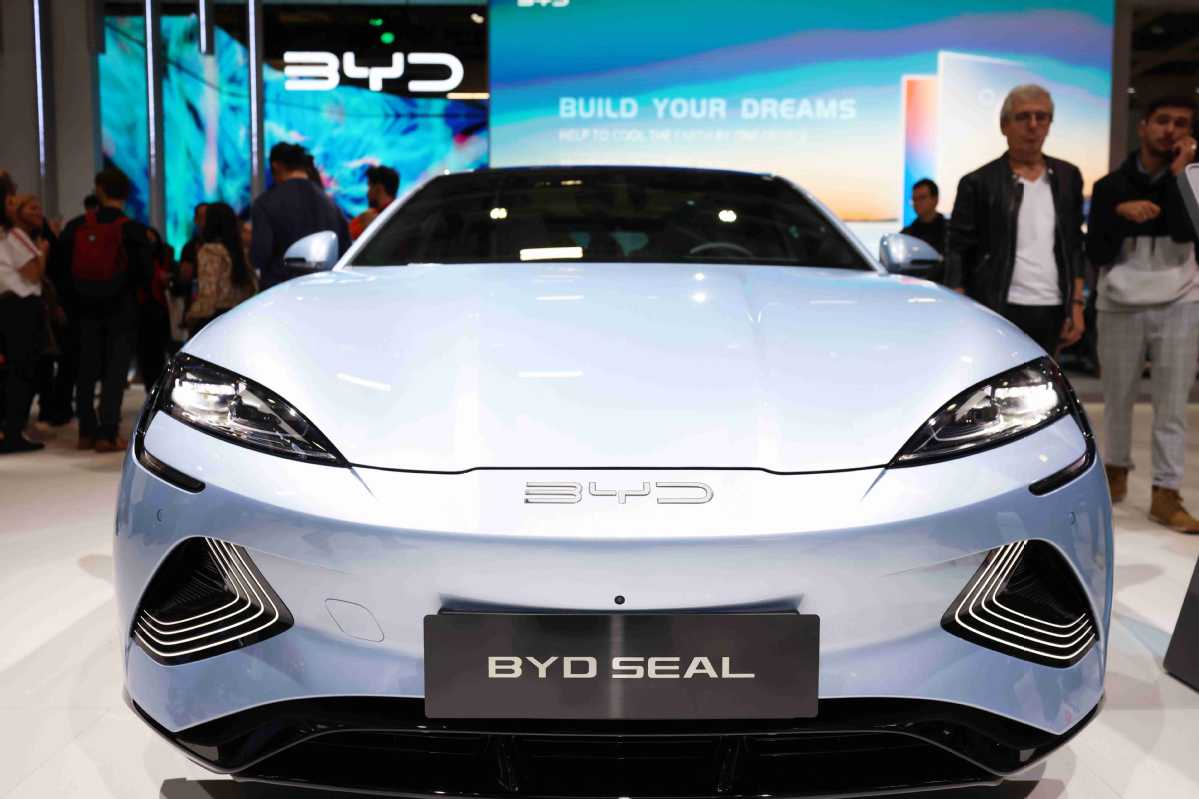
One of the keys to success in the electric vehicle industry is making an affordable car for the mass market.
Chinese automaker BYD — which stands for "Build Your Dreams" — is doing just that.
At the Shanghai auto show in April, BYD rolled out a compact battery-powered hatchback called the Seagull that sells for around 79,000 yuan ($11,000).
"The Seagull was the shot heard around the world when it comes to affordability of electric vehicles," The Washington Post quoted Bill Russo, founder and CEO of the Shanghai-based advisory company Automobility, as saying.
Tu Le, founder of Beijing-based consultancy Sino Auto Insights, said Chinese companies aren't holding back on quality, either, Business Insider reported.
"They have the products to back it up," he said. "I've driven a number of the Chinese EV brands, and boy, oh boy, the Europeans are in trouble."
BYD, a conglomerate headquartered in Shenzhen, Guangdong province, surpassed Elon Musk's Texas-based Tesla this year to become the top-selling EV brand in the world.
BYD delivered 547,917 passenger EVs, including hybrids, in the first quarter of 2023. Tesla shipped around 422,000 vehicles in that time, according to TechCrunch.
Musk "likes to think he can make the EV affordable for everyone — he's been talking about a $25,000 electric vehicle for years, but he doesn't have one right now", Russo told The Washington Post. "If anyone is democratizing the EV, it's Wang Chuanfu, and he's the one who should be called the Henry Ford of the 21st century."
Wang, born to a humble family of farmers in Anhui province, founded BYD in 1995 to make batteries for laptop computers and cellphones. In 2002, BYD entered the auto market when it acquired the failing Tsinchuan Automobile Co.
During a factory tour in 2008, according to Fortune magazine, Wang, now a multibillionaire, told David Sokol, then an executive at Warren Buffett's Berkshire Hathaway, that in an attempt to make recyclable batteries, BYD had developed nontoxic battery fluid. Wang, a chemist, poured it into a glass and drank it. A few months later, Buffett invested $230 million in BYD.
Charlie Munger, Buffett's longtime business partner, said in February that BYD was so far ahead of Tesla that "it's almost ridiculous", the Post reported.
Le, of Sino Auto Insights, told the Post that, "BYD has always built its own chips and made its own batteries and engineered them themselves".
Musk, when asked to name Tesla's main competitor during an earnings call earlier this year, responded "some company out of China".
Former Tesla director Steve Westly said, "By any standard, BYD has come from nowhere to be one of the major car companies in the world.
"Some would say they've out-Tesla'd Tesla," Bloomberg Businessweek quoted Westly as saying.
This year, BYD hopes to sell as many as 3.7 million fully electric and plug-in hybrid cars, reported Bloomberg Businessweek, while Tesla has said it may produce as many as 2 million EVs.
In a company letter in 2022, Wang wrote: "The new energy vehicles sector was facilitated by explosive development in technology, product and market size, and delivered a record high of 1,788,000 new energy vehicles in 2022, representing a year-on-year growth of over 217.6 percent."
Another advantage for BYD is its massive global workforce of 570,000, which is 200,000 more workers than Toyota has.
Wang has said that for now, BYD's expansion strategy requires avoiding "automobile powerhouse countries" like the United States, Germany, Japan and South Korea, where the "political risks are relatively high".
Still, BYD has been manufacturing electric buses at a factory in Lancaster, California, for several years for cities including Los Angeles and Long Beach.
Tesla announced in March that it would open its next Gigafactory in Mexico. Chinese EV makers could follow the lead, possibly avoiding US import restrictions by building vehicles in North America, the Post reported.
As Chinese automakers such as BYD, Geely and Nio consider setting up shops in the US, they will have to overcome political obstacles and also impress US consumers, Business Insider reported.
A Trump-era tariff of 27.5 percent remains on Chinese cars, while the Biden administration's new tax credits for EV purchases favor vehicles built in North America — with battery components that don't come from China.
US auto manufacturers have been promising a long-range EV option priced at or below $30,000 for years. General Motors plans to cancel the Bolt EV, America's cheapest electric vehicle, and use the factory where it's produced to build high-end electric pickup trucks instead, Business Insider reported.
Now, BYD, which stopped making gasoline-powered vehicles in 2022, is rushing to sell EVs in those foreign markets, but for now, not in the US.
"The US market isn't under our current consideration," Stella Li, a senior vice-president of BYD, told Bloomberg in an interview. Li, who is in charge of the company's international expansion, also believes that US President Joe Biden's Inflation Reduction Act may "slow down EV adoption in the US" because it will make affordable EVs inaccessible — such as those from China — to US consumers.
In August, the US Congress passed the IRA, which provides up to $7,500 in tax credits toward purchases of clean energy vehicles that meet certain domestic sourcing and manufacturing criteria.
Those tax credits helped the US move into the No 2 spot in battery-powered EV sales in the first quarter of 2023 (behind China) after it surpassed Germany.
Reuters contributed to this story.




















