Air quality improvements keep nation on track to achieve govt's climate targets







Measures to stop farmers burning straw and encourage alternative uses, such as the production of biomass fuel, are resulting in profound changes in North China. Yuan Hui reports from Hohhot, with Hou Liqiang in Beijing.
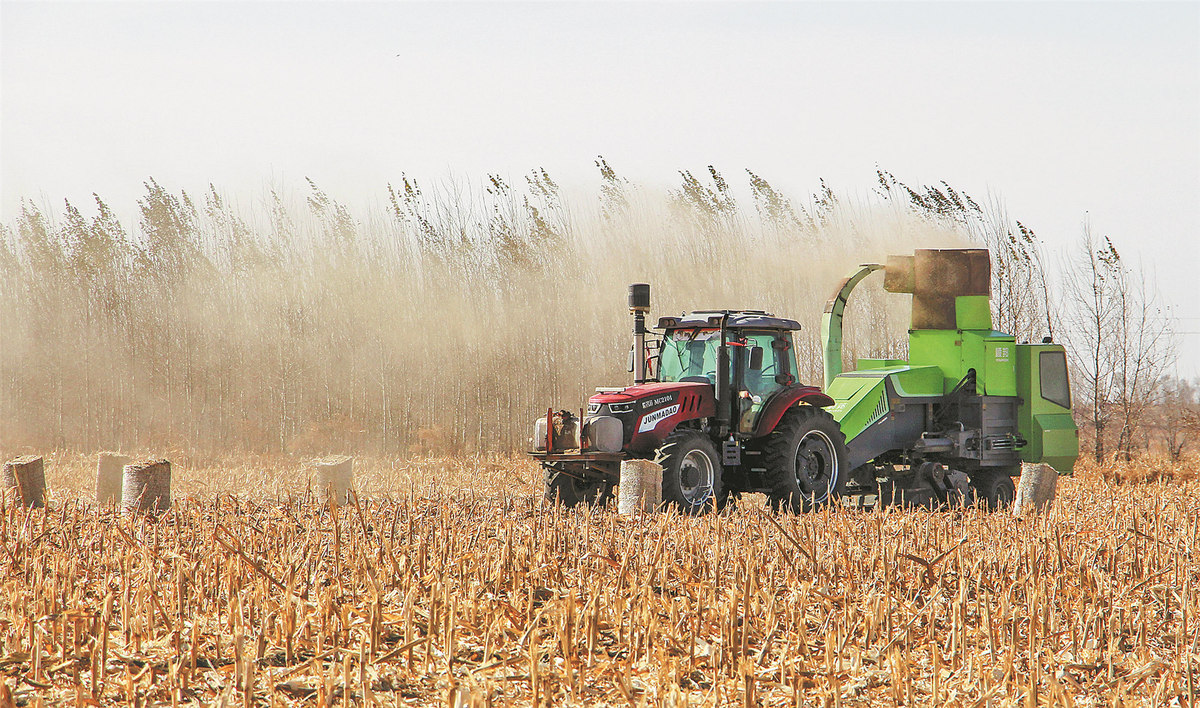
Like their peers in many other parts of North China, generations of farmers in the Inner Mongolia autonomous region once used a simple method to dispose of straw stalks — they simply set them on fire on the farmland.
However, since the turn of the new millennium, when the central authorities imposed a ban as part of efforts to improve control of air pollution, local authorities' supervision of straw burning has evolved into a game of cat-and-mouse between law enforcement officers and farmers.
"As soon as the local government relaxed its supervision a little, farmers went to set fires, no matter whether it was day or night," said Gao Yinhai, a farmer from the region's Hinggan League. "Sometimes, it looked as if entire fields were burning."
With his home area shrouded in heavy smoke, visibility on the local highway was sometimes no more than 100 meters, said Gao, who runs Kunpeng, a dairy cattle cooperative.
Rural vitalization
Now, instead of polluting the air, the straw stalks in many of Inner Mongolia's major grain-producing areas are contributing to efforts to promote rural vitalization and help the country reach the government's climate targets: peaking carbon dioxide emissions before 2030 and becoming carbon neutral before 2060.
A lot of agricultural waste and animal dung is transformed into biomass fuel, a clean, renewable energy source. While the smoke that blocked out the sky has gone, an industry chain has come into being, with many farmers making stable incomes by collecting straw stalks.
As a major grain-producing area, Inner Mongolia boasts about 11.5 million hectares of farmland, second only to the northeastern province of Heilongjiang.
According to a survey of pollution sources in the region published in 2020, more than 36.7 million metric tons of straw stalks are generated every year.
While promoting traditional approaches to the disposal of straw stalks, such as digging them into the soil as organic fertilizer or compressing them to produce animal fodder, places such as Bayannuur have tapped into the potential of waste material as a source of biomass fuel.
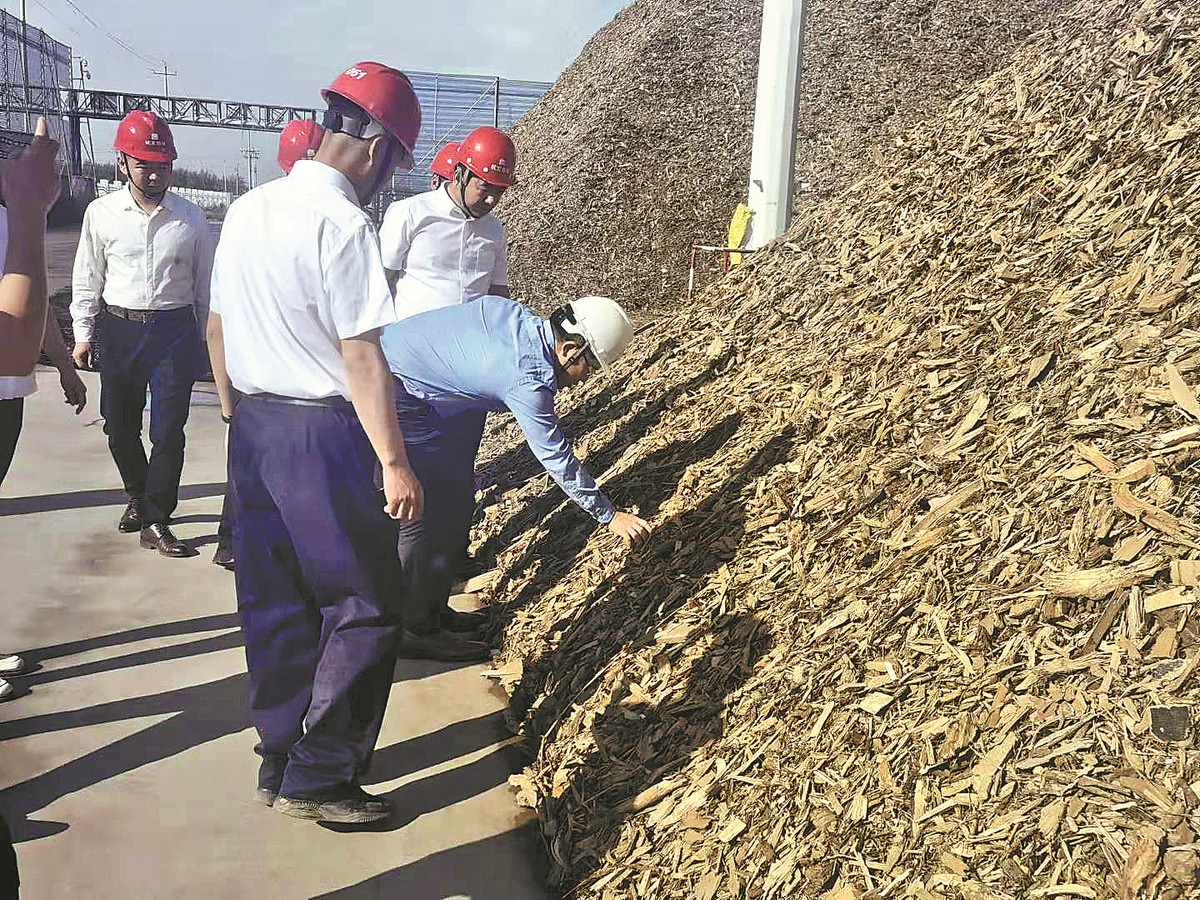
In 2017, the city introduced a biomass power-generation project with total investment of 277 million yuan ($38.7 million). Since becoming operational on May 8, 2019, the project has not only helped improve the environment and mitigate climate change, but also provided financial benefits for local farmers.
Financial bonus
Li Huaiqing, general manager of Hanglong Biomass Power Generation, the company that runs the project, said that in addition to generating about 210 million kilowatt-hours of electricity per year, the project supplies 250,000 tons of industrial steam and provides heating for 1.5 million square meters of housing.
This results in the use of standard coal being reduced by 95,000 tons and lowers carbon dioxide emissions by roughly 210,000 tons every year, he added.
According to the department of industry and information technology in Bayannuur's Hanggin Rear Banner, since the project went into operation it has consumed more than 1.2 million tons of straw stalks. In addition to employing 120 local people, the project has benefited more than 3,000 people, as the company has paid 320 million yuan to local farmers to buy their straw stalks, it added.
One of the beneficiaries is Zhu Xiaomei, who lives in Bayannuur's Menghai township.
The 43-year-old used to take whatever odd jobs she could find — such as working at a local coal washing plant — when she could spare time from her approximately 7 hectares of farmland.
Now, she can make a more stable, higher income as an agent collecting straw stalks for the biomass plant.
"Before, I could only make a little more than 100 yuan a day by working odd jobs," she said, adding that it was impossible to find odd jobs all the time.
All she needed to do to start her straw-collection business was to buy a strapping machine, she said.
The local farmers don't charge her for the straw she collects from their farmland, and she sells it to the biomass plant for about 280 yuan per ton.
From September to May, which is the fallow season for farming, she can collect 700 to 800 tons of straw stalks, she said.
Thanks to the project, many local farmers no longer burn straw.
"The air quality has improved, while the biomass power plant has brought considerable financial benefits to local people," she added.
Wu Zhanjun, from Shanba township in Bayannuur, noted the great environmental and financial benefits from the project. The heavy smoke that blocked out the sun and the sky has gone, said the 50-year-old, who has been a farmer since he was 16.
After the biomass power plant went into operation, Wu bought a strapping machine to collect straw on his 20 hectares of farmland, which produces about 100 tons of stalks every year.
He has also started a business collecting straw stalks from other farms with his machine, charging 150 yuan for every hectare of farmland he clears, he said.
Every year, Wu can collect stalks from almost 670 hectares of farmland, making full use of his time in the fallow season. "It's a good business," he said.
The use of straw stalks as biomass fuel is also popular in Horqin Right Wing Front Banner, Hinggan League, as part of local efforts to dispose of agricultural waste in an environmentally friendly way.
At present, roughly 15 percent of the 130 tons of straw stalks generated in the banner every year are used as biomass fuel.

Business opportunities
Gao, head of the Kunpeng cooperative, also found emerging business opportunities in biomass fuel production after the price of coal rose to a record before winter 2021. Instead of making fodder from straw stalks on his cattle farm, he switched to producing biomass fuel via machines that cost him about 2.6 million yuan.
Local people used to depend on coal to dry grains and heat their homes, but if they use his cooperative's biomass fuel they can cut their costs by 30 percent, he said.
Though his two biomass production lines have a combined production capacity of 60,000 tons a year, they currently only produce 10,000 tons as there is not enough storage space for the large volume of straw stalks required to meet production demand throughout the year, he said.
Despite that, the 10-member-strong cooperative can still make annual net income of about 800,000 yuan by producing biomass fuel, he added.
The local price for straw stalks stands at 220 to 260 yuan per ton, and the cooperative sells the biomass at 900 to 1,200 yuan a ton, Gao said, adding that there is no lack of raw materials for biomass fuel production in his home area.
His village boasts more than 3,300 hectares of farmland, and if they were all planted with corn, they could produce 12,500 tons of straw stalks every year, he noted.
According to the local government, nearly 1.2 million hectares in Hinggan League were sown with grain last year, yielding 6.7 million tons of the crop.
Expansion plans
Gao said that the cost-effectiveness of his cooperative's biomass fuel led the local government to invite him to run the heating supply plant in his home township.
The rise in the price of coal saw the previous contractor quit the business last year as she found it difficult to balance the books, Gao said. As such, the local government was forced to operate the facility itself during the most recent heating supply season, but it lost 800,000 yuan.
Gao said that if he accepts the invitation, the annual output of biomass fuel from his cooperative would be just enough to meet the demand of the heating supply plant, so he is considering investing more money to raise output, he said.
"Demand for fodder is not that high in the local market — however, the demand for biomass fuel is huge," he said.