China explores recycling options for waste from photovoltaic sector







Country planning ahead for end of life of key product for realizing carbon goals
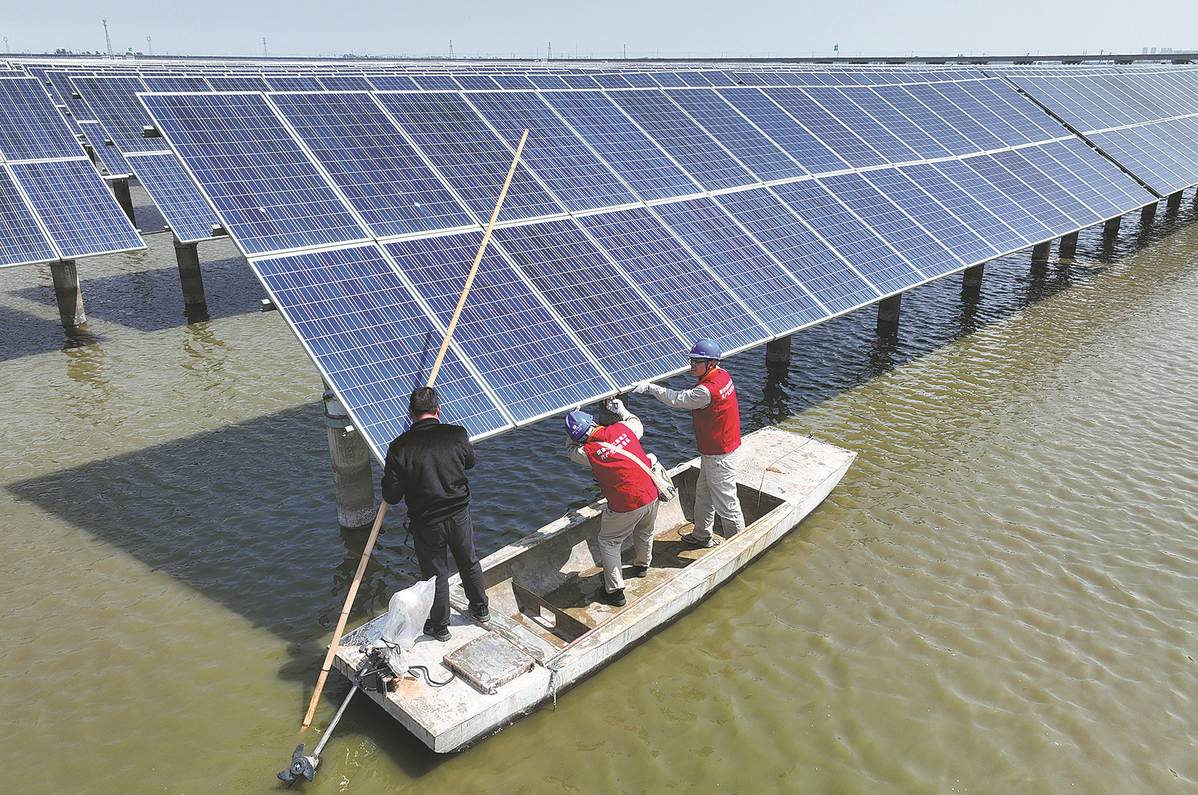
With Monday being China's ninth National Environment Day, themed this year on modernization characterized by harmonious coexistence between man and nature, experts are calling for greater attention to an emerging issue: the coming surge in photovoltaic panel waste.
Modernization cannot be achieved without a huge transition to renewables, especially solar energy, according to industry experts.
As China forges ahead with its green transition, significant progress has been made in the development of solar energy. As the world's largest manufacturer of solar panels, China has been injecting powerful impetus into global solar energy development.
Thanks to devoting a great deal of effort to R&D, China has also made significant progress in PV waste recycling, as demonstration projects are gradually being put into operation.
Experts said that a lot more still needs to be done, as a large percentage of the country's existing solar panels will reach the end of their life spans in the near future. Efforts are urgently needed, for example, to hammer out necessary standards of environmental risk control for the disposal of PV waste.
A 2016 report produced by the International Renewable Energy Agency (IRENA) and the International Energy Agency Photovoltaic Power Systems, projects that as annual end-of-life PV panel waste rises over the next 10-15 years, it will reach a cumulative total of between 60 to 78 million metric tons by 2050. By then, China will also have accumulated the greatest single amount of PV waste, accounting for between 13.5 to 20 million tons of the global figure.
However, Liu Limin, deputy secretary-general of the PV Recycle Industry Development Center in Jiaxing, Zhejiang province, thinks that the large-scale decommissioning of PV panels may come earlier than the IRENA report projects.
Quoting data from the Zero Carbon Research Institute in Hebei province, she said that China may see PV panel waste reach 20 million tons by 2040, and the PV recycling industry worth a potential 150 billion yuan ($21 billion).
"There will be a huge market for PV waste recycling in the future," she said in a recent seminar organized by Beijing's China Environmental Protection Industry Research Institute.
The institute's projection is in line with that made by Liu's center. According to a white paper it published in January on the recycling and use of solar panel waste, the first batch of solar panels installed in China will start being decommissioned in 2025.
The country's cumulative growth of solar panel waste is expected to follow an explosive trajectory after 2035, the white paper noted, given that 2015 marked the start of the extensive installation of solar panels across China.
As a public institution affiliated with the Ministry of Industry and Information Technology, the center was founded in April last year and is the first of its kind in China dedicated to PV recycling.
According to "Policies and Actions for Addressing Climate Change (2022)", a report compiled by the Ministry of Ecology and Environment, 182 gigawatts of photovoltaic power were produced in China in 2021, and the country has led the world in terms of photovoltaic production for 15 consecutive years.
Some 48.3 GW of solar energy capacity was installed in the first four months of this year, compared with almost 16.9 GW during the same period last year, the National Energy Administration said on May 19.
Zhong Dalong, chief technology officer for solar energy at the National Institute of Clean and Low-Carbon Energy, said the influx of PV waste may happen earlier in China because some companies are likely to decommission low-efficiency panels before they reach their expiry date, because land for solar development is becoming increasingly scarce.
Challenges remain
As part of efforts to prepare for the coming influx of waste, China worked hard to develop recycling technology through a 2019-22 national R&D program focused on recycling crystalline silicon PV modules. According to the PV Recycle Industry Development Center's white paper, 13 academic and research institutions and companies participated in the program.
Upon conclusion of the program, two demonstration lines for PV waste recycling were set up, one making use of physical treatment and the other taking a chemical approach.
Despite the fact that Europe and Japan started researching PV waste recycling earlier, Liu said that China doesn't lag behind in recycling technology, and Zhong also pointed to the fact that key national PV waste R&D programs have been introduced in both of the last two Five-Year Plan periods.
With more programs launched during the 14th Five Year-Plan (2021-25) period, he expects to see even greater progress in development, and said both the government and the industry are paying close attention to PV waste recycling. "I think the sector will have an upbeat outlook," he added.
However, Hou Guiguang, an official with the Solid Waste and Chemicals Management Center, said that China isn't well prepared in terms of standards and management policies for PV waste recycling.
The center is an affiliate of the Ministry of Ecology and Environment.
Although the influx of decommissioned PV waste has not yet begun, it will come earlier than many people expect. But the government's work on technical standards and management policies for PV waste recycling is still in the initial stages, he said.
There is currently no rule for managing the mixture of decommissioned PV modules in smelting, or for controlling the emissions, he said. As the country explores how to control the environmental risks that may arise from the dismantling process, no mature standards have yet been introduced.
This means that recycling companies have no do's or don'ts to follow.
Zhong said that recycling companies also face challenges in getting hold of PV waste.
In recent years, centrally administered State-owned enterprises have installed large numbers of solar energy projects, he said. When the panels in these stations reach the end of life, they remain State-owned assets. Currently, neither the central SOEs or the relevant national government bodies have introduced policies for treating PV waste.
Cross-regional transportation of solid waste is also now tightly restricted, complicating the circulation of PV waste, he added.
Experts have noted the dilemma of whether China should introduce an extended producer responsibility mechanism as a way of coping with the coming influx of waste.
As an environmental policy approach, this mechanism would assign producers responsibility for the end of life of products. In China, such a mechanism is applied to manufacturers of home appliances.
Li Dan, executive secretary-general of the Chinese Renewable Energy Industries Association, said that whether China introduces an extended producer responsibility mechanism in the PV sector may largely depend on whether PV waste recycling proves profitable.
There will certainly be companies willing to engage in PV waste recycling if the profit margin is considerable, she said, adding that if that turns out not to be the case and the margin is small or even nonexistent, the mechanism should kick in and producers will be made responsible for recycling.
Liu said that at the moment, recycling PV waste in China is still not economically viable. It currently costs 75 yuan to recycle a standard-size PV module, but gross proceeds only stand at 56 yuan.
"That doesn't necessarily mean that recycling will not be economically viable in the future," she said.






- Most parts of country were warmer than usual in 2025
- Poverty relief transitions to governance
- 'Micro sports areas' boost students' fitness, fun
- China tips scales toward healthier living trends
- Anti-corruption efforts focus more on work conduct issues
- Deeper reflections on 'cave-dwelling conversation'