Bird survey takes wing to produce comprehensive record







Editor's note: As protection of the planet's flora, fauna and resources becomes increasingly important, China Daily is publishing a series of stories to illustrate the country's commitment to safeguarding the natural world.
The three-year monitoring project will provide important data for the country's conservation efforts. Chen Liang reports from Shennongjia, Hubei.
The only reason Zhong Jia could participate in a comprehensive bird survey launched last month at the Shennongjia National Park, Hubei province, is that she is a member of the Rosefinch Center, she said.
Fortunately, the nonprofit, which is dedicated to the promotion of bird-watching and conservation, is the project's contractor, she added.
The ideal survey participant should be an experienced bird-watcher, who is adept at identifying the different bird calls and songs while walking and driving, she said.
"I'm not sensitive to bird noises, too old to walk long distances on mountain paths and I can't drive. So I am barely qualified," she added.
She was being modest. The 70-year-old retired newspaper editor and former environmental reporter was one of the founders of the center and also of the country's first group of bird-watchers.
During her nearly 30 years of bird-watching and participation in numerous surveys, she has gained extensive knowledge of China's avian wildlife.
However, her modesty did reveal the center's determination to run a successful project.
In fact, the survey was the second of 12 such activities in a large-scale, three-year monitoring project organized by the Shennongjia administration to track the status and trends of birds in the park.
"If you know about the country's conservation system, you will know how rare it is that a government institution is willing to give such a project to an NGO," said Lei Jinyu, the center's secretary-general.
As one of the project's main designers, he will manage it over the next three years. "For us, it's a milestone and breakthrough. We can't afford to fail," he said.
Why use amateurs?
Speaking at the national park's headquarters in Muyu town, the administrative seat of the Shennongjia forest area, a county-level area in Hubei, Yu Huiliang, deputy director of the park administration's science academy, said the monitoring project is just one of 15 parts of a comprehensive survey of the park's natural resources.
According to Yu, Shennongjia became one of 10 pilot national parks in 2016 after the central government decided to protect its ecosystem in a more efficient way.
It has completed its pilot period and has applied for official status — a process that will take several years — so a comprehensive survey of resources is of vital importance to the application, Yu said.
In August 2021, the Hubei government merged four nature reserves in four counties with the park, expanding its total area to 2,400 square kilometers.
"The comprehensive survey will cover all the newly added reserves and be conducted in Shennongjia and four other counties," Yu said.
The program, which has a budget of nearly 30 million yuan ($4.20 million), was officially launched in March. It is being conducted by 13 research institutes and universities inside and outside Hubei.
They include the Chinese Academy of Sciences' Institute of Hydro-biology in Wuhan, Hubei's provincial capital, the Institute of Zoology and Institute of Botany in Beijing, the Kunming Institute of Botany in Yunnan province, the Wuhan Botanical Gardens, Wuhan University and the China University of Geosciences (Wuhan).
"The Rosefinch Center is the only NGO involved," Yu said, adding that amateur bird watchers are playing an increasingly important role in related activities nationwide.
They have helped add many new species to the national checklist, and their records of sightings are commonly used in scientific research, according to Yu.
He said the center runs the country's most popular online system for submitting bird records and has published a monthly bird-watching magazine for many years.
Since 2019, the Shennongjia forest area has held four bird-watching festivals. Despite being suspended last year as a result of the COVID-19 epidemic, the annual festival has become a special event for Shennongjia, according to Yu.
"Over the years, the center's members have helped us design the festival, acted as judges and managed the online records of bird-race participants," he said. "Their professionalism has left us with a very positive impression."
As a result, the national park chose the center as one of the contractors for the survey. Lei said the decision illustrates the openness and tolerance of the national parks, a new system of conservation.
"It's a priceless opportunity for a small organization like us," said Lei, an author and compiler of several books about bird-watching, including Methods for Bird Surveys.
"That's why we have tried to put it into the best hands we can find."
In addition to Zhong, Lei and Wei Ming, head of the center's Kunming office, the five other participants of the survey, which ran from May 7 to May 11 — Hu Gang, Chen Shiqiao, Yao Yi, and Li Mingpu and Li Yunfei — are all experienced birders.
"To cover more areas, we surveyed in two groups," Lei said. "In every survey, our aim is the same — to collect as much solid and comprehensive data as possible." Zhong, Wei, Hu and Chen were in Group A. Lei, Yao and the Lis were in Group B.
Major challenges
According to Lei, finding ways to efficiently obtain solid data was a major challenge for their survey. "Actually that's true for all bird surveys," he added.
On a map of the national park, Lei and his colleagues divided the facility into about 40 squares, each representing a different geographical area.
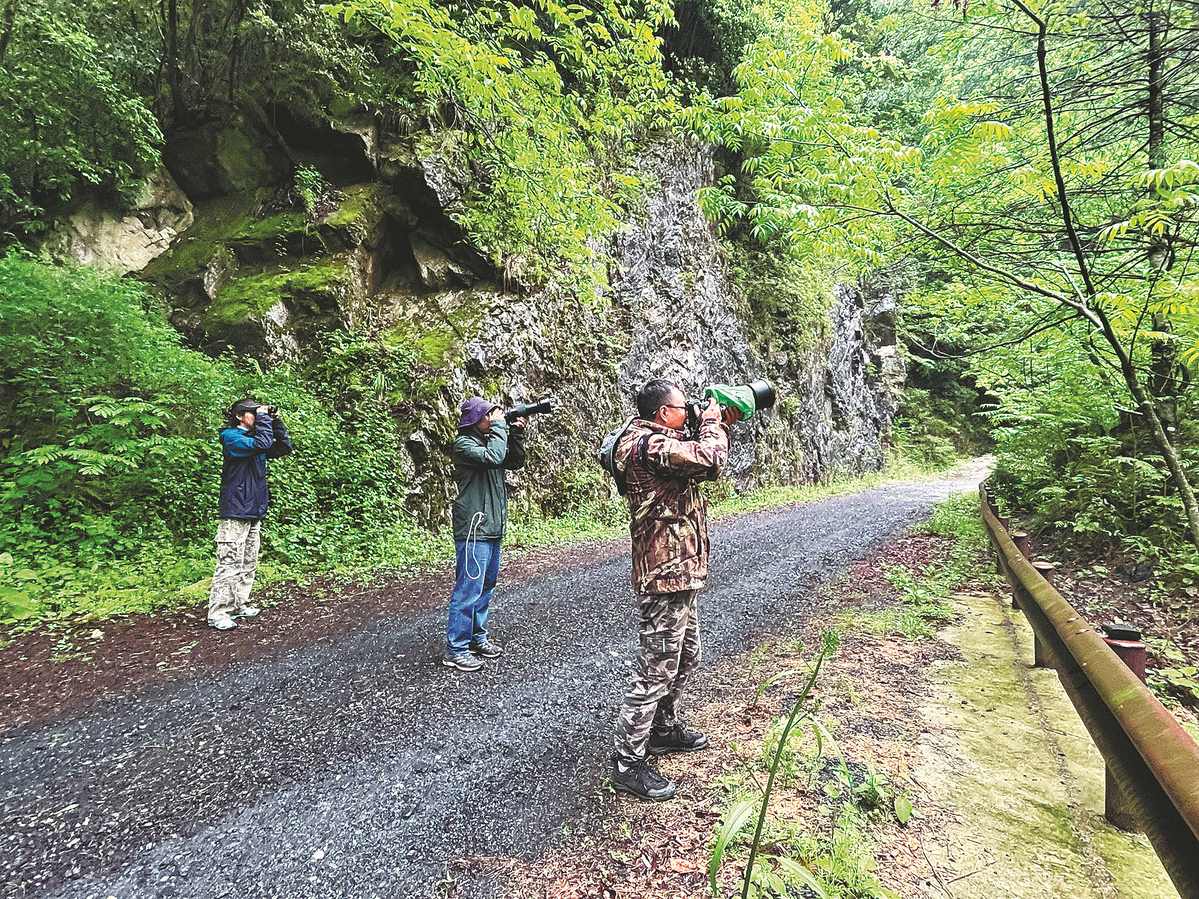
They visited about 20 units which were accessible by road and chose a few 1- or 2-kilometer-long sections of road to walk along while counting birds on the way. The sections are "line transects", or sample areas, which they will visit often during the next three years to count bird numbers and collect data for the monitoring program, Lei said.
Also, they will stand at several specific locations and record all the birds seen and heard within a given time. These locations are regarded as sample points for the survey.
"We have set up about 70 line transects and 30 sample points on the park map," Lei said. "Scattered across the national park and at a wide range of altitudes, they represent various habitats. By visiting them several times in different seasons over the three years, we hope to gain a comprehensive understanding of the birds' status in the park."
Though the line transects look close to each other on the map, the actual distances between them often mean hours of driving along winding mountain roads.
That's why the team was divided into two units: Group A traveled mainly in the southern (comparably lower) part of the park, while Group B focused on the central and northern (higher) parts.
During the first two days of the survey, members of Group A were based in a village in Xingshan county, which was convenient for exploration of the transects on Mount Wanchao.
Wei usually drove the group along a winding road into a remote valley, dropped Zhong and Chen at the starting point of a transect line, then drove on for about 1 kilometer and pulled over. Having placed the car keys on the front left tire, he and Hu started counting birds along the road.
After Zhong and Chen finished their 1-km survey, they retrieved the car keys and drove to the end of the transect to wait for the others to finish their own 1-km survey. "In this way, we could finish transects more efficiently," Wei said.
They tried to complete as many transects as possible between 8 am and 7 pm. However, many factors "disturbed our rhythm", Zhong said.
On the afternoon of May 7, their rental car blew a tire on a mountain trail. Wei and Chen had to change the tire and drive to Xingshan town to collect a new car, leaving Zhong and Hu to finish a transect.
On May 8, heavy rain hit, so the team had to stop the survey and shelter from the storm. When the downpour ceased, they returned to the road, finished one section and headed to another.
However, they found that a huge fallen rock was blocking the road, which would take a day and a half to clear. Therefore, they had to leave the area and return another day.
In Shennongjia, variable weather can be a headache for survey members in any season. During the week of the survey, a cold front covered the area and it rained continuously. At higher altitudes that often meant not only rain, but also heavy mist.
Lei and his team members often had to count birds through clouds and mist, wearing all their clothes to keep warm.
"The count can be very slow," Lei said. "Birds hide in the cold and wet."
Exciting sightings
Still, they managed to see a Eurasian crag martin — a first for the park — and found a white-bellied green pigeon, a rare bird under level two State protection, feeding on a cherry tree.
On May 10, Li Yunfei caught a cold that developed into a fever, so she had to withdraw from the survey. Lei said: "These things happen. During the first survey in March, a volunteer withdrew after falling ill."
Despite the setback, the team completed the survey. They covered dozens of transect lines and sample points, and recorded 24 species under levels one and two State protection. They included a golden eagle, a Bonelli's eagle, a golden pheasant, a Temminck's tragopan and a spotted laughingthrush.
Later, the fourth Shennongjia bird-watching festival was held from May 12 to 14. The cold front passed and it was sunny every day. More than 200 birders took part in a three-day bird race, recording nearly 300 different species.
"Their data will be added to the results of our survey," Lei said.






- Dog weddings — how new industry laps up puppy love
- Efficient medical care draws foreigners
- Arrival of Losar brings joy, good fortune to Tibetans
- Wide view seen as key to full grasp of China
- 10 dead and 84 injured in explosion at steel plant
- China unveils flexible urban planning rules to improve lives, foster new industries