



Financial reform will help supervision system







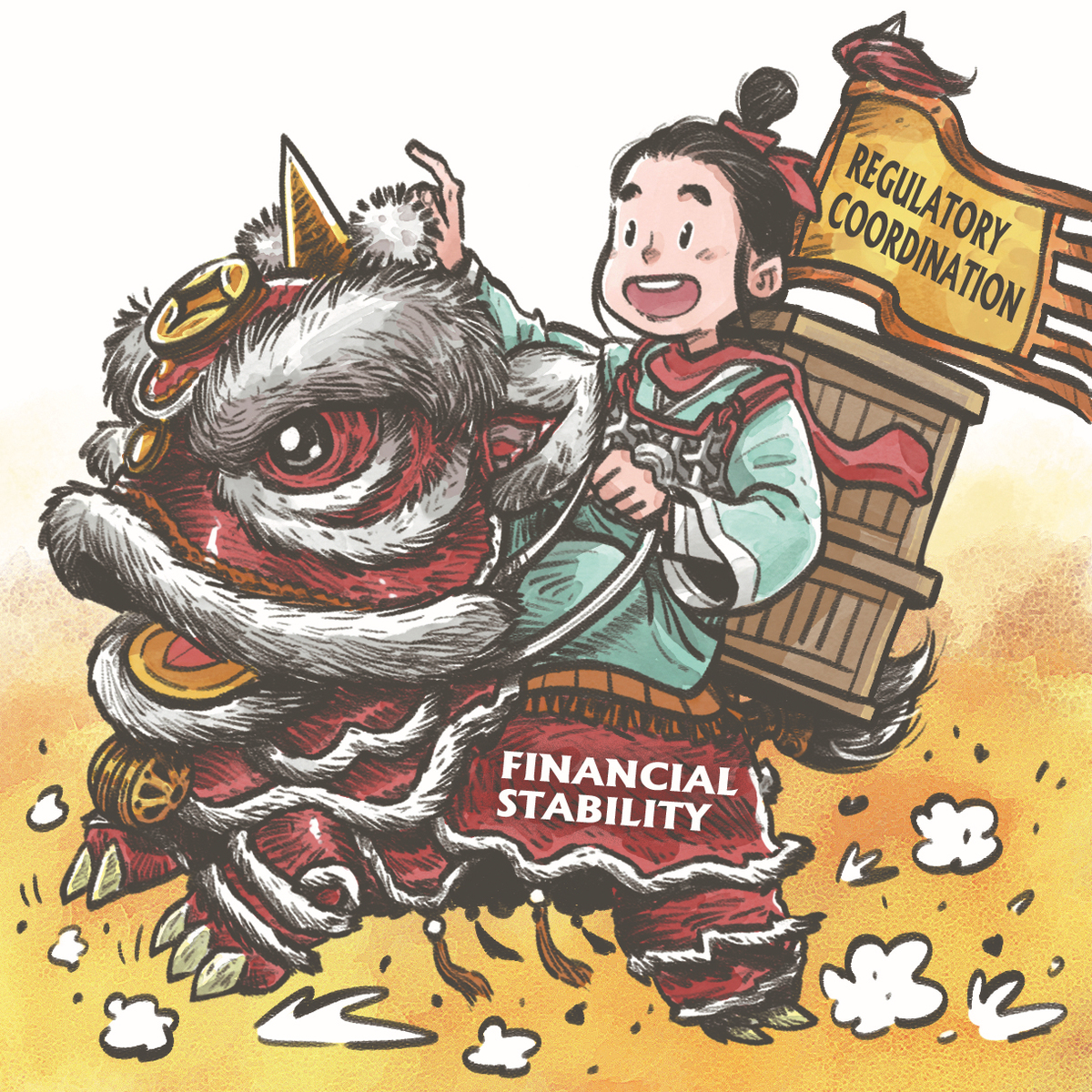
The National Administration of Financial Regulation, China's new financial regulator, was officially unveiled on May 18, marking another big-ticket reform in the domestic financial sector.
It not only reflects the nation's efforts to establish a regulatory system with Chinese characteristics based on specific practices to build its socialist market economy, but that its financial supervision — an important part of a country's financial governance system — is evolving in accordance with its development of finance.
Before NAFR
For a certain period following the reform and opening-up, China had a unified financial structure, until the early 1990s when the Shanghai and Shenzhen stock exchanges, and later the China Securities Regulatory Commission, were established one after another, ushering in modern financial supervision in the governance system of China's finance sector.
After the establishment of the China Insurance Regulatory Commission in 1998, the China Banking Regulatory Commission was set up in 2003, marking the official start to a separate financial supervision system.
Since then, China has been continually improving supervision within the financial industry, strengthening coordination among regulatory bodies and making up for regulatory shortcomings.
For example, in November 2017, the Financial Stability and Development Committee under the State Council, or China's Cabinet, was established. In 2018, the CBRC and the CIRC merged to establish the China Banking and Insurance Regulatory Commission to uniformly supervise the two industries.
The commission — as the State Council's deliberative and coordinating body for major issues in terms of financial stability, reform and development — held dozens of interministerial meetings between regulators in the years since its establishment before it ceased operating due to the recent reform.
In the years since the establishment of the commission, supervision remained somewhat "decentralized "despite better coordination mechanisms built among various regulatory bodies. It is in view of this that the 20th National Congress of the Communist Party of China urged measures to regulate all types of financial activities, strive to eliminate regulatory gaps and blind spots, vigorously promote regulatory coordination among central and local governments, and firmly hold the bottom line of no systemic financial risks. This is the fundamental basis for the latest round of reform in financial regulation.
Significant changes
After the first session of the 14th National People's Congress in early March, there was a brief glimpse into how China's new financial regulatory regime would be presented to the world.
First, a central finance committee, shouldering the original responsibilities of the Financial Stability and Development Committee, was unveiled at this year's two sessions. The newly established committee will ensure top-level design, overall planning, better coordination, holistic development and solid implementation of work plans related to financial stability and development. It will also study and deliberate on major policies and critical issues in the financial sector.
Second, the NAFR, which will function directly under the State Council, has been formed on the basis of the former CBIRC. The responsibilities of the People's Bank of China, the central bank, of conducting routine supervision over financial groups, such as financial holding companies and those related to investor protection of the CSRC, have been transferred to the new administration. The NAFR has now undoubtedly become China's main financial supervisory authority.
Third, CSRC's role in capital market supervision has been enhanced. The responsibility for reviewing corporate bond issuances has been transferred to it from the National Development and Reform Commission. The regulatory situation of China's bond market, which was split in the past, has finally moved toward a unified system.
Finally, reforms in the local financial regulatory system have been advanced.
A local financial supervision system, with special government units dispatched from central financial management departments as the mainstay, will be established. In the past, the local financial departments assumed both some regulatory and service functions, which led many local governments to leverage these departments for more loans from commercial banks, likely compromising financial stability. With the latest redistribution of the central and local financial supervision authority, especially with local financial regulators carrying out just the supervision function, the government's financial supervision responsibilities will be better exerted, which is beneficial for overall financial stability.
The latest reform is the biggest change in China's financial regulatory system since 2003. It is an initiative to adapt to the trend of financial development, not only respecting the internal laws of financial development, but closely combining with the specific practice of China's financial structure, which reflects the innovation in financial supervision.
Knowing the purpose
The fundamental purpose of this financial regulatory reform is to prevent systemic financial risks and effectively protect the rights and interests of financial consumers. In order to better understand this financial regulatory change, it is necessary to clarify the reasons behind it.
First, China has a huge financial market. According to the latest data released by the PBOC in March, by the end of 2022, the total assets of China's financial institutions reached 419.64 trillion yuan ($59.45 trillion), of which those of the banking industry were 379.39 trillion yuan, and of securities and insurance institutions 13.11 trillion yuan and 27.15 trillion yuan, respectively. The total liabilities of financial institutions were 382.33 trillion yuan, of which those of financial institutions in the banking, securities and insurance industries were 348 trillion yuan, 9.89 trillion yuan and 24.45 trillion yuan, respectively.
These data show that financial depth, which captures the financial sector relative to the economy, has reached a fairly high level in China. It also means that once systemic financial risks break out, the real economy will be adversely affected, and so will be the wealth, employment and income of households.
Second, the reform of the regulatory system is a response to new financial market developments. At present, financial institutions are closely connected. Some enterprise groups, for example, have mixed operations of banking, securities and insurance at the group level in the form of various subsidiaries. Different financial institutions, though not related to each other, may also hold bonds issued by each other. Such a phenomenon of cross-penetration has been continuously strengthened with the expansion of the financial scale and the increase of business scope. Additionally, the trend of crosscutting, cross-border competition, and co-innovation and cooperation between various types of financial institutions is becoming increasingly obvious, especially in the field of asset management, forming a new scenario of mutual channel sharing and cross-investment.
Third, the structure of financial products is getting more complex. With the continuous development and enrichment of basic financial instruments and their derivatives, some institutions have recombined different types of such combos and developed a variety of nested structured financial products, leading to a more complex structure of financial products and making financial risks more complex and more contagious.
Fourth, financial risks are not easy to spot. Whether it is the financial institutions as parties or the regulatory authorities, it is difficult to effectively and clearly identify the potential risks in advance, after which financial risks may erupt unexpectedly. This makes it more difficult for governments and central bank to handle. The recent bankruptcy of US' Silicon Valley Bank is a typical case.
Lastly, the reform of financial supervision is a move to adapt to the new development of finance and the new characteristics of financial risks. Preventing systemic financial risks is the primary goal. It is also a key move to protect the rights and interests of financial consumers more effectively. Financial consumers deal with wealth management products, insurance products and various funds. However, many cannot protect themselves due to a disadvantage in acquiring information on time. Their rights and interests may be damaged without better government supervision.
The writer is research fellow of the Institute of Finance & Banking at the Chinese Academy of Social Sciences.
The views don't necessarily reflect those of China Daily.



















